
A monthly, seasonal, and annual plumbing checklist: shutoff location, supply-line checks, water-heater valve test—plus when to call a plumber.
Key takeaways
- Find your main water shutoff before you need it—most leaks get worse the longer the water stays on.
- EPA WaterSense: household leaks waste more than 9,300 gallons a year on average, mostly from worn toilet flappers and faucet washers.
- IBHS recommends replacing washing machine supply hoses every 3–5 years and other braided appliance hoses every 5 years, regardless of how they look.
- Test the water heater's temperature and pressure-relief valve once a year; have it professionally inspected every 3 years per Watts' installation guidance.
- A slow drip under a sink, a rust ring around a fitting, or a soft spot in the floor are early leak signs worth a monthly look, not a yearly one.
- Multiple fixtures backing up at once, a suspected slab leak, or any gas-line work on a water heater are not DIY—call a licensed plumber.
A home plumbing maintenance checklist works when it’s a repeating routine, not a one-time inspection: a short monthly look under sinks and around the water heater, a seasonal check of visible supply lines and pipe insulation, and an annual test of the water heater’s pressure-relief valve. EPA WaterSense reports that the average household’s leaks waste more than 9,300 gallons of water a year—most of it from worn toilet flappers, faucet washers, and supply-line connections that never got a second look. This page is the routine that catches those before they become a repair bill. If a specific symptom already showed up—a running toilet, banging pipes, a slow drain, a sewage smell, or a pressure drop—the diagnostic guides linked throughout this page cover the fix.
The plumbing maintenance schedule at a glance
| Task | Frequency | Why it matters |
|---|---|---|
| Look under every sink and around the water heater for moisture or stains | Monthly | Catches a slow leak before it soaks a cabinet floor or subfloor |
| Test the main water shutoff valve | Every 6 months | A valve that’s never turned can seize shut exactly when you need it |
| Clean faucet aerators and showerheads | Every 3–6 months | Mineral buildup restricts flow and masks a fixture problem as “weak pressure” |
| Inspect visible supply lines and appliance hoses | Every 6 months | Rubber and braided hoses fail from the inside; catch cracking or bulging early |
| Test the water heater’s temperature and pressure-relief valve | Annually | Confirms the valve will actually vent pressure if the tank overheats |
| Replace washing machine supply hoses | Every 3–5 years | IBHS: these hoses are a leading cause of appliance-related water damage claims |
| Replace dishwasher and refrigerator supply hoses | Every 5 years | Same failure pattern as washer hoses, on a longer clock |
| Insulate exposed pipes in unheated spaces | Before the first freeze | Uninsulated pipe in a crawlspace or garage is the most common freeze-and-burst point |
Every month (the five-minute leak check)
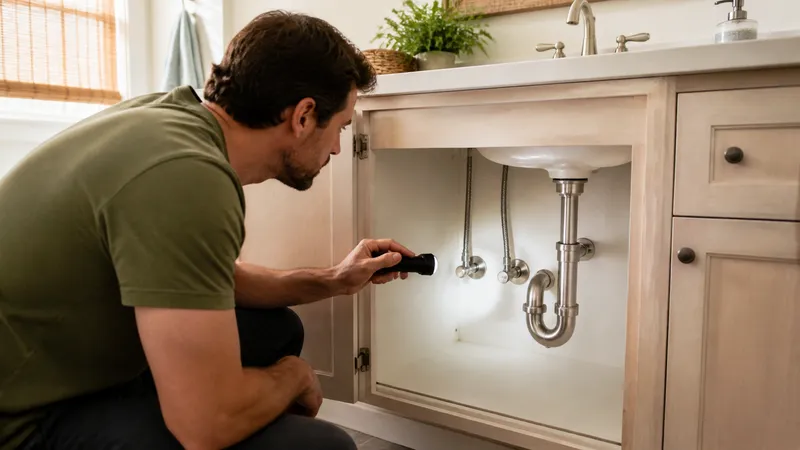
This is the habit that matters most. A leak you catch at “damp cardboard under the sink” costs a $10 part. The same leak found six months later costs cabinetry, subfloor, and possibly mold remediation.
| Where to look | What you’re looking for | If you find it |
|---|---|---|
| Under kitchen and bathroom sinks | Water stains, warped wood, a musty smell, or an active drip at the supply lines or trap | Tighten the connection first; if it keeps weeping, see slow drain / trap guidance or call a plumber |
| Around the water heater base | A rust ring, mineral crust, or puddle at the tank or fittings | Don’t ignore rust at the tank seam—that can mean the tank itself is failing, not just a loose fitting |
| Toilet base and tank | Water on the floor at the base, or a tank that refills without a flush | Running toilet? Diagnose flapper vs. fill valve |
| Rarely used drains (guest bath, floor drain, laundry sink) | A sewage smell after weeks of disuse | Run water for 30–60 seconds to refill the trap; see the full explanation if the smell persists |
| Visible supply lines and shutoff valves | Kinks, bulges, green or white corrosion at fittings | Note it and plan a replacement before it fails, not after |
Seasonal and semi-annual checks
| When | Task | Why |
|---|---|---|
| Spring | Check outdoor hose bibs for freeze cracks before reconnecting hoses | A cracked bib leaks inside the wall, not just outside |
| Before the first hard freeze | Insulate exposed pipe in crawlspaces, garages, and attics; disconnect and drain outdoor hoses | Uninsulated pipe is the most common source of a winter freeze-and-burst |
| Every 6 months | Inspect washing machine, dishwasher, refrigerator, and toilet supply hoses for cracking, bulging, or rust at the fittings | IBHS flags supply hoses as a leading cause of appliance water-damage claims; failure often starts inside the hose, invisibly |
| Every 6 months | Test the main shutoff valve by turning it fully closed and back open | A valve that’s stiff or won’t fully close needs replacing before it’s the only thing between you and a flood |
| Every 3–6 months | Unscrew and clean faucet aerators and showerheads in vinegar | Restores flow and rules out mineral buildup before you assume a pressure problem elsewhere |
Annual jobs
| Task | What it protects | Source or rule of thumb |
|---|---|---|
| Test the water heater T&P (temperature and pressure-relief) valve | Prevents dangerous tank over-pressurization | Lift the lever briefly with a bucket underneath; let it close on its own. Manufacturer guidance (Watts) calls for this at least once a year, with a full professional inspection every 3 years |
| Flush the water heater tank | Removes sediment that insulates the heating element and clogs the drain valve | See the full water heater flush guide for the step-by-step and hard-water frequency adjustment |
| Have a plumber inspect visible supply and drain lines during any other service call | Catches slow corrosion you wouldn’t see monthly | Especially worth it in homes over 20 years old or with galvanized or polybutylene pipe |
| Replace washing machine hoses on schedule, not just on failure | Avoids the single most common appliance-related water claim | IBHS: replace every 3–5 years |
When to call a professional
| Situation | Why it’s not DIY |
|---|---|
| More than one fixture is backed up or affected at once | Points to the main drain line, not a single trap or fixture |
| Water stains or warped flooring with no visible source nearby | Possible slab leak or pipe inside a wall—needs leak detection, not guesswork |
| The main shutoff valve won’t close | You have no way to stop a future leak until it’s replaced |
| Any gas line, gas control valve, or sealed component on a gas water heater | Combustion and gas-leak risk; this is licensed-plumber or gas-utility work |
| The T&P valve leaks continuously or won’t reseat after testing | A relief valve that won’t function is a safety component, not a maintenance item |
| Visible galvanized or polybutylene supply pipe showing corrosion or discoloration | Both are known-failure pipe materials; a plumber should assess replacement, not a patch |
| Sewage odor that persists after refilling every trap in the house | Points to a vent or main line issue beyond a single fixture |
Related guides
Frequently asked questions
What plumbing maintenance should I do every month?
Look under every sink and around the water heater for moisture, a rust ring, or a mineral crust—those are early leak signs. Also run water into any rarely used drain to keep its trap sealed, and glance at visible supply lines for kinks, bulges, or corrosion.
How often should I replace supply lines and hoses?
The Insurance Institute for Business & Home Safety recommends replacing washing machine supply hoses every 3–5 years and other braided appliance supply lines (dishwasher, refrigerator) every 5 years, even if they look fine—rubber and braided hoses fail from the inside before they show visible wear.
Do I need to test my water heater’s pressure-relief valve myself?
Yes, once a year. Lift the test lever briefly with a bucket underneath, let hot water discharge for a few seconds, then let the lever close gently on its own—don’t force it shut. If it doesn’t discharge, doesn’t stop, or leaks afterward, call a plumber rather than working on a gas or electric water heater’s safety valve yourself.
How often should I clean faucet aerators and showerheads?
Every 3 to 6 months, or sooner if flow feels noticeably weaker. Mineral buildup inside the small screen or nozzle holes restricts flow and often gets mistaken for a bigger pressure problem—unscrewing the aerator and soaking it in vinegar usually restores full flow in minutes.
How do I know if a leak is serious enough to call a plumber instead of fixing it myself?
A single dripping faucet or a running toilet is homeowner-level work. Call a plumber if more than one fixture is affected at once, if you see water stains with no clear source (possible slab or under-floor leak), if the main shutoff won’t close, or if the fix involves the gas line or sealed components on a water heater.