
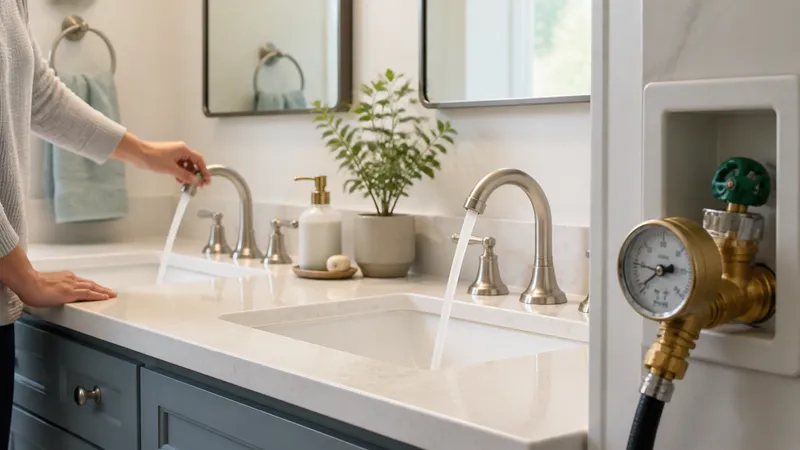
Usually normal physics, not a leak: two open faucets split one fixed pipe's flow. Here's how to tell that apart from a valve, regulator, or pipe problem.
Key takeaways
- Pressure dropping when a second faucet opens is usually normal: one fixed-diameter pipe is now splitting its flow two ways, not leaking.
- Normal static pressure runs about 40–80 psi; a plumbing code typically requires a pressure-reducing valve once it's above 80 psi.
- A partially closed shutoff valve at the meter, water heater, or under a fixture is the most common fixable cause of a bigger-than-expected drop.
- A failing pressure-reducing valve shows up as pressure that swings unpredictably all over the house, not just a dip with two taps open.
- Corroded galvanized pipe narrows from the inside over decades and drops pressure everywhere, not only during simultaneous use.
- On a well system, check the pressure tank's air charge and cut-in/cut-out settings before assuming the pump itself is failing.
Water pressure dropping when a second faucet turns on is, in most houses, just physics: your home’s supply line has a fixed inside diameter, and splitting one flow of water between two open fixtures means each one gets less of it. That’s normal and not a sign of a leak or a failing system. It becomes a real problem when the drop is severe, doesn’t recover once a faucet closes, only affects part of the house, or comes with other symptoms — banging pipes, rusty water, or pressure that swings wildly even with one tap open.
Normal drop vs. an actual problem
| Signal | Usually normal | Usually a real problem |
|---|---|---|
| How much it drops | A noticeable but modest dip — the shower gets a little weaker while the sink runs | Pressure collapses to a trickle at one or both fixtures |
| Recovery | Bounces back the instant the second faucet closes | Stays weak even after both fixtures are off |
| Location | Happens anywhere two fixtures share a branch (bath sink + shower, kitchen + hose bib) | Confined to one fixture or one part of the house, or affects the whole house even with just one tap open |
| Other symptoms | None | Banging pipes, rust-colored water, hissing at the meter, or pressure that surges and drops on its own |
| Static pressure at a hose bib gauge | Sits in the 40–80 psi range most utilities target | Reads under 40 psi even with nothing running, or swings widely minute to minute |
If your situation matches the left column, you likely don’t need to do anything. If it matches the right column, work through the causes below in order — cheapest and most common first.
What actually causes an abnormal drop
| Cause | How it shows up | Fix |
|---|---|---|
| Partially closed shutoff valve | Whole-house pressure is lower than it should be even before a second fixture opens | Check the valve at the meter, the main shutoff, and the valve on the water heater’s cold inlet — turn each fully open |
| Clogged aerator or showerhead | Weak flow at one fixture only; other fixtures are fine | Unscrew and soak in vinegar, or replace — cheap and takes minutes |
| Corroded galvanized supply pipe | Gradual, house-wide weakening over years; often with rust-tinted water | Corrosion narrows the pipe from the inside; a plumber sections or repipes the run |
| Failing pressure-reducing valve (PRV) | Pressure swings unpredictably — spikes, drops, sometimes with banging pipes — not just a dip under simultaneous use | Test at a hose bib gauge; a stuck or worn PRV usually needs the seat kit replaced or the valve swapped |
| Well pressure tank low on air charge, or undersized for the house | Pump short-cycles, pressure sags hard and recovers slowly when two fixtures run | Check the tank’s air pre-charge and cut-in/cut-out settings; may need a larger tank |
| Hidden leak (slab, wall, or yard line) | Pressure is low everywhere, meter spins with everything off, or water bills jump | Shut off every fixture and watch the meter; a moving dial with nothing running means a leak, not simultaneous-use physics |
A supply pipe’s diameter is what a plumbing code sizes around in the first place — the Uniform Plumbing Code assigns each fixture a water-supply fixture unit and sizes branch lines to carry the combined load of the fixtures on them. A branch sized correctly for a bathroom sink and a shower running together will still show a small drop; it’s built to handle both, not to keep each one at full solo pressure.
A quick way to test it yourself
Screw a $10–15 pressure gauge onto an outdoor hose bib. Read the static pressure with nothing else running — that’s your baseline. Most homes should sit in the 40–80 psi range; utilities commonly target around 60 psi as a comfortable middle, and static pressure above 80 psi is generally where a pressure-reducing valve becomes required, not optional, under most plumbing codes.
Then open a second fixture and watch the gauge. A drop of a few psi that recovers immediately is the normal shared-pipe effect described above. A drop that doesn’t recover, or a baseline reading under 40 psi to begin with, points to one of the real causes in the table — start with the shutoff valves, since they’re the fastest and cheapest to check.
Low-flow fixtures change the math slightly: a WaterSense-labeled faucet is capped at 1.5 gpm and a WaterSense showerhead at 2.0 gpm, both lower than older fixtures. Two efficient fixtures running together draw less total water than two older ones would, so newer bathrooms sometimes show a smaller drop than a house with 1990s fixtures — not because the pipes changed, but because the fixtures now ask for less.
When to call a professional
| Situation | Why it’s not DIY |
|---|---|
| Suspected slab or wall leak (meter moving with everything off) | Locating and repairing a concealed leak needs leak-detection equipment and often demolition |
| Corroded galvanized pipe confirmed by rusty water or a plumber’s inspection | Repiping a section or the whole house is licensed work, not a homeowner repair |
| Well pump or pressure switch electrical issues | Working inside a well control box or pump wiring is an electrical and shock risk |
| Main-line pressure regulator (PRV) that’s stuck, leaking, or reads pressure swinging widely | The valve sits on the main supply; a failed PRV can overpressure the whole house if handled wrong |
| Pressure drop plus water damage, mold, or a rising water bill | These point to an active leak that needs a professional diagnosis, not a faucet fix |
Keep a record of what you find
A pressure gauge reading, a photo of the shutoff valve position, and the date you last checked are worth more than a guess next time a technician asks what’s normal for your house.
Related guides
Frequently asked questions
Is it normal for water pressure to drop when two faucets run at the same time?
Yes, in most homes. A supply pipe has a fixed diameter, so opening a second fixture splits the same flow two ways and each one gets less. A small, predictable drop that recovers as soon as one faucet closes is normal plumbing physics, not a defect.
How do I know if my water pressure regulator is failing?
A failing pressure-reducing valve (PRV) usually shows up as pressure that swings across the whole house — sudden surges, then weak flow, sometimes with banging pipes — rather than a predictable dip only when two fixtures run. Manufacturers like Watts rate residential PRVs for roughly 10–15 years of service before the seat or diaphragm needs attention.
Can a private well system cause pressure drops when multiple faucets are on?
Yes. Well systems rely on a pressure tank cycling between a cut-in pressure (commonly 20–40 psi) and a cut-out pressure (commonly 40–60 psi). A waterlogged tank, a worn pressure switch, or a tank sized too small for the household can make that drop larger and slower to recover under simultaneous demand.
What water pressure is considered normal for a house?
Most residential systems run between 40 and 80 psi, with many utilities and plumbers targeting around 60 psi as a comfortable middle. Static pressure above 80 psi typically requires a pressure-reducing valve under the Uniform Plumbing Code, since sustained high pressure stresses pipes, valves, and appliance connections.
Why does only one faucet lose pressure while others are fine?
That points to a local restriction, not a whole-house pressure problem — most often a clogged aerator or showerhead, mineral buildup in that fixture’s supply line, or a partially closed stop valve under that specific sink. Clean or replace the aerator first; it’s the cheapest thing to rule out.