
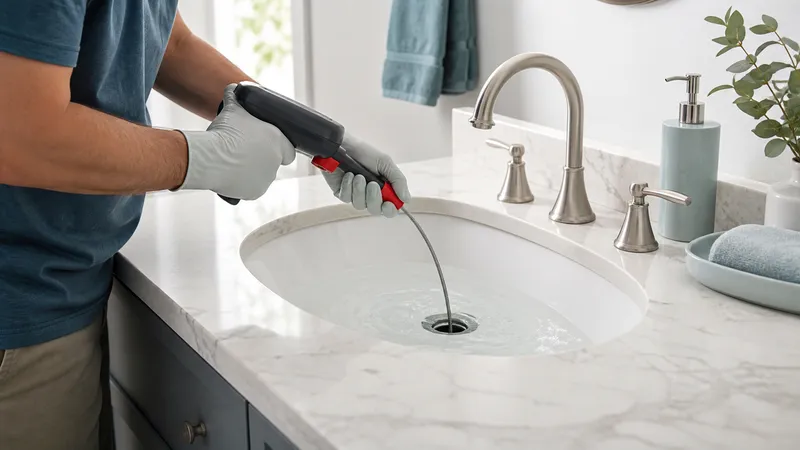
A slow drain that never fully stops is usually a partial buildup or a venting problem, not a clog—here's how to tell which, and how to fix each safely.
Key takeaways
- A drain that's slow but never stops is almost always partial buildup on the pipe wall—hair, soap scum, or grease—not a full clog.
- Gurgling, bubbling, or a slow drain right after another fixture runs points to a venting problem, not the drain itself.
- Try hot (not boiling) water and dish soap first, then a drain-safe enzyme cleaner, then a hand auger or zip-it tool.
- The EPA recommends boiling water or a drain snake over chemical drain openers, which can damage pipes and kill septic bacteria.
- If every drain in the house is slow at once, or the slowness comes back within weeks of clearing it, stop DIY and call a plumber.
A drain that’s slow but not fully clogged is usually one of two things: a partial obstruction—hair, soap scum, or grease coating the inside of the pipe and narrowing the opening—or a venting problem, where air can’t get into the drain line to replace the water flowing out, so the water drains slower than it should and the fixture may gurgle. A full clog stops water completely; a slow drain still empties, just over minutes instead of seconds. Telling these apart decides whether you reach for hot water and an auger or call a plumber about the vent stack.
Partial obstruction vs. a venting problem
| Signal | Likely cause | What it means |
|---|---|---|
| Slow at one sink or tub, water still fully drains | Buildup on the pipe wall—hair, soap scum, grease—narrowing the passage | Mechanical: clear it with heat, an enzyme cleaner, or an auger |
| Gurgling or bubbling as it drains, especially right after a toilet flushes or another fixture runs | A vent that’s blocked, undersized, or too far from the trap, so air is pulled back through the water seal instead of down the vent | Venting: often needs a look at the roof vent or vent routing |
| Slow drain plus a rotten-egg smell that comes and goes | Can overlap with a dry P-trap letting sewer gas back up, which is its own issue—see Why Does My Sink Smell Like Sewage? | Two different root causes can share one symptom |
| Every drain in the house slow at once | Main drain line partially blocked, often tree roots or a low spot | Not a single-fixture fix—call a plumber |
Partial buildup happens gradually. Hair catches soap scum and grease from dishes or cooking, and the mix hardens against the pipe wall the way plaque narrows an artery—water still gets through, just slower each week. Bathroom sinks and tub drains are the most common spot because of hair and soap; kitchen sinks slow down from grease and food residue.
A venting problem shows up differently: the drain gurgles or bubbles, sometimes a nearby fixture’s water level jumps when you flush, and the slowness can seem to come and go depending on what else is running. Every drain, vent, and trap in a house is supposed to work as one connected system—venting lets air in behind the draining water so it doesn’t have to fight a vacuum. When the vent is blocked (often by debris, ice, or a bird’s nest at the roof terminal) or a fixture is installed too far from its vent, that air can’t get in, and the drain both slows down and gurgles as it pulls air back through the trap seal instead.
Fix a partial obstruction yourself, in order
These steps assume one slow fixture and no gurgling. Stop and move to the professional table if a step makes it worse or nothing changes.
- Hot water and dish soap. Run the hottest tap water you have—not boiling, which can crack porcelain or loosen PVC joints—with a squeeze of dish soap for a minute or two. This softens grease and soap-scum buildup on the pipe wall.
- A drain-safe enzyme or bacterial cleaner. These use enzymes or bacteria to digest organic buildup (hair, soap film, grease) over several hours rather than dissolving it with heat or caustic chemicals. Follow the label’s contact time; they work slower than a chemical opener but don’t damage pipes or a septic system.
- A hand auger or a zip-it (drain snake) tool. For hair and buildup within a few feet of the drain opening, a $10–20 plastic zip-it tool or a hand-crank auger physically pulls out what heat and enzymes can’t. Work it in slowly, twist, and pull back out rather than forcing it.
- Recheck the trap. If the drain is still slow after steps 1–3, the P-trap under the fixture may hold the buildup. It’s a homeowner-accessible job on most sink traps (bucket underneath, unscrew the slip nuts by hand) but skip it if you’re not comfortable, since a cracked or stripped fitting turns into a leak.
When it’s a venting issue instead
Venting problems aren’t a DIY drain-clearing job, because the obstruction (if there is one) isn’t in the trap or the drain arm—it’s in the vent piping that runs up through the wall to the roof. What you can check yourself:
| Check | What to look for | Next step |
|---|---|---|
| Roof vent terminal (from the ground, binoculars, or a stable ladder only if you’re comfortable) | Leaves, a bird’s nest, or ice capping the open pipe | Clear visible debris from ground level or a stable low ladder; anything higher is a roofer’s job |
| Multiple fixtures gurgling together | A shared vent or stack serving several fixtures | Points to shared plumbing, not one drain—call a plumber |
| Only happens after another fixture runs (e.g., tub gurgles when the toilet flushes) | Fixtures sharing a vent that’s undersized or poorly routed | A plumbing code question (vent sizing and distance from the trap), not a snake-and-soap fix |
The International Plumbing Code (referenced by most U.S. jurisdictions, sometimes with local amendments) sets minimum vent pipe sizes and maximum distances between a fixture’s trap and its vent connection specifically because too little venting lets drain-line pressure pull water out of nearby trap seals. That’s a design and installation problem, not something a homeowner corrects by working the drain harder—an actual vent fix usually means opening a wall or accessing the roof penetration, which is licensed-plumber territory.
Caveats that change the picture
| Situation | Why it matters |
|---|---|
| Older galvanized steel pipes | Corrosion narrows the inside diameter over the pipe’s whole length, not just one spot—repeated slow drains across a house can mean the pipe itself, not a clearable clog |
| Homes on a septic system | Chemical drain cleaners and even some enzyme products can disrupt the septic tank’s bacteria; stick to the EPA’s boiling-water-or-snake approach |
| Recently remodeled bathroom or kitchen | New fixture venting sometimes doesn’t match old code-era assumptions—recurring gurgling after a remodel is worth a plumber’s look even if it’s “new” |
| Long, low-slope drain runs (basement laundry, garage sink) | Slower drainage is sometimes normal pipe geometry, not buildup—compare against how it drained when new, not against a faster fixture elsewhere in the house |
When to call a professional
| Situation | Why it’s not DIY |
|---|---|
| More than one drain is slow at the same time | Points to the main line, not a single fixture—clearing one sink won’t fix a shared blockage |
| The slowness returns within a few weeks of clearing it | Recurring buildup that fast often means a belly (sag) in the pipe or root intrusion, both requiring camera inspection |
| Gurgling at multiple fixtures, or gurgling that doesn’t stop after checking the roof vent from the ground | Vent stack access usually means the roof or an opened wall |
| No accessible cleanout or drain-cleaning access point | Snaking without a proper access point risks damaging fixtures or fittings |
| Sewage odor along with the slow drain | Can indicate a P-trap or venting fault feeding sewer gas into the house—see Why Does My Sink Smell Like Sewage? |
| Standing water backing up into a tub or floor drain when you run another fixture | Sign of a main-line blockage that needs professional clearing, not a household tool |
Visit the systems maintenance hub for the rest of the home-systems cluster, including water pressure, water hammer, and running-toilet issues.
Related guides
Frequently asked questions
Why is my drain slow but water still eventually goes down?
That pattern points to a partial obstruction—hair, soap scum, or grease coating the inside of the pipe—rather than a full blockage. The opening is narrowed, not closed, so water still drains, just slower than it should.
Why does my drain gurgle before it drains slowly?
Gurgling usually means air is being pulled back through the trap because the vent that’s supposed to let air in isn’t working—either it’s partially blocked or too far from the fixture. That’s a venting issue, not a clog, and a plunger or auger on the drain itself won’t fix it.
Is it safe to use a chemical drain cleaner on a slow drain?
The EPA recommends boiling water or a drain snake instead of chemical drain openers. Caustic and acidic cleaners can generate enough heat to soften PVC or crack older pipes, and they’re not effective against a partial buildup spread along several feet of pipe.
When should I stop trying to fix a slow drain myself?
Call a plumber if more than one drain is slow at the same time, if a drain-cleaning access point isn’t reachable, if the slowness returns within a few weeks of clearing it, or if you notice sewage odor or backup at a floor drain—those point to a main line or venting issue beyond a single fixture.