
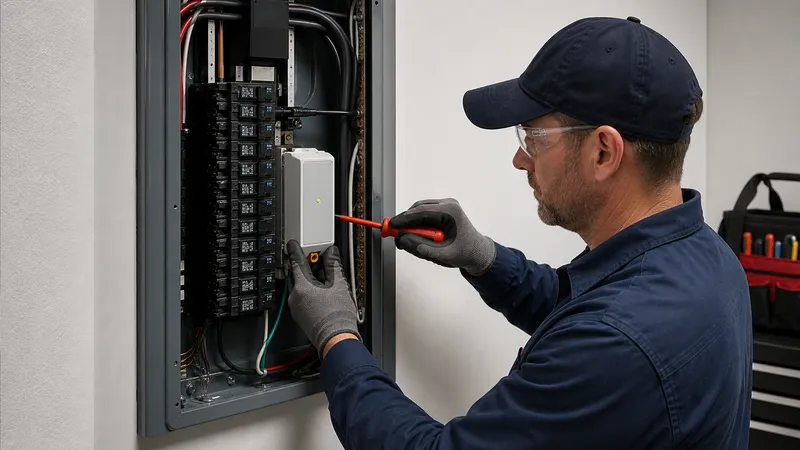
A whole-house surge protector blocks large external surges that a power strip can't. Type 1 vs 2 vs 3 explained, cost, and when it's worth installing.
Key takeaways
- A whole-house (Type 1 or Type 2) SPD guards against large external surges—grid switching, nearby lightning—that a power strip cannot stop.
- Whole-house and point-of-use (Type 3) surge protectors work together, not as alternatives. One does not replace the other.
- No SPD stops a direct lightning strike to your house. That energy needs a separate lightning protection system, not a panel-mounted SPD.
- Installed cost typically runs $250–$1,100, most of it a licensed electrician's 1–2 hours at the panel plus a dedicated breaker.
- Homes with more electronics and connected appliances—smart thermostats, induction ranges, EV chargers—get more value per dollar from one device.
- This is licensed-electrician work: it involves opening the live panel and matching the device to your service and available fault current.
A whole-house surge protector is a device installed at your electrical panel that blocks large voltage spikes—from utility grid switching, nearby lightning activity, or a transformer event—before they reach your home’s wiring and everything plugged into it. It is not an alternative to the surge-protector power strips at your desk or entertainment center; it’s a different layer that a power strip physically cannot provide, because a strip only protects what’s plugged into it, and only against smaller, localized spikes. The two work together. What a whole-house unit (a “Type 1” or “Type 2” SPD, in UL/NEC terms) cannot do is stop a direct lightning strike to the house itself—that requires a separate lightning protection system, not a panel device.
Type 1 vs. Type 2 vs. Type 3: where each one goes
UL 1449 and NEC Article 285 define three SPD categories by where they’re installed, not by brand or price point. NEMA’s Surge Protection Institute frames Type 1 and Type 2 as guarding against the same category of threat—“lightning [energy on the line] or utility capacitor bank switching”—with the location determined mostly by where your utility and local code allow the connection.
| SPD type | Where it’s installed | What it protects against |
|---|---|---|
| Type 1 | Ahead of the main service disconnect—utility side of the meter, or the meter socket itself | Large external surges: grid switching events, utility capacitor bank switching, lightning-related energy on the incoming line |
| Type 2 | Load side of the main service disconnect—the main panel or a subpanel, on a dedicated breaker | The same category of large surges as Type 1, plus surges generated inside the house (large motors, HVAC compressors cycling) |
| Type 3 (point-of-use) | Cord-connected or receptacle-mounted, at least 30 feet of conductor from the service panel per NEMA | Smaller, localized spikes right at the device—what a surge-protector power strip or plug-in unit does |
Most residential installs today use a Type 2 SPD at the main panel—simplest single point to protect the whole house without touching the utility-side connection. Some utilities offer a meter-collar-mounted Type 1 device as a rental or purchase option instead; check with yours before assuming you need a panel job.
What it actually stops, and what it doesn’t
Surge protection is about clamping a spike down to a safer voltage, fast, and diverting the excess to ground—not blocking electricity outright.
| Event | Does a whole-house SPD help? |
|---|---|
| Utility grid switching, a nearby transformer fault, or capacitor bank switching | Yes—this is the core job of a Type 1/2 device |
| Lightning striking the grid or a line some distance away, inducing a surge on incoming power | Yes, within the device’s rated surge current (commonly 36–400 kA per phase depending on model) |
| A direct lightning strike to your house, roof, or service mast | No—that energy exceeds what a panel SPD is rated to absorb; needs a dedicated lightning protection system |
| A small surge generated inside the house (a large motor or compressor cycling) | Partially—Type 2 devices are rated for this; a Type 1 device further upstream is not always as effective for internally generated events |
| A sustained overvoltage lasting seconds to minutes (not a transient spike) | No—NEMA notes SPDs aren’t designed for temporary overvoltage events, and repeated ones are a common cause of SPD failure, not something the SPD prevents |
Manufacturer ratings vary by product line: Square D’s SDSA1175 (Type 1) is rated 36 kA peak surge current per phase with a 25 kA short-circuit current rating; Leviton’s residential Type 2 panels range from roughly 36 kA up to 400 kA per phase. A higher kA rating means more surge energy absorbed before replacement is needed, not a difference in what categories of event the device handles.
Is it worth it for your house?
| Household electronics load | Worth it? |
|---|---|
| Older home, few connected devices, no smart appliances | Smaller benefit—still protects the HVAC control board and any newer appliance, but the payoff period is longer |
| Typical modern home: smart thermostat, TVs, computers, a few smart-home devices | Solid case—one device protects everything downstream at once, versus buying and replacing point-of-use strips everywhere |
| Heavy electronics load: home network/server gear, induction range, EV charger, whole-home audio/smart-home hub, multiple large appliances with control boards | Strong case—the replacement cost of any one of these after a surge often exceeds the SPD’s installed cost |
| Frequent grid instability, rural utility with older infrastructure, or a history of storm-related outages in your area | Stronger case regardless of electronics load |
The math: a single control-board replacement on a modern range, refrigerator, or HVAC unit commonly runs a few hundred dollars in parts and labor—close to the SPD’s installed cost. A surge that takes out three or four appliances at once easily exceeds it. According to the Insurance Information Institute, the average lightning-related homeowners insurance claim in 2023 was $17,513. This historical claims figure is not an estimate of what a surge protector will save or a guarantee of protection.
Installation: this is panel work
There isn’t a meaningful DIY path here. A whole-house SPD wires directly to the panel bus, needs a dedicated breaker sized to the device, and—for a Type 1 unit—may connect ahead of the main disconnect on the utility side, which most utilities require a licensed electrician (and sometimes a permit) to touch.
| Step | What the electrician does |
|---|---|
| Sizing | Matches the SPD’s surge current rating and short-circuit current rating (SCCR) to your panel’s available fault current—not a homeowner judgment call |
| Placement | Confirms Type 1 (utility side) vs. Type 2 (load side, at the panel) based on your utility’s rules and where the device physically fits |
| Circuit | Installs a dedicated double-pole breaker sized to the device—commonly in the 20–60 amp range depending on the model |
| Wiring | Connects line, neutral, and ground per the manufacturer’s instructions, torqued to spec |
| Verification | Confirms the device’s status indicator shows active protection before closing the panel |
Typical installed cost runs $250–$1,100, with a straightforward job on an accessible, modern panel closer to $300–$450—the device itself plus 1–2 hours of licensed electrician labor. Cost climbs with a crowded or older panel, a required permit, or if the panel needs other work done at the same time. For general panel condition and when a panel itself needs attention beyond adding an SPD, see home electrical maintenance.
When to call a professional
There’s no DIY version of this job to weigh against a pro version—every step below requires a licensed electrician.
| Decision | Why it needs a licensed electrician |
|---|---|
| Choosing Type 1 vs. Type 2 for your service | Depends on utility rules, your meter setup, and local code—not a product-page comparison |
| Sizing the SCCR and surge current rating | Requires knowing your panel’s available fault current, which isn’t on a spec sheet you can read from outside the panel |
| Wiring into the panel bus or ahead of the main disconnect | The panel carries live, potentially lethal voltage even with the main breaker off |
| Adding or replacing a breaker for the SPD’s dedicated circuit | Breaker sizing and panel bus space are a licensed judgment call, not a plug-and-play swap |
| Confirming grounding and bonding are adequate for the SPD to work | An SPD only diverts surge energy effectively if the grounding path is sound |
Keep the record
Once it’s installed, note the model, the kA rating, and the install date somewhere you’ll see it again. Most whole-house SPDs have a visible status indicator (a light or an LCD counter) that shows when the device has absorbed enough surge energy to need replacement—typically after a major event, not on a fixed schedule. Check it after any severe storm.
Related guides
Frequently asked questions
Does a whole-house surge protector stop a direct lightning strike?
No. A panel-mounted SPD is built to clamp large but transient voltage spikes coming in on the utility line—it is not rated for the energy of a direct strike to the house or its wiring. Direct-strike protection is a separate lightning protection system with air terminals and dedicated grounding conductors.
Do I still need power strip surge protectors if I install a whole-house unit?
Yes. A whole-house SPD and point-of-use (Type 3) protectors work together in a layered strategy. The panel unit knocks down the big surge; point-of-use units clean up smaller, more frequent spikes closer to your electronics.
What is the difference between Type 1 and Type 2 surge protective devices?
Type 1 SPDs are rated for installation ahead of the main service disconnect—on the utility side of your meter—while Type 2 SPDs install on the load side, typically at the main panel or a subpanel. Both handle the same category of large external surges; the choice is mostly about where your utility and local code let you connect one.
How much does a whole-house surge protector cost installed?
Most homeowners pay $250–$1,100 total, including the device and licensed electrician labor for a dedicated breaker and panel connection. A straightforward install on an accessible modern panel runs closer to $300–$450.
Is a whole-house surge protector worth it for an older home with few electronics?
It’s a smaller win there, but not zero—modern HVAC control boards and any newer appliance still benefit. The value case is strongest in homes with a lot of electronics: smart thermostats, home networking gear, induction cooktops, EV chargers, and multiple large appliances with control boards.