
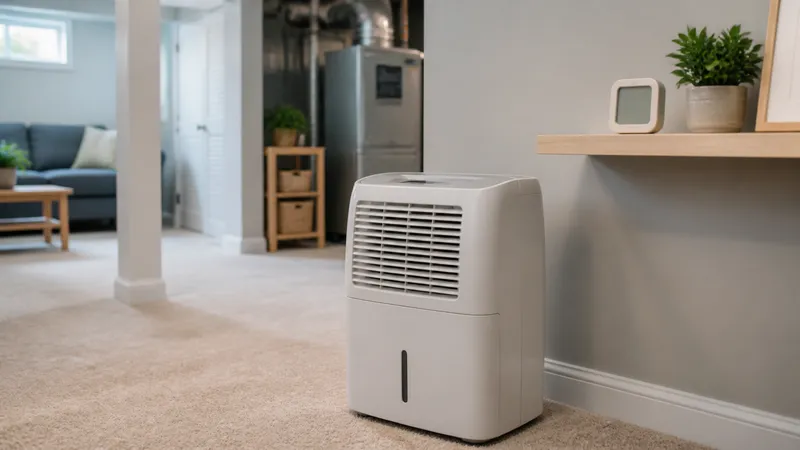
The practical dehumidifier setting to stop mold before it starts, based on EPA's indoor humidity range, plus basement and room-by-room targets.
Key takeaways
- Set most dehumidifiers to 50% relative humidity as a starting point; drop to 45% for a basement or a home with a past mold problem.
- The EPA's target range is below 60%, ideally between 30% and 50%, and a dehumidifier dial is how you actually hold a house inside it.
- A built-in humidistat can read 5-10 points off; verify the room's real humidity with a separate $10-15 digital hygrometer.
- Setting below 45% rarely buys extra mold protection and just runs the compressor and your electric bill harder.
- Empty a bucket-style unit's tank daily or run continuous drainage—an ignored full tank shuts the unit off and lets humidity climb back up unnoticed.
- Size the unit to the space in pints removed per 24 hours, not just the square footage on the box; a damp basement needs more capacity than a dry one.
Set a dehumidifier to 50% relative humidity for most living spaces, and to 45% for a basement, crawlspace, or any room that’s had a musty smell or mold before. That target sits inside the EPA’s recommended indoor humidity range of below 60%, ideally between 30% and 50%, and it’s the number that actually gets typed into the dehumidifier’s dial or app—not just a range to aim near. Going lower than 45% rarely buys more protection; it mostly means a harder-working compressor and a higher electric bill.
The setting, by space
| Space | Recommended setting | Why |
|---|---|---|
| Main living areas (bedrooms, living room) | 50% | Middle of the EPA’s 30-50% ideal range; comfortable and low-maintenance |
| Basement | 45% | Cooler concrete and block surfaces reach dew point at a lower measured room humidity than upstairs |
| Crawlspace (encapsulated) | 50-55% | Crawlspaces run more humid by nature; manufacturer guidance for encapsulated systems often allows a slightly higher ceiling |
| Laundry room or bathroom | Exhaust fan first, dehumidifier as backup | These rooms spike briefly and recover fast; venting the moisture out beats trying to out-dry it with a dial setting |
| Room with a past mold or musty-smell history | 45%, checked weekly at first | Extra margin below the EPA’s 60% ceiling while you confirm the moisture problem actually stayed fixed |
Why 45-50%, not lower
The EPA’s guidance draws the ceiling at 60% and the ideal band at 30-50%. A 45-50% setpoint keeps a room comfortably inside that band with room to spare before a hot, humid day pushes it toward 60%. Going down to 35-40% is not dangerous, but it adds diminishing returns: the ENERGY STAR dehumidifier guidance is built around sizing a unit to remove enough moisture to hold a target, not to chase the lowest number possible, and very dry settings can pull moisture out of wood furniture, flooring, and trim in the same room.
Trust the room, not just the dial
Built-in humidistats on dehumidifiers can read 5-10 percentage points off from the room’s actual humidity, especially as a unit ages. Put a separate $10-15 digital hygrometer a few feet away from the unit—not right next to the intake—and adjust the dial based on that independent reading rather than only the unit’s own display.
| What the hygrometer shows | What to do |
|---|---|
| Matches the dehumidifier’s setting within a couple of points | Setting is working; leave it |
| Room reads higher than the dial’s setpoint even after running for a day | Unit may be undersized for the space, or a door/window is letting humid air back in |
| Room reads lower than the setpoint | Dehumidifier is oversized for the space, or another factor (AC, ventilation) is already doing the work |
| Reading swings widely day to day | Check for a leak, a full tank going unnoticed, or seasonal humidity swings outpacing the unit’s capacity |
Sizing the unit to the space
A dehumidifier that’s too small for the room will run constantly and still lose the fight against a truly damp basement. ENERGY STAR’s sizing guidance is based on pints of moisture removed per 24 hours, matched to square footage and how damp the space already is—not just the square footage alone. It’s generally better to size a notch up than to undersize and have the unit run nonstop without ever reaching its setpoint.
| Space condition | What to look for on the box |
|---|---|
| Moderately damp (musty smell in humid weather only) | Lower end of the manufacturer’s pint rating for your square footage |
| Very damp (damp spots, visible condensation) | Upper end of the rating, or a step up in unit size |
| Wet (standing water, flooding history) | This is a moisture-source problem first—see basement waterproofing and leak prevention—a dehumidifier alone won’t keep up |
If you’ve fixed the setting and sizing and the room still won’t hold 50% (or 45% in a basement), that’s usually a sign of an ongoing moisture source—a grading problem, a leak, or ductwork pulling in humid outside air—not a dehumidifier that needs to run colder. See why your basement smells musty if a smell is part of the picture.
When to call a professional
| Situation | Why it is not DIY |
|---|---|
| Humidity stays above 60% even with a correctly sized, correctly set dehumidifier running continuously | Points to an active moisture source (leak, grading, duct) that needs its own diagnosis |
| You need a whole-home dehumidifier tied into ductwork | Installation ties into the HVAC system and usually needs an HVAC technician |
| The dehumidifier’s continuous-drain line needs a new path to a sump pump or drain | Plumbing and electrical work near a sump pit is a job for a licensed pro if it involves new wiring or drain tie-ins |
| A single dehumidifier can’t keep up with a large or heavily damp basement | May need multiple units or a properly sized whole-space system—get a contractor’s capacity estimate rather than guessing |
Related guides
Frequently asked questions
What humidity percentage should I set my dehumidifier to?
50% relative humidity is the practical starting point for most living spaces. For a basement, a crawlspace, or any room with a history of mold or a musty smell, set it to 45% instead—the extra margin matters more in spaces that run cooler and damper than the rest of the house.
Is 40% humidity too low for a dehumidifier setting?
It’s not harmful, but it’s usually unnecessary. The EPA’s target is below 60%, ideally 30-50%, so 40% is inside range—it just runs the compressor more than a 45-50% setting without meaningfully lowering mold risk further. Very low settings can also dry out wood furniture and trim in the room.
Should my basement dehumidifier be set lower than the rest of the house?
Often yes, to 45% rather than 50%. Basement surfaces—concrete floors, block walls—run cooler than upstairs, so condensation and localized mold-friendly conditions can form there even when the room’s average reading looks acceptable. A slightly lower setpoint gives more margin in the coolest corners.
Do smart or built-in dehumidifier humidistats read accurately?
Not always. Built-in sensors can be off by 5-10 percentage points from the room’s actual humidity, especially in an older or heavily used unit. Cross-check with a separate digital hygrometer placed a few feet away and adjust the dial based on that reading, not just the unit’s own display.
How is this different from knowing what humidity level triggers mold growth?
This page answers what number to actually set the dial to. The science behind why mold becomes a real risk as humidity climbs—and how that threshold shifts with temperature and surface type—is covered in what humidity level triggers mold growth, which is worth reading if you want the reasoning behind the target, not just the setting.