
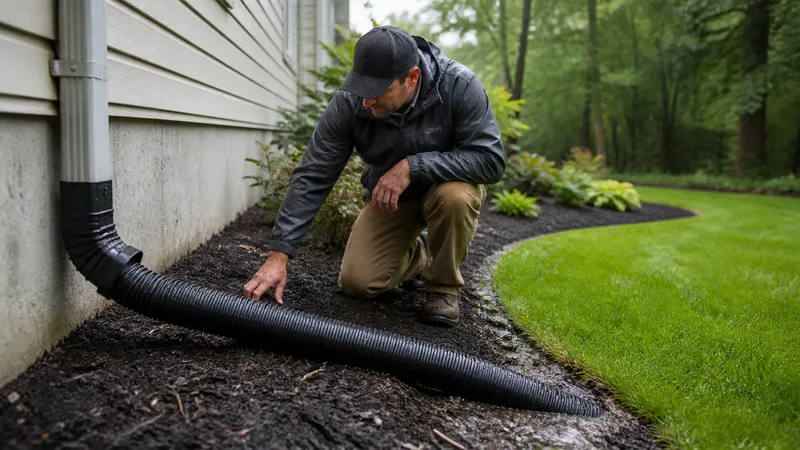
Most basement moisture is a grading or downspout problem, not a foundation defect. The fixes that solve it, plus when you actually need a French drain.
Key takeaways
- Most basement moisture is grading or downspouts, not a cracked or failed foundation—fix the water's path before you call a waterproofing company.
- Grade should drop about 6 inches over the first 10 feet from the foundation; downspouts should discharge at least 4-6 feet away, not right at the wall.
- White, chalky efflorescence means water passed through the wall and evaporated—it's a moisture signal, not the same as active running water.
- A French drain or interior drainage system is a fix for water still coming in after grading and downspouts are already corrected, not the first step.
- Stop and call a professional for active water intrusion during heavy rain and for any stair-step or horizontal cracking—that's a structural question, not a moisture one.
- Keep indoor basement humidity below 60%, ideally 30-50%, the same EPA range that applies to the rest of the house.
Most basement water problems start outside the foundation, not inside it. Before assuming a crack or a failed waterproofing system, check the two things that cause the majority of basement moisture: grading that doesn’t slope away from the house, and downspouts that dump roof water right at the foundation wall. The EPA’s mold and moisture guidance puts it plainly: “make sure the ground slopes away from the building foundation, so that water does not enter or collect around the foundation.” University of Minnesota Extension goes further—above-grade corrections like regrading and downspout extensions should be done before any below-grade drainage system, because they solve a large share of basement water problems on their own.
This page covers water and moisture management: grading, downspouts, window wells, and reading the signs on your walls. It does not cover structural foundation cracks—that’s a separate diagnosis, and a future guide covers it. It also doesn’t repeat the sump pump or humidity pages: see sump pump maintenance for the pit and pump itself, and why a house stays humid with the AC running for the mechanical side of indoor humidity.
Moisture sign, likely cause, and fix
| What you see | Likely cause | Fix |
|---|---|---|
| Damp wall or floor only after rain | Grading or downspout runoff reaching the foundation | Regrade and extend downspouts (see table below) before anything else |
| White, chalky powder on block or concrete (efflorescence) | Water has passed through the wall and evaporated at the surface | Not urgent by itself, but trace the moisture source outside; clean with a stiff brush, don’t seal over active seepage |
| Musty smell with no visible water | High humidity condensing on cool surfaces, or a hidden slow leak | Check a hygrometer first—see humidity guidance; inspect behind stored items and inside wall cavities |
| Water at the wall-floor joint during or after heavy rain | Hydrostatic pressure pushing groundwater in below grade | Often needs an interior drainage system (French drain) tied to a sump pit—grading alone won’t stop this |
| Standing water in a window well after rain | Clogged window well drain or a well filling faster than it drains | Clear debris and gravel, confirm the drain isn’t blocked, add a cover |
| Wet carpet or standing water spreading from one spot regardless of rain | A plumbing leak, not the foundation | Check nearby supply lines and the water heater before blaming the foundation |
| Cracks that grow, step diagonally, or run horizontal | Possible structural movement | Stop diagnosing moisture—get a foundation assessment |
Grading and downspout check
This is the first-line fix, and it’s usually inexpensive. Walk the perimeter after the next rain and check each item.
| Check | What “good” looks like | What to fix |
|---|---|---|
| Soil slope near the foundation | Drops roughly 6 inches over the first 10 feet away from the wall (PNNL Building America cites 0.5 inch of drop per foot for 10 feet) | Add and compact soil against the foundation to restore the slope; don’t just pile mulch |
| Downspout discharge point | Empties at least 4-6 feet from the foundation, onto a splash block or into a solid extension | Add a downspout extension; cheap flexible or rigid extensions run under $20 each |
| Number of downspouts vs. roof area | Water is split across enough downspouts that none is overwhelmed in a heavy storm | Add a downspout or a larger gutter if one corner floods every time it rains hard |
| Flower beds and mulch rings against the foundation | Don’t create a dam that traps water against the wall | Regrade so mulch slopes away, not level or bowl-shaped |
| Patios, walks, and driveways within 10 feet of the house | Slope away from the foundation, not toward it | Hard to DIY-regrade concrete; a mason or contractor may need to reset a slab or add a drain |
| Sump pump discharge line outlet (if present) | Empties well away from the foundation, not back toward the same soil you just graded | Extend the discharge line; see sump pump maintenance for the pump itself |
Regrading and downspout extensions together typically cost under a couple hundred dollars in materials for an average lot and can be done in a weekend. That’s worth doing before spending thousands on an interior drainage system that treats water your yard could have redirected for free.
Window wells: a smaller but common leak point
If a basement has below-grade windows, the window well is a frequent, overlooked entry point. Water that pools in a well with a blocked or missing drain eventually finds its way past the window seal.
- Clear leaves, soil, and debris out of the well at least twice a year, in spring and fall.
- Confirm the well has a working drain at the bottom—typically a perforated pipe under a gravel bed. If water still stands an hour after a hard rain, the drain is clogged or was never installed.
- Keep gravel a few inches below the windowsill, not packed up against the glass or frame.
- A clear well cover keeps out rain and debris while still letting light in, and it’s one of the cheapest fixes on this page.
- Confirm the grading immediately around the well also slopes away from it, not toward it—the same principle as the foundation itself.
Efflorescence vs. active water vs. just humid
These three get lumped together as “a wet basement,” but they call for different responses.
Efflorescence is the white, chalky mineral deposit left behind after water moves through concrete or block and evaporates at the surface. It means water has been getting into the wall material at some point—not necessarily right now. Brushing it off and painting over it doesn’t fix anything; find where the water is entering from outside first.
Active water infiltration is water you can see moving—seeping through a crack, running down a wall, or pooling at the wall-floor joint, especially during or right after a storm. This is the pattern that points toward hydrostatic pressure and often needs more than grading fixes.
Humidity and condensation show up as a musty smell, dampness on cool surfaces (a water pipe, a concrete floor in summer), or a hygrometer reading above 60%. This is an air-moisture problem, not a water-entry problem, and it’s usually solved with a dehumidifier and better airflow rather than digging up the yard. The same EPA range—below 60%, ideally 30-50%—applies in the basement as anywhere else in the house. See why a house stays humid even with the AC running for the mechanical causes if the humidity problem is whole-house, not basement-specific.
When grading isn’t enough: French drains and exterior membranes
If the exterior fixes above are already done—grading corrected, downspouts extended, window wells draining—and water still gets in, the next step is usually one of two systems:
| System | What it does | When it’s the right call |
|---|---|---|
| Interior French drain / drainage system | A channel along the interior perimeter of the basement floor collects water and routes it to a sump pump | Water is entering at the wall-floor joint or seeping up through the slab, and grading/downspout fixes didn’t stop it |
| Exterior waterproofing membrane | A waterproof coating or membrane applied to the outside of the foundation wall, usually with excavation | Water is entering through the wall itself, often in a home with a known high water table or a wall that was never waterproofed during construction |
| Exterior French drain (footing drain) | A drain pipe installed at the footing level outside the foundation, routing water away before it reaches the wall | New construction or a major excavation project; disruptive and costly to retrofit on an existing home |
An interior drainage system is usually less invasive and less expensive to retrofit than exterior excavation, which is why many contractors recommend it first for existing homes. Either way, these are excavation- or foundation-adjacent jobs for a licensed waterproofing contractor, not a homeowner project—get more than one quote and ask what grading and gutter work they expect you to handle yourself first.
When to call a professional
| Situation | Why it is not DIY |
|---|---|
| Active water intrusion during or right after heavy rain | Needs a proper diagnosis of entry point and possibly a drainage system, not another patch |
| Water still getting in after grading and downspouts are already fixed | Points to hydrostatic pressure that needs a French drain or interior drainage system, sized and sloped correctly |
| Considering an exterior waterproofing membrane | Requires excavation around the foundation—a specialized, permitted job |
| Any crack that is growing, stepping diagonally through block joints, or running horizontal | Signals possible structural movement—get it assessed rather than guessing from a photo |
| Water pooling against a foundation wall you can’t regrade yourself (retaining wall, hillside lot) | Drainage design on sloped or constrained lots needs an engineer or contractor, not trial and error |
A visual check, a photo of the crack or the water line, and a booked assessment are the right next step once the problem goes past grading and gutters. That’s not giving up on doing it yourself—foundation and drainage diagnosis is a specialized trade.
Related guides
Frequently asked questions
Does a damp basement always mean the foundation is failing?
No. Most basement moisture traces back to grading that slopes toward the house or a downspout dumping water at the foundation, not a defect in the foundation itself. Fix the exterior water path first; a foundation problem is more likely if cracks widen, step, or run horizontally rather than the wall simply feeling damp.
What is the white powder on my basement wall?
It’s efflorescence—mineral salts left behind after water passed through the concrete or block and evaporated at the surface. It confirms moisture has been getting into the wall, even if the surface is dry right now, and it is worth tracing to a source rather than just brushing off.
How far should downspouts extend from the house?
At least 4 to 6 feet from the foundation, and further if the ground is flat or clay-heavy. A downspout that empties within a foot or two of the wall is one of the most common, cheapest-to-fix causes of a wet basement.
When do I actually need a French drain instead of just fixing the grading?
After you’ve corrected the grading and downspouts and water is still getting in, especially from below the floor or through the wall-floor joint during heavy rain. That pattern points to a high water table or hydrostatic pressure that surface fixes can’t solve, and it’s the point where an interior drainage system or exterior waterproofing membrane becomes the right call.
Can I fix basement moisture myself?
Often, yes. Regrading the soil near the foundation and adding or redirecting downspout extensions are homeowner-level jobs that solve a large share of basement moisture complaints. Interior drain systems, exterior membrane excavation, and anything involving a sump pit tie-in are contractor jobs.