
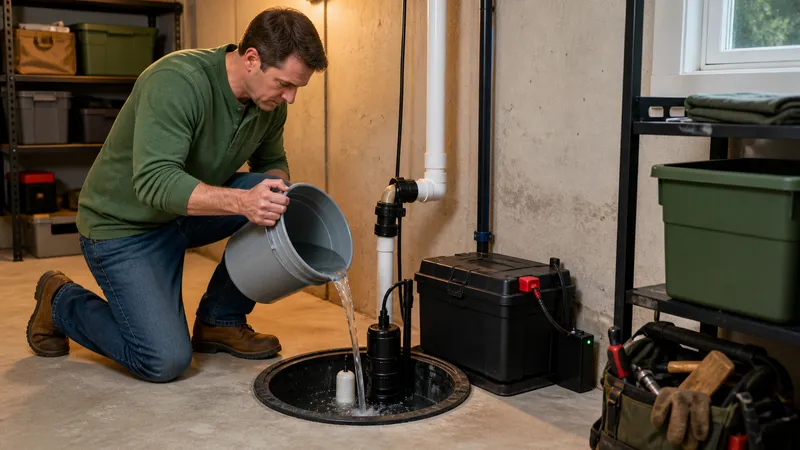
Sump pumps fail silently until a flood happens. The quarterly test, pit and screen cleaning, check valve check, and battery vs. water-powered backup.
Key takeaways
- Test quarterly: pour water into the pit until the float lifts, confirm the pump kicks on, and confirm it discharges outside, away from the foundation.
- Clean the pit and inlet screen a few times a year—debris on the float or screen is the most common cause of a pump that runs but doesn't clear water.
- Check the check valve on the discharge line. A missing or failed one lets water drain back into the pit and makes the pump short-cycle.
- Power outages often hit during the same storms that flood basements—FEMA recommends a battery or water-powered backup, not the electrical pump alone.
- A battery backup gives 4-7 hours on a fresh charge; a water-powered backup runs as long as municipal water pressure holds, but only on a public water supply.
- Most submersible sump pumps have a working life around 7-10 years. Past that, plan a replacement instead of waiting for a failure during a storm.
A sump pump gives almost no warning before it fails—there’s no filter that visibly clogs or a noise that gets louder for months first. It runs quietly for years, and then, during the storm that actually needs it, it doesn’t. That’s why testing, not just cleaning, is the core of sump pump maintenance: pour water into the pit every three months, confirm the float switch triggers the pump, and confirm it discharges outside the house and away from the foundation. Between tests, clean the pit and inlet screen, check the discharge check valve, and make sure the pump has a backup power source, because FEMA notes that outages often hit during the same storms that cause the flooding a sump pump exists to prevent. This page covers a submersible or pedestal sump pump already installed in a basement or crawlspace sump pit. For the systems it works alongside, see the home systems hub.
Sump pump maintenance schedule
| Task | Frequency | Why it matters |
|---|---|---|
| Pour water into the pit and test the float/pump | Every 3 months, plus before a forecast heavy rain | Confirms the pump still starts on its own and actually clears the pit—this is the check that catches a failure before a flood does |
| Clean the pit and inlet screen | Every 3-4 months | Wayne Pumps service guidance calls for checking the inlet screen and clearing stones or debris; a blocked screen is a common cause of a pump that runs but won’t pump |
| Inspect the discharge check valve | Every 6 months | A stuck or missing valve lets water drain back into the pit after each cycle, forcing the pump to run more than it should |
| Test the battery or water-powered backup | Every 3 months, with the main pump test | A backup that hasn’t been tested is not a backup—confirm the battery holds a charge or the water-powered unit primes and discharges |
| Replace the backup battery | Every 3-5 years | Sump pump backup batteries lose capacity over time; a dead battery during an outage is the same as having no backup |
| Confirm the discharge line outlet is clear | Each season change | Ice, leaves, or soil can block the outdoor discharge point, sending water right back toward the foundation |
The quarterly test procedure
Zoeller, a major sump pump manufacturer, describes testing a sump pump with the same basic steps regardless of brand:
- Locate the pit and clear the lid. Make sure the area around the pump is free of stored boxes or debris that could fall in.
- Pour a bucket of water into the pit slowly, enough to raise the water level to where the float switch normally triggers.
- Watch the float rise and confirm the pump turns on within a few seconds of the float reaching that point.
- Confirm water is actually leaving the discharge line outside, not just that the motor is running. A pump can hum and spin without moving water if the check valve or line is blocked.
- Watch the pump shut off once the pit drains back down, and confirm the float resets cleanly without hanging up on the pit wall or a power cord.
If the float doesn’t trigger the pump, the float switch (or the float’s freedom of movement in the pit) is the first thing to check, not the motor. If the pump runs but no water reaches the outside discharge point, move to cleaning the screen and checking the valve below before assuming the pump has failed.
Cleaning the pit and inlet screen
Sediment, gravel, and fine grit settle in a sump pit over time, and they get pulled toward the pump’s inlet screen every time it runs. A partially blocked screen makes the pump work harder and can eventually stop it from moving water at all, even though the motor still runs.
- Unplug the pump before reaching into the pit.
- Lift the pump out (most submersible units simply lift off the discharge pipe) and wipe down the inlet screen, removing any gravel, sediment, or debris caught in the slots.
- Rinse the bottom of the pit and remove any sediment that has built up, since a deep layer of grit can interfere with the float’s swing.
- Check the float switch and its cord for anything wrapped around it that could keep it from moving freely.
- Reseat the pump, plug it back in, and re-run the water test above before you consider the job done.
Why the check valve matters
The check valve sits in the discharge line, usually a few feet above the pump, and is a one-way valve: it lets water flow out during a pump cycle and then closes so that column of water in the pipe can’t fall back into the pit once the pump shuts off. Without a working check valve, that water drains back down every cycle, which means the pump has to turn back on almost immediately to clear it again—a pattern called short-cycling that wears out the motor and the float switch faster than normal use would.
Check the valve by watching the discharge pipe right after a test cycle: if you hear water running back down into the pit for more than a second or two after the pump shuts off, the valve isn’t sealing. Valves are inexpensive and usually replaceable without special tools, but if the pump short-cycles even with a new valve installed, that points to a bigger issue—see the professional table below.
Battery backup vs. water-powered backup
A sump pump that only runs on household electricity has a single point of failure: the same storm that fills the pit can also knock out the power. FEMA’s guidance on maintaining a sump pump recommends a backup power source specifically because power outages and flooding conditions tend to arrive together, and a battery backup pump is described as an inexpensive safeguard against basement flooding once the float switch calls for it.
| Battery backup | Water-powered backup | |
|---|---|---|
| How it runs | A rechargeable battery drives a second pump when the main pump loses power | Municipal water pressure creates suction (a venturi effect) that pulls water out—no electricity involved |
| Typical runtime | Roughly 4-7 hours on a fresh, charged battery | Runs as long as municipal water pressure holds, effectively unlimited during most outages |
| Works on well water | Yes—doesn’t depend on the water utility | No—if your home is on a private well, the well pump also loses power in an outage, so a water-powered backup has no supply |
| Ongoing cost | Replace the battery every 3-5 years; test charge quarterly | Uses roughly 1 gallon of municipal water for every 2 gallons pumped out; adds to the water bill during use |
| Installation | Straightforward—often shares the main pump’s discharge line | Requires a connection to the potable water line and a backflow preventer; many jurisdictions require a licensed plumber |
| Where it falls short | Finite runtime; a dead or untested battery is the same as no backup | Lower flow rate than an electric pump; unusable during a boil-water advisory or if the water utility itself loses pressure |
Sources: Zoeller’s battery vs. water-powered comparison and FEMA’s sump pump maintenance guidance. Homes on municipal water with a basement worth protecting are the best fit for a water-powered unit; homes on a well, or anywhere local code restricts a water-powered connection, should use battery backup instead.
How long a sump pump actually lasts
Most submersible sump pumps run for roughly 7 to 10 years before wear on the motor, float switch, and seals makes failure more likely, according to industry service estimates for residential units. Manufacturer warranties are typically shorter than that expected service life—Liberty Pumps, for example, warrants its pumps for 3 years from purchase, with some models offered at 5 years—so a warranty expiring is not itself a sign the pump is done. Heavy, continuous use (a high water table, a home near a slope, or a poorly draining lot) shortens the practical lifespan; light, occasional use extends it.
When to call a professional
| Situation | Why it is not DIY |
|---|---|
| The pump runs constantly or won’t shut off | Points to a stuck float, a failed switch, or a pit that’s taking on more water than the system was sized for |
| The discharge line is frozen or blocked outside the house | Requires safely thawing or clearing a line without damaging the pipe or flooding the area right at the foundation |
| Electrical issues with a wired-in unit—tripped breaker, scorched outlet, or a pump that hums but won’t start | Electrical diagnosis and repair near water is a licensed electrician’s job, not a maintenance task |
| Repeated pump failures despite regular maintenance | Can signal an oversized water table problem that needs a French drain, a larger pump, or a full system evaluation, not another replacement pump |
A visual check, a video of the pump cycling, and a booked appointment are often the right next step once a problem goes past testing and cleaning. That’s not a failure to do it yourself—sealed switches, wired-in electrical connections, and drainage sizing are jobs a licensed plumber or waterproofing contractor is equipped to diagnose properly.
Related guides
Frequently asked questions
How often should I test my sump pump?
Test it quarterly, and again before a forecasted heavy rain. Pour a bucket of water into the pit until the float switch rises, confirm the pump starts and runs quietly, and confirm water is actually leaving the discharge line outside the house.
Why does my sump pump run but the pit doesn’t drain?
The most common causes are a clogged inlet screen, debris jamming the float switch, or a failed check valve letting discharged water flow back into the pit. Clean the screen and pit first, then check the valve before assuming the pump itself has failed.
Do I need a battery backup if I already have a sump pump?
Yes, if flooding would be costly. Sump pumps run on household electricity, and power outages frequently happen during the same storms that cause basement flooding. A battery backup or water-powered backup keeps the pit pumping when the primary system loses power.
How long do sump pumps last?
Most submersible sump pumps run for roughly 7 to 10 years with regular testing and cleaning. Continuous heavy use, a high water table, or a skipped maintenance routine can shorten that; a pump nearing 10 years old is worth replacing proactively rather than waiting for it to fail.
What’s the difference between a battery-powered and water-powered backup pump?
A battery backup runs off a rechargeable battery and typically lasts 4 to 7 hours per charge before needing to recharge or be replaced. A water-powered backup uses municipal water pressure to remove pit water with no electricity or battery at all, but it only works on a public water supply and requires a licensed plumber to install the required backflow preventer.