
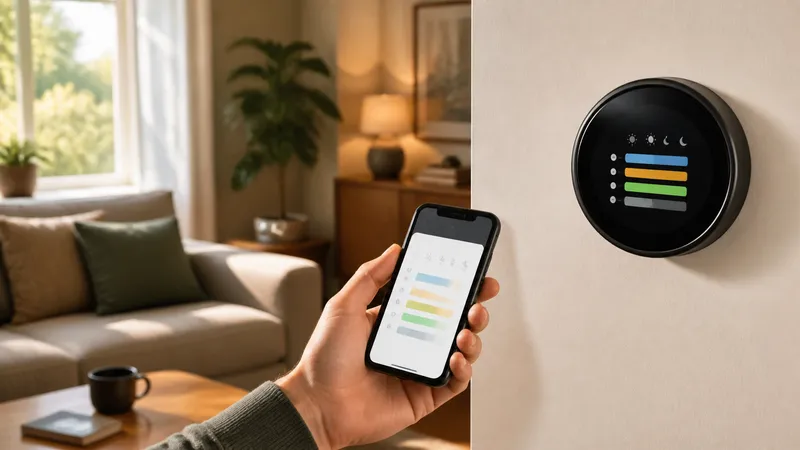
ENERGY STAR's certified average is about 8% off heating and cooling bills, not the 20%+ some brands market. Here's what actually moves your number.
Key takeaways
- ENERGY STAR's certified average is about 8% off heating and cooling costs, or roughly $50 a year—not the 20%+ some brand marketing pages claim.
- If you already manually set the thermostat back when you leave or sleep, a smart thermostat mostly automates a habit you have—expect savings toward the low end.
- If you never adjust the thermostat, DOE says a 7-10°F setback for 8 hours a day can save up to 10% a year—a smart thermostat captures that automatically.
- A $130-$280 device plus possible professional install (common wiring: no C-wire, or a multi-stage/heat-pump system) usually pays back in 2-4 years on savings alone.
- Remote control, filter and HVAC alerts, and geofencing are the genuinely useful features; room sensors and 'AI learning' claims vary more by brand than marketing suggests.
A smart thermostat is worth it for most households that never manually adjust their thermostat, and worth less for households that already do. ENERGY STAR’s certification data—based on a year of real field data submitted by certified manufacturers, not a marketing team—puts the average savings at about 8% of heating and cooling costs, or roughly $50 a year. That is the honest number. It is not the “save up to 20%” or “save up to 23%” figure some smart thermostat brands print on their own product pages, because those figures are usually a best-case household, not a typical one. This page is the decision layer for whether the purchase pays off in your house; for the HVAC system it controls, see the HVAC maintenance guide.
Does it pay off in your house? Start here
| Your current habit | What a smart thermostat adds | Expected savings vs. marketing claims |
|---|---|---|
| Never adjust the thermostat when out or asleep | Automatic setback captures savings you’re leaving on the table | Closer to DOE’s 7-10°F for 8 hours = up to 10%/year figure—likely the strongest case for buying |
| Manually set back sometimes, forget often | Consistency—the schedule runs even when you forget or you’re away unexpectedly | Moderate; you already capture part of the saving, the device closes the gap |
| Always manually set back on a disciplined schedule | Convenience (remote control, alerts) more than new savings | Toward ENERGY STAR’s 8%/$50 average, likely lower—you’re mostly automating what you already do |
| Home is occupied most hours, little schedule variation | Least setback opportunity exists in the first place | Below the 8% average—there’s less “unused” time to not-heat or not-cool |
| Renting, or already have a working programmable thermostat you use correctly | A programmable thermostat you actually program can get close to the same savings for a fraction of the cost | Marginal—the smart features (remote access, alerts) are the real upgrade, not the base savings |
The pattern: smart thermostats don’t create savings out of nothing. They automate a temperature setback. The less of that setback you’re already doing by hand, the more a smart thermostat is worth to your energy bill specifically.
The real savings numbers, and where marketing inflates them
ENERGY STAR certifies smart thermostats only after a manufacturer submits a full year of anonymized field data from real installed homes, analyzed with EPA-provided software. The bar to certify: documented reductions of at least 8% for heating and 10% for cooling, calculated conservatively (the lower bound of a 95% confidence interval across the sampled homes), per ENERGY STAR’s smart thermostat criteria. The headline savings figure ENERGY STAR publishes for consumers from that same program is about 8% of combined heating and cooling costs, or roughly $50 a year.
Compare that with the Department of Energy’s guidance on thermostat setbacks, which predates smart thermostats and applies to any setback method: turning the thermostat back 7°-10°F for 8 hours a day can save up to 10% a year on heating and cooling. These are different estimates, not a guaranteed saving for your home: ENERGY STAR describes certified smart thermostats, while DOE describes a setback strategy. Actual savings depend on climate, equipment, and the schedule you already use.
Where marketing claims come from: some manufacturers cite their own best-case pilot studies, older self-selected surveys, or combine heating-only and cooling-only percentages in ways that read larger than a blended annual number. Treat any brand’s own website as a source with an incentive, not a neutral one—ENERGY STAR and DOE have no product to sell.
What actually determines your number
| Factor | Why it moves your savings | Direction |
|---|---|---|
| Current thermostat habits | Automating an existing manual setback adds less than creating a new one | Manual setback already = lower added savings |
| Climate severity | Bigger swings between setback and normal setpoint = more energy not spent | Extreme heat/cold climates = higher savings |
| Occupancy pattern | Empty house 8+ hours a day (work, school) creates real setback opportunity | Predictable empty hours = higher savings |
| HVAC equipment type | Multi-stage and heat pump systems behave differently under aggressive setbacks; heat pumps can trigger inefficient backup heat on a big recovery | Standard forced-air = more predictable savings; heat pumps need setback-aware settings |
| Home envelope | A leaky, poorly insulated house loses the “coast” period faster, undercutting setback savings | Well-insulated home = setback holds longer, saves more |
Installation: the part vendor pages skip
The device is simple to buy. Wiring is where it gets uneven house to house.
| Situation | What it means for install | DIY or pro |
|---|---|---|
| Existing thermostat has a C-wire (common wire) | Straightforward swap, usually 30-60 minutes | DIY for most homeowners comfortable with a screwdriver and labeled wires |
| No C-wire present (common in older 2-4 wire systems) | Some smart thermostats include a power-adapter or “add-a-wire” kit; others need one run through the wall | Try the included adapter first; if unreliable, an HVAC technician can run a C-wire |
| Multi-stage furnace, dual-fuel, or heat pump system | Not every smart thermostat supports every stage combination correctly out of the box | Check the manufacturer’s compatibility checker by model number before buying; a mismatch shows up as short-cycling or inconsistent heat |
| Zoned system with multiple thermostats | Smart thermostats replacing one zone controller need to match the existing zone panel’s wiring | Often a professional job—zone panels aren’t standardized like single-zone wiring |
| Knob-and-tube or otherwise unusual/older wiring | Compatibility tools may not reflect the actual wiring behind the plate | Have an electrician or HVAC technician confirm before you commit to a return-restricted purchase |
Every major smart thermostat brand publishes a compatibility checker that asks for your current thermostat’s wire labels—use it before buying, not after you’ve opened the box. A wrong-fit purchase and a $100-$200 technician visit to add a C-wire both erase a chunk of the payback period below.
Upfront cost and payback
| Item | Typical 2026 range | Notes |
|---|---|---|
| Smart thermostat device | $130-$280 | Entry models with basic scheduling and remote control at the low end; sensor bundles and premium displays at the high end |
| Professional install (C-wire run, complex multi-stage/heat pump setup) | $100-$250 | Skip this if your wiring is already compatible and you’re comfortable with a DIY swap |
| ENERGY STAR average annual savings | ~$50/year | National average; your utility rates and climate move this number up or down |
| Simple payback (DIY install) | 2-4 years | Device cost only, divided by $50/year |
| Simple payback (with professional install) | 4-6 years | Adds the install cost to the numerator |
Some utilities offer rebates ($25-$100 is common) for ENERGY STAR-certified models—check your utility’s website before buying, since that can shave a year or more off payback. This is a real, if modest, financial case: a smart thermostat that costs $180 installed and saves $50 a year pays for itself in under four years and keeps saving after that, assuming your habits and climate match the national average.
Real features vs. marketing gimmicks
| Feature | Genuinely useful, or gimmick? | Why |
|---|---|---|
| Remote control via phone app | Useful | Lets you adjust before arriving home, or fix a setting you forgot—directly supports the setback behavior that creates savings |
| HVAC system alerts (short-cycling, filter due, extreme runtime) | Useful | Surfaces problems—like the kind covered in the HVAC maintenance guide—before they become a service call |
| Geofencing (detects your phone leaving/entering a radius) | Useful, with caveats | Automates setback for irregular schedules better than a fixed clock schedule, but drains phone battery faster and needs location permissions left on |
| “AI learning” that builds a schedule from your adjustments | Mixed | Works reasonably well after a few weeks in a household with a consistent routine; less useful if your schedule is already irregular, since it has less pattern to learn from |
| Room sensor bundles for “even temperature” | Marginal for savings | Improves comfort in a specific room; ENERGY STAR’s certified savings numbers are not built around sensor bundles, so don’t expect a different savings percentage from adding them |
| Voice assistant integration | Convenience only | Doesn’t change energy use; purely a control-method preference |
| Energy usage reports/dashboards in the app | Useful for awareness, not savings itself | Helps you verify your own before/after numbers—see the tip above—but the report itself doesn’t reduce a bill |
When to call a professional
| Situation | Why it is not DIY |
|---|---|
| No C-wire and the included adapter kit doesn’t hold a reliable connection | May need a new wire run through a wall or attic |
| Multi-stage, dual-fuel, or heat pump system the compatibility checker flags as uncertain | Wrong wiring on staged equipment can cause short-cycling or no-heat/no-cool faults |
| Zoned HVAC system with a central zone panel | Zone panel wiring isn’t standardized; a wrong connection can affect every zone, not just one |
| You see exposed wiring, scorch marks, or a breaker trips while working on the low-voltage wiring | Even low-voltage thermostat wiring runs through a system connected to line-voltage equipment—stop and call a technician |
Records worth keeping
| Keep this | Why |
|---|---|
| Model number and install date | Needed for warranty claims and future compatibility questions |
| Utility bill, one season before and after | The only real proof of what the device changed in your house |
| Wiring photo (before removing the old thermostat) | Saves a technician a diagnostic step if something needs troubleshooting later |
| Any rebate confirmation from your utility | Rebate paperwork sometimes has a claim window—don’t let it lapse |
Related guides
Frequently asked questions
How much money does a smart thermostat actually save?
ENERGY STAR’s certification data—based on a year of real field data from certified devices—shows an average of about 8% off heating and cooling costs, or roughly $50 a year. That’s the honest, independently verified number, not the higher percentages some manufacturers advertise on their own product pages.
Is a smart thermostat worth it if I already set mine back manually?
The savings will be smaller, because you’re already capturing most of what the setback would provide. A smart thermostat’s value in that case is convenience, remote control, and consistency—not new savings on top of a habit you’ve already built.
How long does it take a smart thermostat to pay for itself?
At $50 a year in savings against a $130-$280 device, most households break even in 2 to 4 years, faster if installation is simple. Add a $100-$200 professional install for a missing C-wire or a multi-stage/heat-pump system, and payback stretches closer to 4-6 years.
Do I need a C-wire for a smart thermostat?
Not always—some models include a power-adapter kit or work off battery, but most full-featured smart thermostats want a common wire (C-wire) for reliable power. If your existing thermostat has only 2-4 wires and no C-wire, check the smart thermostat’s compatibility tool before buying, or budget for an HVAC technician to run one.
What smart thermostat features are actually useful versus marketing gimmicks?
Remote control from a phone, alerts for HVAC problems (short-cycling, filter reminders, extreme temperature swings), and geofencing that detects when you’ve left are genuinely useful. “AI learning” that claims to predict your schedule better than a simple setback schedule, and multi-room sensor bundles sold as necessities, deliver less consistent value and add cost.