
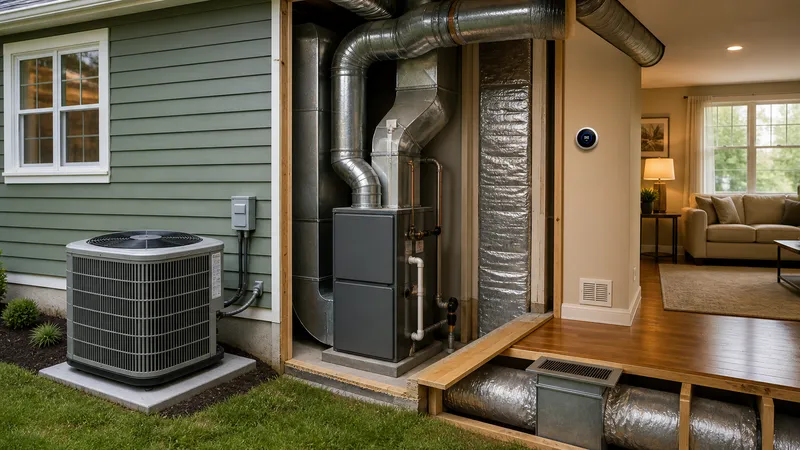
The whole HVAC system explained by part—condenser, coils, ducts, thermostat, refrigerant lines—plus a master maintenance table and when each job needs a pro.
Key takeaways
- An HVAC system is five parts working together: outdoor condenser, indoor coil/furnace, ductwork, thermostat, and refrigerant lines connecting the first two.
- Homeowners maintain filters, the outdoor unit's surroundings, visible duct connections, and the thermostat—refrigerant and combustion components are licensed-only.
- ENERGY STAR: about 20-30% of conditioned air is lost through duct leaks before it reaches a register—most homeowners never check the ducts they can actually see.
- Only an EPA Section 608-certified technician can legally purchase or handle refrigerant; DIY recharging isn't just risky, it's against federal rule.
- Ice on a refrigerant line, hissing at a fitting, or weak warm airflow are signs to call a technician, not signs to add refrigerant yourself.
- This page is the whole-system map. Filter intervals, tune-up cadence, humidity, and duct balancing each have a dedicated deep-dive linked below.
HVAC maintenance means keeping up five connected parts, not one box: the outdoor condenser, the indoor coil and furnace or air handler, the ductwork that moves the air, the thermostat that runs the whole cycle, and the refrigerant lines linking the outdoor and indoor units. Most homeowners only ever think about the filter, but a system with a clean filter can still lose 20-30% of its conditioned air to duct leaks, per ENERGY STAR, or fail to cool at all if refrigerant is low. This page is the whole-system map: what each part does, what maintenance actually covers it, and where the deep-dive guides for filters, tune-up timing, humidity, and cold rooms live so you don’t have to re-learn them here.
The five parts of an HVAC system
| Part | What it does | Where it lives |
|---|---|---|
| Outdoor condenser/compressor | Compresses refrigerant and rejects heat outside (cooling mode); the reversing valve on a heat pump also pulls heat in during winter | A boxy unit on a pad outside the house |
| Indoor evaporator coil | Refrigerant absorbs heat from indoor air passing over the coil, cooling and dehumidifying it | Mounted above or beside the furnace or air handler, usually in a coil cabinet |
| Furnace or air handler | Moves air across the coil (and, for a furnace, burns fuel or runs electric elements to heat it) | A closet, basement, attic, or utility room |
| Ductwork | Carries conditioned air from the equipment to each room and pulls return air back | Inside walls, attics, crawlspaces, basements |
| Thermostat | Reads room temperature and tells the system when to run, and in what mode | A wall-mounted control, usually central to the house |
| Refrigerant lines | Two insulated copper lines carrying refrigerant between the outdoor and indoor units | Run outside along the house, then penetrate a wall near the indoor unit |
Everything below maps maintenance to these six pieces (refrigerant lines counted separately from the coils they connect), because “service the HVAC” is too vague to act on.
Master maintenance-by-part table
| Part | Homeowner maintenance | Cadence | Deep dive |
|---|---|---|---|
| Filter | Check, clean, or replace | Monthly check; replace every 30-90 days (1”) to 6-12 months (4-5”) | Filter schedule, quick AC answer |
| Outdoor condenser | Keep 2+ feet of clearance, clear leaves/grass clippings, rinse fins gently with a hose from inside out, confirm it’s level | Each season; after storms or heavy mowing | This page (below) |
| Indoor coil | Homeowner: none beyond a clean filter, which protects the coil. Cleaning the coil itself is a technician job | Annual, with the pro tune-up | Maintenance schedule |
| Ductwork | Visual check of accessible connections and insulation; seal small visible gaps with mastic or metal tape (not duct tape) | Each season change | This page (below) |
| Thermostat | Confirm it responds within a couple minutes of a setpoint change; replace batteries; keep it out of direct sun and drafts | Each season change | Maintenance schedule |
| Refrigerant lines | Visual check only: look for ice, oily residue, or crushed/kinked line; never open a fitting | Whenever airflow or cooling seems off | This page (below) |
| Whole system | Book a licensed pro tune-up | 1x/year (heat pump) or 2x/year (separate AC + furnace) | Maintenance schedule |
The outdoor unit: what a homeowner can actually do
The condenser sits outside year-round and takes the most physical abuse—grass clippings, leaves, ice, and whatever a trimmer throws at it. ENERGY STAR’s maintenance checklist includes cleaning the coils as part of an annual professional visit, but the homeowner-level upkeep between visits is simpler: keep at least 2 feet of clearance on all sides for airflow, cut back plants and clear leaves or clippings that build up against the fins, and rinse the outdoor fins gently with a garden hose from the inside out after mowing season kicks up debris. Confirm the unit still sits level on its pad—a unit that’s settled or tilted can strain the compressor over time.
Ductwork: the part most homeowners never check
Ductwork is the part of the system most likely to be losing performance silently. ENERGY STAR puts a number on it: about 20 to 30 percent of the air moving through a typical duct system is lost to leaks, holes, and poorly connected joints before it reaches a register. That page lists rooms that are hard to heat or cool and elevated bills as the practical signs, and specifically names ducts running through an attic, crawlspace, or garage as the likeliest trouble spots.
What a homeowner can do without opening a wall:
- Walk accessible duct runs—attic, basement, or crawlspace—and look at the visible joints and boots for gaps, disconnected sections, or crushed flexible duct.
- Feel for air at connections while the system runs. A hiss or a puff of air at a joint means it’s leaking there.
- Seal small, accessible gaps with mastic sealant or metal (foil-backed) tape—ENERGY STAR specifically says not to use standard cloth-backed duct tape, which dries out and fails.
- Check that insulation still fully covers ducts running through unconditioned space, with no gaps or crushed sections where someone (or something) pushed past it.
What that check does not cover: ducts inside finished walls or ceilings, total system leakage testing, or resizing an undersized run. ACCA’s duct sealing standard calls for sealing every connection and seam before insulation goes back over it, and targets 10% or less total leakage after a professional sealing job—numbers a homeowner’s visual check can’t verify on its own. If one specific room stays consistently off-temperature, that’s a narrower diagnosis with its own guide: see Why Is One Room Always Colder Than the Rest of the House? for duct balancing, register checks, and envelope caveats in depth.
| What you see | Likely meaning | Who fixes it |
|---|---|---|
| Visible gap or separation at a duct joint | Air leaking straight into the attic/crawlspace instead of the room | Homeowner can seal small gaps with mastic/foil tape; larger separations need a technician |
| Flex duct crushed, kinked, or coiled tightly | Restricted airflow to whatever room that run feeds | Technician—may need rerouting, not just straightening |
| Insulation missing or compressed on a duct in unconditioned space | Air heats or cools in transit before reaching the register | Homeowner can add batt/wrap insulation to accessible runs; sealed ducts first |
| A specific room is always weaker or warmer than the rest | Balancing or sizing issue on that branch | Technician—see the cold room guide |
Thermostat: the control layer
The thermostat is the one part every homeowner already touches, but “maintenance” here is mostly about confirming it’s doing its job correctly, not repairing it. As part of a seasonal tune-up, ENERGY STAR’s checklist includes verifying thermostat operation. Between visits: change backup batteries before they die mid-season, keep the unit out of direct sunlight and drafts (both throw off its reading), and test that the system responds within a couple of minutes when you change the setpoint by 5°F. A thermostat that’s slow to respond, mismatched to a multi-stage heat pump, or reading several degrees off can undercut an otherwise well-maintained system. If you’re deciding whether a smart thermostat is worth adding to that mix, see Is a Smart Thermostat Worth It?.
Refrigerant lines: what you can see, and what’s licensed-only
The two insulated copper lines running between the outdoor condenser and the indoor coil carry refrigerant through a closed loop—refrigerant that should never need “topping off” in a properly working, leak-free system. Homeowner maintenance here is entirely visual: look at the exposed line set (usually running along the outside wall from the condenser to where it enters the house) for ice buildup, cracked or missing line insulation, oily residue at a fitting (a common sign of a slow leak), or a line that’s been crushed or kinked by a trimmer or a parked object.
What you cannot legally do yourself is touch the refrigerant. The EPA’s Section 608 refrigerant sales restriction limits refrigerant purchases to certified technicians (or employers with a certified technician on staff)—a homeowner without EPA Section 608 certification cannot legally buy the refrigerant a recharge would require, separate from the skill and equipment it also takes to do the job safely. This isn’t a “voids the warranty” caution; it’s a federal purchase restriction under the Clean Air Act.
| What you see on the outside | Possible cause | Your move |
|---|---|---|
| Ice on the indoor coil or the refrigerant lines | Low refrigerant, restricted airflow, or a dirty coil | Turn the system off, let it thaw, call a technician |
| Hissing or bubbling near a line fitting | Refrigerant leak | Call a technician—don’t run the system on a known leak |
| Oily residue at a joint or fitting | Refrigerant leaks often carry compressor oil with them | Note the location, call a technician |
| System runs but air stays lukewarm | Could be refrigerant, could be the compressor, could be a dirty coil | Confirm the filter is clean first, then call a technician if warm air persists |
| Line insulation cracked, sun-damaged, or missing | Reduces efficiency and can lead to condensation drips | Homeowner can replace foam line insulation sleeves yourself—no refrigerant involved |
If low humidity indoors despite a running AC is your actual symptom, that’s usually a coil or duct issue rather than refrigerant alone—see Why Is My House Too Humid Even With the AC Running? for the full diagnostic path, including how to tell short-cycling from a mechanical fault.
Putting it together: the annual rhythm
| Cadence | What happens | Who does it |
|---|---|---|
| Monthly | Check the filter; replace if gray or matted | Homeowner |
| Each season change | Clear the outdoor unit, walk visible ducts, test the thermostat response, glance at the refrigerant line set for ice or damage | Homeowner |
| Spring (cooling) / fall (heating), or once a year for a heat pump | Full tune-up: coil cleaning, refrigerant check, combustion and heat-exchanger inspection, electrical checks | Licensed technician |
| As symptoms appear | Diagnose weak rooms, humidity, noise, or airflow complaints | Technician, or the relevant Housetto deep-dive first |
The full breakdown of that annual rhythm—by equipment type, including heat pumps, mini-splits, and window units—lives in the HVAC maintenance schedule. This page exists so you know what each visit is actually touching.
When to call a professional
| Situation | Why it is not DIY |
|---|---|
| Refrigerant charge, leak repair, or opening any refrigerant fitting | Illegal without EPA Section 608 certification—technicians must be certified to purchase or handle refrigerant |
| Removing the outdoor unit’s access panel | Exposes the compressor and high-voltage electrical connections |
| Combustion, gas connections, pilot lights you can’t relight from the manual, or the heat exchanger | Carbon monoxide and fire risk; requires opening the burner compartment with combustion-testing tools |
| Electrical panel work, motor or capacitor replacement inside the unit | Shock risk; requires correctly locked-out power |
| Duct sealing beyond small accessible gaps, or any duct inside a finished wall | Requires access, leakage testing, and correct sealing order under ACCA’s standard |
| Reversing valve or defrost-cycle issues on a heat pump | Specialized refrigerant-cycle diagnostics |
| A room or system that stays wrong after filter, thermostat, and visible-duct checks | Needs load calculation or duct/airflow measurement tools a homeowner doesn’t own |
Keep the records that make service calls faster
| Record | Why it matters |
|---|---|
| Equipment type, age, and filter size | Tells a technician (or you) what schedule and parts apply before they arrive |
| Last tune-up date and notes | Confirms whether refrigerant, coils, or the heat exchanger were flagged last visit |
| Duct check notes and photos | Turns “a vent feels weak” into a specific room and run a technician can start from |
| Any refrigerant line damage or ice you’ve seen | Gives a technician a starting point instead of a cold diagnosis |
Related guides
Frequently asked questions
What are the main parts of a home HVAC system?
A typical split system has five parts: the outdoor condenser/compressor unit, the indoor evaporator coil paired with the furnace or air handler, the ductwork distributing air through the house, the thermostat controlling all of it, and the refrigerant lines connecting the outdoor and indoor units. Each part has its own maintenance needs and its own failure signs.
Can I check my ductwork myself, or does that need a professional?
You can do a visible-connection check yourself: look at accessible duct joints in the attic, basement, or crawlspace for gaps, disconnected sections, or crushed flex duct, and feel for air leaking at connections while the system runs. Sealing hidden ducts, testing total leakage, or resizing a run is a professional job—ACCA’s leakage target after sealing is 10% or less of total airflow.
Is it actually illegal to add refrigerant to my own AC?
Yes, in practice. The EPA’s Section 608 rule restricts refrigerant sales to certified technicians (and their employers) for ozone-depleting and common substitute refrigerants—a homeowner without certification cannot legally purchase the refrigerant needed to recharge a system, regardless of whether they own the tools.
How do I know if my system has a refrigerant problem versus a duct or filter problem?
Refrigerant problems usually show up at the equipment itself: ice on the indoor coil or the copper lines running to the outdoor unit, hissing or bubbling near a fitting, or air that stays lukewarm even after a fresh filter and clear ducts. Duct and filter problems usually show up as weak airflow at specific registers rather than warm air at all of them.
How is this guide different from the HVAC filter and tune-up articles?
This page is the whole-system map—what each part is, what maintenance covers it, and where to route deeper questions. The filter guide covers exact replacement intervals by thickness, the maintenance schedule guide covers spring/fall tune-up cadence by equipment type, and the humidity and cold-room guides cover two specific symptom diagnoses in depth.