
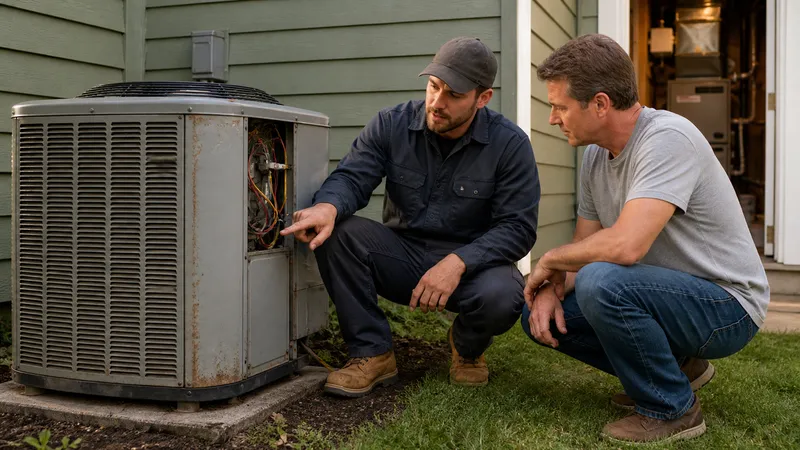
Furnaces run 15-25 years, central AC 7-15, heat pumps about 10-15 — the sourced ranges, what shortens them, and the signs it's time to replace.
Key takeaways
- Furnaces typically last 15-25 years and central air conditioners 7-15 years, per InterNACHI's life-expectancy chart.
- Heat pumps run their compressor for both heating and cooling year-round, so most need replacement around 10-15 years.
- ENERGY STAR flags replacement once a heat pump or AC passes 10 years, or a furnace passes 15, especially with rising repair bills.
- Skipped filter changes and tune-ups are the biggest controllable factor in HVAC lifespan — not the brand on the nameplate.
- R-22 systems are effectively obsolete: production and import for new equipment ended, so parts and refrigerant only get pricier.
- If a compressor or heat-exchanger repair quote nears 50-70% of a new system's installed cost, replace instead of repairing.
An HVAC system’s lifespan depends on which piece of equipment you’re asking about: a furnace commonly lasts 15-25 years, a central air conditioner 7-15 years, and a heat pump around 10-15 years since its compressor runs year-round for both heating and cooling instead of resting half the year. Those ranges come from InterNACHI’s life-expectancy chart, the professional home-inspector association’s standard reference, and they assume normal use with the manufacturer’s recommended maintenance — not neglect. This page covers what shortens that range, the signs a system is on its way out, and the math behind repairing versus replacing it. For the maintenance schedule that keeps a system near the long end of its range, see HVAC Maintenance Schedule. For how HVAC compares to every other major appliance, see the appliance lifespan guide.
HVAC lifespan by equipment type
| Equipment | Typical lifespan | Why it differs | Source |
|---|---|---|---|
| Furnace (gas or electric) | 15-25 years | No refrigerant compressor to wear out; heat exchanger cracks are the usual end-of-life failure | InterNACHI |
| Central air conditioner | 7-15 years | Outdoor compressor and condenser run through every cooling season and sit exposed to weather | InterNACHI |
| Heat pump (air-source) | ~10-15 years (homeowner rule of thumb) | Same compressor technology as central AC, but it runs in both heating and cooling mode, adding run-hours every year | ENERGY STAR flags replacement consideration once a heat pump passes 10 years old |
ENERGY STAR’s replacement guidance uses a simpler rule of thumb for homeowners deciding whether to even start looking: consider replacement once “your heat pump or air conditioner is more than 10 years old” or “your furnace or boiler is more than 15 years old” — especially if repairs or energy bills are climbing at the same time.
What actually shortens HVAC life
The equipment on the nameplate matters less than what happens to it over 10-plus years. Three things do the most damage:
- Skipped filter changes and tune-ups. A blocked filter forces the blower motor to work harder and starves the coil of airflow, and a skipped annual tune-up misses early refrigerant, coil, and heat-exchanger problems before they become failures. This is the one lifespan factor a homeowner fully controls — see the HVAC maintenance schedule for the actual cadence by equipment type.
- Oversized or undersized equipment. A system sized wrong for the house short-cycles — it turns on and off in quick bursts instead of running a full cycle — which wears the compressor and controls far faster than steady operation.
- Refrigerant leaks left unaddressed. A slow leak drops the system below its correct charge, forcing the compressor to run longer and hotter to hit the setpoint. Left unrepaired, that’s a compressor failure waiting to happen, not just a comfort problem.
Signs a system is failing, not just aging
Age alone isn’t the trigger — age combined with one of these is:
| Sign | What it usually means |
|---|---|
| Energy bills rising for the same usage pattern | The compressor or heat exchanger is losing efficiency, often years before it fails outright |
| Frequent repair calls (more than one a year) | The system is in its failure period, not an unlucky streak |
| Uneven heating or cooling room to room | Ductwork, a failing blower, or a system that’s now undersized for wear-related output loss |
| Running an R-22 system | Production and import of R-22 for new equipment has ended in the U.S.; recharges now depend on reclaimed supply that costs far more per pound each year |
| Age past 15 years plus any needed repair | Even a moderate repair quote is a strong signal to get a replacement quote first |
An R-22 system deserves its own line because it’s a different problem than ordinary aging: it’s not that the equipment is failing, it’s that keeping it running gets structurally more expensive every year the reclaimed refrigerant supply shrinks. If a technician quotes a recharge on an R-22 system, ask what a full replacement would cost before agreeing — the math has usually shifted since the unit was installed.
Repair or replace: the HVAC-specific math
The general appliance rule — repair if it’s under roughly 50% of a new unit’s cost, replace above that — holds for HVAC, but the two repairs that actually hit that threshold are specific: a compressor and a furnace heat exchanger. Both sit at the center of the system, both require significant labor to access, and both commonly land in the 50-70% range of a new, installed system’s cost once you add labor, refrigerant, and any code-required upgrades to old ductwork or electrical.
| Situation | Typical call |
|---|---|
| Repair is a minor part (capacitor, thermostat, blower motor) and system is under 10 years | Repair |
| Repair is a compressor or heat exchanger and system is past 12-15 years | Get a full-replacement quote before authorizing the repair |
| System still uses R-22 refrigerant | Replace — the refrigerant cost alone tends to erase any repair savings within a season or two |
| Same major component has already failed once | Replace — a repeat failure is the clearest sign the unit is done |
The efficiency case for replacing an old system
Age doesn’t just raise failure risk — it raises the operating cost of the years a system has left. ENERGY STAR states that ENERGY STAR-certified furnaces run about 15% more efficient than a standard new furnace, and that upgrading to high-efficiency ENERGY STAR heating and cooling equipment can cut heating and cooling costs by up to 20%. A system installed 15-20 years ago is being compared against decades of subsequent efficiency gains, not just against a new baseline unit — so the gap for a genuinely old system is usually larger than either figure alone suggests.
When to call a professional
| Situation | Why it is not DIY |
|---|---|
| Diagnosing whether a repair quote is fair | A second licensed opinion, not a homeowner guess, is the only real check on a major-component quote |
| Refrigerant charge, leak repair, or sealed-system access | Requires EPA Section 608 certification; unlicensed work can void remaining warranty coverage |
| Heat exchanger inspection or replacement | Requires opening the burner compartment with combustion-testing tools |
| Deciding between repair and full replacement on an aging system | A technician can measure actual remaining component condition, not just age on paper |
| Any system still running R-22 | A licensed technician can quote both the recharge and the replacement so you’re comparing real numbers, not guesses |
Keep the decision simple by tracking what you actually know: install date, last service date, and any repair quotes so far.
Related guides
Frequently asked questions
How long does an HVAC system last?
It depends on the equipment. Per InterNACHI’s life-expectancy chart, a furnace commonly lasts 15-25 years and a central air conditioner 7-15 years. Heat pumps run their compressor year-round for both heating and cooling, so most reach the end of their useful life around 10-15 years, even though ENERGY STAR uses 10 years as a general replacement checkpoint for both heat pumps and central AC.
What shortens an HVAC system’s life the most?
Skipped filter changes and skipped professional tune-ups are the biggest controllable factor — a blocked filter forces the blower motor and compressor to work harder for years before something fails. Oversized or undersized equipment that short-cycles, and refrigerant leaks left unaddressed, are the next two most common causes of an early failure.
Is it worth repairing an old R-22 air conditioner?
Usually not. Production and import of R-22 refrigerant for use in new equipment in the U.S. has ended, so any system still using it depends on recycled or reclaimed supply that costs far more per pound than modern refrigerants. Combined with a system that is already past 10-15 years old, most homeowners find replacement cheaper over a few years than repeated R-22 recharges.
When does a repair cost too much to be worth it?
When the repair quote — most often a compressor or a furnace heat exchanger — approaches roughly 50-70% of what a new, installed system costs. At that point you’re paying most of a new unit’s price to keep an aging system running, with no guarantee another part won’t fail next season.
How much more efficient is a new HVAC system than one that’s 15-20 years old?
ENERGY STAR-certified furnaces run about 15% more efficient than a standard new furnace, and high-efficiency ENERGY STAR heating and cooling equipment can cut heating and cooling costs by up to 20% compared to older, less efficient equipment — before counting the extra strain an aging system already carries from years of wear.