
A refrigerator maintenance schedule you can actually keep: coil cleaning, seal checks, filter swaps, safe temperatures, and when to call a repair tech.
Key takeaways
- Keep the fridge at 40°F or below and the freezer at 0°F, following FDA food-storage guidance.
- Clean condenser coils every 6–12 months, or every 3–6 months with pets or a dusty spot near the unit.
- Run the dollar-bill test on both doors each season; a bill that slides out with no drag means a worn gasket.
- Swap the water/ice filter about every 6 months or 200 gallons, whichever comes first—check your model's light.
- Wipe spills within a day and keep the drain pan clean; standing moisture is how fridge odor and mold start.
- Unplug before touching coils or a fan. Leave the sealed refrigerant system and compressor to a licensed tech.
A refrigerator maintenance schedule has five recurring jobs: check the temperature, clean the condenser coils (every 6–12 months), test the door seals, replace the water/ice filter (about every 6 months), and wipe out spills before they turn into odor or mold. None of these require opening the sealed refrigerant system. This page is the year-round master list for the refrigerator hub. For the full coil-cleaning how-to and warning signs, see How Often Should You Clean Refrigerator Coils?; for filter part numbers and water-quality caveats, see When to Replace Your Refrigerator Water Filter.
Refrigerator maintenance schedule at a glance
| Task | Frequency | DIY or pro | Source or rule of thumb |
|---|---|---|---|
| Check fridge/freezer temperature | Monthly | DIY | FDA: fridge 40°F or below, freezer 0°F |
| Clean condenser coils | Every 6–12 months (3–6 months with pets/dust) | DIY | ENERGY STAR: keep coils clean; check your manual first |
| Test door seals (dollar-bill test) | Every season change | DIY | ENERGY STAR: seals should be airtight |
| Replace water/ice filter | About every 6 months or 200 gallons | DIY | Manufacturer example: Whirlpool—your model wins |
| Wipe interior spills, check drain pan | Weekly wipe-down, monthly pan check | DIY | EPA: dry wet spots within 48 hours to stop mold |
| Vacuum the door gasket folds and kick-plate vents | Every 3 months | DIY | Keeps airflow and seal contact clean |
| Compressor, sealed system, or evaporator fan issue | As needed | Licensed appliance tech | Requires opening refrigerant components |
Set the right temperature first
Temperature is also a food-safety issue. The FDA’s food-storage guidance recommends keeping the refrigerator at 40°F or below and the freezer at 0°F. Use appliance thermometers to check the actual temperatures rather than relying only on the control dial.
For everyday efficiency (not just safety), the Department of Energy’s Energy Saver program suggests running the fridge at 35–38°F and the freezer at 0°F in its 2022 guide. Avoid setting either compartment colder than necessary. Use a separate appliance thermometer if your unit does not display an actual temperature—dial settings like “4” are relative, not degrees.
Clean the condenser coils (brief version)
Dust on the condenser coils makes the compressor work harder and run longer to hit the same temperature. ENERGY STAR recommends keeping coils clean, especially on older models, and checking your manual for the safe method—some built-in and newer units have sealed coils that do not need cleaning at all. As a rule of thumb, plan on cleaning exposed coils every 6–12 months, or every 3–6 months if you have shedding pets or the fridge sits in a garage or dusty utility room. The full step-by-step, including how to tell a dirty coil from a failing fan, is in How Often Should You Clean Refrigerator Coils?
Check the door seals: the dollar-bill test
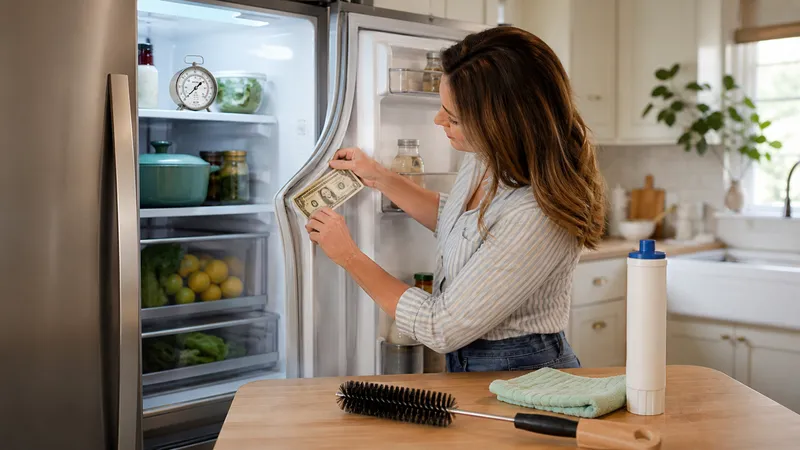
A loose gasket lets warm, humid air into the cabinet, which raises energy use, frosts up the freezer, and can push the fridge above the 40°F line. Close a dollar bill in the door so it crosses the full width of the seal, then pull it out. A healthy gasket grips with noticeable drag. If the bill slides out easily at one or more spots—top, bottom, and both sides—clean the gasket with mild soap and water first and retest, since dirt and food residue are a common false alarm. If it still slides out clean after that, order a replacement gasket by model number rather than a universal one.
Do this on both the fridge and freezer doors, and repeat it each season change, since gaskets stiffen and crack with age and heat cycling.
Replace the water filter on schedule (brief version)
If your refrigerator has an ice maker or water dispenser, it has a filter that needs regular replacement, not just when the water tastes off. A common manufacturer default—Whirlpool’s is representative—is every 6 months or about 200 gallons, whichever comes first, with a status light that tracks usage on many models. Hard water, high household use, or a well supply can shorten that interval; your model’s manual and part number are the final word. The full replacement walkthrough, filter types, and water-quality caveats live in When to Replace Your Refrigerator Water Filter.
Clean the interior and drain pan before odor becomes mold
Refrigerator odor and mold almost always trace back to standing moisture: a spill under the crisper drawer, a clogged interior drain tube, or water sitting in the drain pan underneath the unit. The EPA’s mold and moisture guidance is blunt about the fix—dry wet materials within 48 hours, since mold can start growing in that window. Applied to a fridge:
| Spot to check | How often | What you’re looking for |
|---|---|---|
| Shelves, drawers, door bins | Weekly wipe-down | Spills, expired food, sticky residue |
| Interior drain hole/tube (back of fridge compartment) | Every few months | Clog that backs water up onto shelves |
| Drain pan under the unit (pull the kick-plate) | Monthly | Standing water, musty smell, visible growth |
| Door gasket folds | With coil cleaning | Trapped crumbs and moisture that hold odor |
If you clear a clogged drain and the smell returns within a week, or you see visible mold rather than a food-residue smell, that is a signal to call a technician rather than keep re-cleaning the same spot.
Caveats: what changes the schedule
| Situation | Change the schedule | Why |
|---|---|---|
| Garage, basement, or unconditioned space | Coils and gaskets need more frequent checks | Dust and temperature swings stress both faster |
| Pets that shed | Clean coils every 3–6 months | Pet hair mats onto coils quickly |
| Well water or hard water | Filters may clog sooner than the 6-month default | Sediment and mineral scale load the filter faster |
| Built-in or newer sealed-coil models | Skip manual coil cleaning; follow the manual | Some designs have coils you cannot access safely |
| Frequent power outages | Re-check temperature after every restart | A warm restart can push both compartments above the safe line for hours |
When to call a professional
| Situation | Why it is not DIY |
|---|---|
| Fridge won’t hold temperature after coils, seals, and clearance are all checked | Likely a compressor, sealed refrigerant, or thermostat fault |
| Refrigerant smell, hissing, or oily residue near the back panel | Sealed system leak; requires EPA-certified refrigerant handling |
| Condenser or evaporator fan motor replacement | Requires disassembly behind panels not meant for daily access |
| Water leaking from inside the cabinet or under the unit that isn’t a clogged drain | Could be a failed water-inlet valve or internal line |
| Compressor cycles constantly, trips a breaker, or smells hot/burnt | Electrical or motor fault; stop and call a tech |
| Built-in unit with a sealed coil compartment | Not designed for homeowner access |
Related guides
Frequently asked questions
How often should I clean refrigerator condenser coils?
Every 6 to 12 months for most households, and every 3 to 6 months if you have shedding pets or the fridge sits in a dusty spot like a garage. Some built-in models have sealed coils that don’t need cleaning—check the manual first.
What temperature should my refrigerator and freezer be set to?
FDA food-safety guidance calls for 40°F or below in the fridge and 0°F in the freezer. The Department of Energy’s 2022 Energy Saver guide suggests 35–38°F for the refrigerator and 0°F for the freezer. Check the actual temperature with an appliance thermometer.
How often should I replace the refrigerator water filter?
A common manufacturer default is every 6 months or about 200 gallons, whichever comes first, or sooner if flow slows or the filter light turns on. Your model’s manual sets the exact interval and part number.
How do I know if my refrigerator door seal needs replacing?
Close a dollar bill in the door so it crosses the gasket, then pull it out. A good seal grips with real drag; if the bill slides out with no resistance at multiple points along the seal, replace the gasket.
Why does my refrigerator smell even though it’s clean on the outside?
Odor usually comes from a spill in a hard-to-see spot, a clogged drain tube, or standing water in the drain pan under the unit. Wipe spills within a day and check the pan and drain tube if a musty smell persists.