
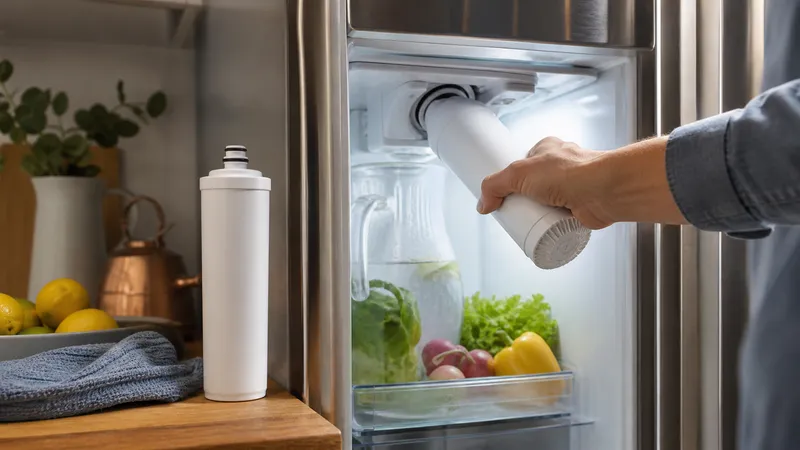
Refrigerator water filters need replacing about every 6 months or 200–300 gallons—here's the cost range, the signs it's overdue, and how to swap one.
Key takeaways
- Replace most refrigerator water filters every 6 months or about 200–300 gallons, whichever comes first.
- Your model's manual wins over any generic interval—some filters are rated for 100 gallons, others for 500.
- Slow dispenser flow, off taste or odor, and a lit filter indicator all mean the filter is overdue now.
- OEM filters typically run $40–$60 each; certified third-party filters run $15–$30.
- For non-OEM filters, check for NSF/ANSI 42 or 53 certification on the box—certification matters more than brand name.
- After replacing, run about 2 gallons through the dispenser to clear air and carbon fines before drinking it.
The fridge maintenance schedule covers the whole appliance; this page is the water-filter deep dive it points to. Most refrigerator water filters need replacing about every 6 months or every 200–300 gallons dispensed, whichever comes first—that’s the interval built into the vast majority of manufacturer manuals and the timer behind most built-in filter-status lights.
Why the interval matters
A refrigerator water filter is a consumable, not a permanent part. As it filters more water, the carbon media saturates and its ability to reduce chlorine taste, odor, and particulates drops off—well before it visibly clogs. A filter left in past its capacity also sits full of trapped moisture and organic material for weeks between uses, which is the kind of stagnant, low-flow condition where bacteria can multiply. Replacing on schedule, not just when flow noticeably drops, keeps both filtration performance and water freshness where they should be.
Most refrigerator filters are certified against one or more NSF/ANSI standards, which describe what a filter was independently tested to reduce, not how long it lasts:
| Standard | What it covers | Source |
|---|---|---|
| NSF/ANSI 42 | Aesthetic effects: chlorine taste and odor, particulates | NSF |
| NSF/ANSI 53 | Health-related contaminants: lead, certain VOCs, cysts like Cryptosporidium and Giardia | NSF |
| NSF/ANSI 401 | Emerging contaminants: trace pharmaceuticals, herbicides, pesticides | NSF |
A higher number is not automatically “better”—it’s a different scope of testing. The EPA’s own guidance for identifying lead-reducing filters points consumers to look for products evaluated against NSF/ANSI 53, specifically because that standard covers health-related reduction claims, not just taste and odor.
Signs it’s overdue
Some refrigerators track filter life electronically and light an indicator when it’s time; most don’t, so the physical signs matter.
| Sign | What it means |
|---|---|
| Dispenser or ice-maker flow noticeably slower | Saturated media is restricting flow, or the filter has exceeded its rated gallons |
| Water tastes or smells “off”—chlorine, plastic, or musty | Chlorine and odor reduction has dropped off; this is the earliest reliable sign |
| Filter status light is orange, pink, or red | Model-specific timer (commonly ~5–6 months) says replace now |
| No light change but it’s been 6+ months | Assume it’s due even without a light—not every model has one |
If your model has a status light, reset it after every filter change so the countdown restarts—models vary in the exact button sequence or app menu (some standard control panels use a “Filter Reset” button held for a few seconds; Wi-Fi-connected models often move the reset into a companion app’s fridge settings).
How to replace it
Refrigerator filters come in two common formats: a twist-out cartridge in the fridge compartment or base grille, and an inline filter mounted behind the fridge or under a sink. The twist-out type is by far the more common DIY job.
- Find your filter’s exact model number on the old cartridge or in the manual, and buy the matching replacement.
- Turn off the ice maker at its switch or control-panel button so it doesn’t cycle mid-replacement.
- Locate the filter housing (inside the fresh-food compartment, in the base grille, or in a dedicated compartment) and twist the old filter a quarter-turn to release it, then pull it out. Keep a towel handy—a small amount of water typically drains out.
- Remove any protective cap from the new filter, line it up with the housing, push it in, and twist until it clicks into place.
- Turn the ice maker back on.
- Run about 2 gallons of water through the dispenser to purge trapped air and carbon fines before drinking it.
Inline filters (mounted on a bracket, not inside the fridge) usually disconnect with quick-connect fittings instead of a twist—check your model’s manual for the exact release mechanism before pulling on the tubing.
What it costs (2026)
| Filter type | Typical price per filter | Notes |
|---|---|---|
| OEM (Whirlpool EveryDrop, Samsung, LG, GE, etc.) | $40–$60 | Whirlpool’s own EveryDrop filters list around $40–$48 for a single filter as of August 2026 (Whirlpool) |
| Certified third-party | $15–$30 | Look for NSF/ANSI 42 or 53 certification on the packaging, not just “compatible with” wording |
| Uncertified generic | Often under $15 | No independent verification of reduction claims—skip these |
National prices vary by model and retailer; buying a 2- or 3-pack usually lowers the per-filter cost by 10–20%. What matters more than the price tag on a non-OEM filter is whether it’s actually NSF-certified to the standard you care about (42 for taste/odor, 53 if you also want health-contaminant reduction)—an uncertified cartridge that fits your housing is not the same product as a certified one at a similar price.
When to call a professional
This is one of the safest DIY jobs in the kitchen, but a few situations are worth stopping for:
| Situation | Why it’s not a DIY fix |
|---|---|
| Persistent leak at the filter housing after a correct reinstall | Points to a cracked housing or damaged O-ring, not a filter problem |
| Water won’t flow at all after purging air | Could be a kinked supply line, a frozen inlet valve, or a blocked water line needing appliance repair |
| Filter housing cracks or won’t seal during removal | Forcing a damaged housing risks a bigger leak near refrigeration electronics |
Related guides
Frequently asked questions
How often should I replace my refrigerator water filter?
Most manufacturers recommend every 6 months or roughly 200–300 gallons of water, whichever happens first. Households with heavy dispenser or ice-maker use, or high sediment in the incoming water, should replace sooner. Check your model’s manual for the exact rated capacity.
What happens if I don’t replace the water filter?
A stale, saturated filter loses its ability to reduce chlorine, taste, and particulates, and can become a place for bacteria to grow as flow slows. You’ll typically notice reduced water pressure at the dispenser and a worse taste or odor before anything else fails.
Is a third-party water filter as good as the OEM one?
It can be, if it carries NSF/ANSI 42 or 53 certification for the contaminants you care about. Certification—not the brand name—is what tells you the filter was independently tested to reduce what it claims. Uncertified cartridges are the ones to avoid.
Why is my refrigerator’s water flow slow even with a new filter?
Trapped air is the most common cause right after a replacement—run about 2 gallons through the dispenser to purge it. If flow is still weak after that, check for a kinked supply line or a filter housing that isn’t fully twisted into place before calling for service.