
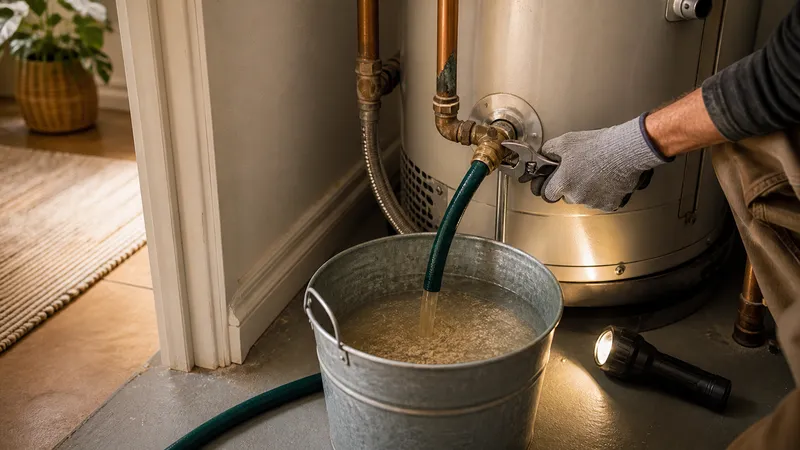
Learn how hard water changes flush frequency, when a blocked water heater drain needs a plumber, and why older tanks need extra care.
Key takeaways
- Hard water (121+ mg/L, about 7+ grains per gallon) means flushing every 6 months, not once a year.
- A drain valve that will not open or drain needs a plumber; do not force it, probe it, or pressurize it to clear a blockage.
- No flow at the drain can indicate a blockage or valve fault; stop and arrange a professional assessment.
- Rust-colored water that won't run clear can mean a depleted anode rod or a corroding tank, not just sediment.
- A tank that's never been flushed in 8+ years can be safer left alone than force-flushed—ask a plumber first.
Flushing a tank water heater once a year clears sediment before it insulates the heating element, clogs the drain valve, or shows up as a rumbling tank—every 6 months instead of once a year if your water is hard. The full 10-step procedure, anode rod inspection, and T&P valve test are already covered in detail in When to Service Your Water Heater—that’s the page to open for the actual steps. This page covers what goes wrong mid-flush, how often hard water changes the schedule, and the one case where flushing isn’t automatically the right move.
Hard water changes the flush schedule
Water hardness is measured in milligrams of calcium carbonate per liter (mg/L) or grains per gallon (gpg). The Maryland Geological Survey’s standard classification puts soft water at 0–60 mg/L, moderately hard at 61–120 mg/L, and hard water at 121 mg/L and above (about 7+ grains per gallon) (Maryland Geological Survey: Water Hardness). Above that line, dissolved minerals settle out of the tank fast enough that an annual flush leaves sediment time to build a real layer before the next service.
| Water hardness | mg/L | Grains per gallon | Flush frequency |
|---|---|---|---|
| Soft | 0–60 | 0–3.5 | Once a year |
| Moderately hard | 61–120 | 3.6–7.0 | Once a year; check for sediment at 9 months if unsure |
| Hard | 121–180 | 7.1–10.5 | Every 6 months |
| Very hard | Above 180 | Above 10.5 | Every 6 months, and inspect the drain valve each time |
If you don’t know your number, a municipal water report (often called a Consumer Confidence Report) usually lists hardness in mg/L, or a home test strip gives a rough grains-per-gallon reading. Rheem’s own service guidance for tank water heaters lands on the same split—annual for most households, every 6 months with hard water—for the same reason: more dissolved mineral means more sediment per gallon heated (Rheem: How Often to Flush Your Water Heater).
Mid-flush troubleshooting
A blocked drain is a reason to stop, not to force water through the tank. Rheem recommends professional help when a drain valve will not open or is leaking.
| Problem | Likely cause | What to do |
|---|---|---|
| Drain valve won’t open, or opens but nothing comes out | Possible sediment blockage or valve fault | Stop and call a qualified plumber. Do not force or probe the valve, or reopen the cold supply to clear it. The plumber can assess the blockage and whether the valve needs replacement |
| No pressure at the hose end mid-flush | Possible blockage in the drain, hose, or valve | Stop the flush and follow the model manual for a safe shutdown. Have a plumber assess the blockage; do not use a pressure burst to clear it |
| Water runs rust-colored and doesn’t clear after several minutes | Sediment discoloration is normal at first; rust that persists can mean the anode rod is fully consumed and the tank’s steel lining has started corroding | If color doesn’t clear, stop and check the anode rod (see anode rod replacement). A corroding tank isn’t fixed by a flush |
| Popping or rumbling that continues after a full flush | Sediment traps pockets of water against the heating element or burner; trapped water flashes to steam and the bubbles collapsing through the sediment crust make the popping sound | One flush doesn’t always break up sediment that’s hardened over multiple years. If the noise doesn’t improve within a flush or two, the layer may be too solid to clear with a garden-hose flush and is worth a professional look |
Plastic drain valves fail this way often enough that some plumbing guides recommend replacing the stock valve with a brass ball valve during the first flush that gives you trouble, specifically because the wider full-port opening resists clogging in a way the narrow factory valve doesn’t (Engineer Fix: Replacing a Water Heater Drain Valve).
Should you flush a tank that’s never been flushed?
Not automatically, and this is a genuine judgment call rather than a scare tactic. A tank that’s gone 8 or more years without a flush can develop a hardened sediment layer thick enough that it’s doing something unintentional: sealing small leaks or weak spots in the tank lining. Force a flush on that tank and you can dislodge the layer that was quietly containing a problem, exposing a leak that the sediment had been masking—or clogging the drain valve so badly the flush can’t finish anyway. Some plumbing companies advise leaving a long-neglected tank alone rather than flushing it once you’re past the point where sediment removal is routine maintenance, and instead watching for warning signs (rumbling, reduced hot water, rust-colored water) while planning for eventual replacement (Trident Plumbing: When Not to Flush Your Water Heater).
When to call a professional
| Situation | Why it is not DIY |
|---|---|
| Drain valve is seized or rounds off when you try to turn it | Forcing a stripped valve can crack the tank’s threaded fitting, turning a clog into a leak |
| Tank is 8+ years old and has never been flushed | A hardened sediment layer may be masking a leak; a plumber can assess before you flush |
| Rust-colored water doesn’t clear and the anode rod is fully consumed | The tank itself may be corroding—a flush and a new anode rod won’t reverse that |
| Popping or rumbling continues after two flush attempts | Sediment may be bonded to the tank wall or the heating element may be failing under the crust |
| Any water at the base of the tank during or after a flush | The source could be a fitting, valve, or tank leak; a plumber should identify it |
Related guides
Frequently asked questions
Why won’t the water heater drain valve open?
Sediment or a valve fault can stop the drain from opening or flowing. Stop and contact a qualified plumber. Do not force the handle, insert a wire, or add pressure to clear it; hot water can cause burns and a damaged valve can leak.
How often should you flush a water heater with hard water?
Every 6 months. Water at or above 121 mg/L of hardness (roughly 7 grains per gallon) builds sediment fast enough that an annual flush isn’t enough to keep it from insulating the heating element and clogging the drain valve.
Why is the water rust-colored after flushing a water heater?
Brief discoloration during a flush is normal sediment. Rust color that doesn’t clear after several minutes of flushing can mean the anode rod is fully consumed and the steel tank itself has started to corrode, which a flush cannot fix.
Should you flush a water heater that’s never been flushed in years?
Not automatically. Some plumbers advise against force-flushing a tank that’s gone 8+ years without service, because hardened sediment can be plugging small leaks in the tank lining—removing it can expose a leak instead of preventing one. A professional inspection before flushing is the safer call on a very old, neglected tank.