
Check the anode rod at year 3, then yearly—replace it when less than 1/2 inch of core wire is exposed. Inspection steps, rod types, and 2026 costs.
Key takeaways
- Replace the rod once less than 1/2 inch of core wire is exposed or it's shorter than 4 inches, per A.O. Smith's own service guidance.
- Inspect at year 3, then annually—every year from year one if you have a water softener, since softened water speeds up anode consumption.
- A rotten-egg smell points to a magnesium rod reacting with sulfate bacteria—switching to aluminum/zinc usually stops it, per A.O. Smith Bulletin 22.
- Factory rods are torqued tight: a 1-1/16 in. socket and breaker-bar leverage (or an impact wrench) are standard, not optional.
- DIY parts run about $20-50; professional replacement runs roughly $150-400 installed in 2026.
- Tankless water heaters have no tank and no anode rod—there's nothing to inspect on those units.
Check your tank water heater’s anode rod at year 3, then every year after that—every year from year one if you have a water softener. Replace the rod once less than half an inch of the steel core wire is exposed, or it’s shrunk to under 4 inches long, whichever comes first. This page is the anode rod deep dive: what it does, how to actually get it out, what a worn one looks like, which replacement material to buy, and what a 2026 replacement runs. For the rest of the annual tank routine—sediment flush, T&P valve test, thermostat check—see When to Service Your Water Heater.
What the anode rod actually does
Every tank water heater has a corrosion problem: steel tanks sit full of water and oxygen around the clock, which is exactly the recipe for rust. Manufacturers solve it with a sacrificial anode rod—a length of reactive metal (magnesium, aluminum, or an aluminum/zinc alloy) bolted into the top of the tank and submerged in the water.
A.O. Smith’s technical documentation on cathodic protection explains the mechanism in electrochemical terms: a low-resistance circuit forms inside the tank, and metals like magnesium and aluminum sit higher on the electromotive series than the tank’s steel, meaning they give up electrons more readily. That reactivity is put to use on purpose—the anode corrodes first, protecting the tank, “perhaps the severest form of corrosion in water heaters” otherwise (A.O. Smith Technical Bulletin 43: Cathodic Protection). In plain terms: the rod is designed to rust away so the tank doesn’t. Once the rod is consumed, the tank’s steel becomes the next-easiest target, and that’s the corrosion that eventually opens a pinhole leak at the bottom of the tank.
Inspection interval: 3 years, then annually—sooner with a softener
A.O. Smith’s own water heater maintenance guidance calls for checking the anode rod once a year, and recommends a first check no later than year 3 for a new unit (A.O. Smith: Water Heater Maintenance). The same guidance lists what actually speeds up anode consumption: water chemistry, how much hot water the household uses, and whether a water softener is installed. Softened water carries more dissolved sodium and fewer scale-forming minerals, both of which make the water more electrically conductive—which speeds up the galvanic reaction that consumes the rod. If your home runs on softened water, don’t wait for year 3; start annual inspections from year one.
How to inspect the rod
This is a strictly sequential job. Do the steps in order.
- Shut off power or gas. Electric: switch off the breaker feeding the water heater. Gas: turn the gas control to “pilot” or off per your model’s manual.
- Close the cold water supply valve at the top of the tank.
- Relieve pressure by opening a hot water tap elsewhere in the house, and consider opening the T&P valve’s test lever briefly to drop tank pressure before you loosen anything.
- Find the anode rod’s hex head, usually a bolt on top of the tank (sometimes under a plastic cap, sometimes combined with the hot-water outlet on a combo rod).
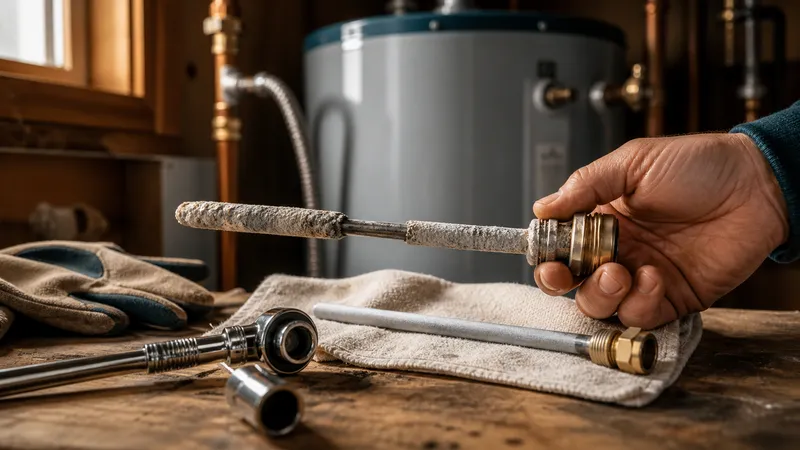
- Break it loose. A.O. Smith’s own guidance calls for an electric impact wrench with a 1-1/16 in. deep-well socket to remove the anode—factory-installed rods are torqued down tight enough that a wrench alone usually won’t move them (A.O. Smith: Water Heater Maintenance). Without an impact wrench, a breaker bar on the socket gives you the leverage a standard ratchet doesn’t.
- Pull the rod straight up. If ceiling clearance is too tight for the full length, pull up what you can, cut that section off, and repeat until the rod clears the opening.
- Inspect and reinstall or replace, then restore the cold supply, power or gas, and check for drips at the fitting.
What a worn rod looks like
| Condition | What it means | Action |
|---|---|---|
| Smooth, roughly 1/2 in. across its full length | Healthy—normal wear, coating intact | Reinstall, recheck next year |
| Several inches of exposed steel core wire | Rod material is consumed in that section | Replace |
| Knobby, pitted, or “beaded” surface | Uneven consumption, common in hard or softened water | Replace |
| Rod shorter than about 4 in. total | Most of the sacrificial metal is gone | Replace |
| No rod present, or only the core wire remains | No corrosion protection left—tank is next | Replace immediately |
A.O. Smith describes a good rod as “smooth and around a half inch in diameter,” and calls for replacement once it shows “signs of deterioration or has several inches of exposed core wire” (A.O. Smith: Water Heater Maintenance).
Choosing a replacement: rod material comparison
Not every replacement rod is the same material as the factory original, and the choice affects both corrosion protection and one specific odor problem.
| Rod type | Corrosion protection | Trade-off | Best for |
|---|---|---|---|
| Magnesium | Strongest protection; most common factory rod | Can react with sulfate-reducing bacteria to produce a rotten-egg (hydrogen sulfide) smell, especially in well water or softened water | Municipal water, no odor history |
| Aluminum | Cheaper, often lasts longer than magnesium | Some ingestion-related health debate around aluminum exposure (see below); somewhat weaker galvanic protection | Budget replacement, hard water |
| Aluminum/zinc alloy | Good protection, and the zinc component suppresses the bacterial reaction that causes odor | Slightly less corrosion protection than pure magnesium | Homes with an existing rotten-egg smell problem |
| Powered (electric) anode | No sacrificial metal consumed, so no odor reaction and no rod to replace on a schedule | Higher upfront cost; needs a power outlet near the tank | Well water, chronic odor issues, “install once” preference |
A.O. Smith’s technical bulletin on smelly water attributes the rotten-egg odor to sulfate-reducing bacteria that convert dissolved sulfate into hydrogen sulfide gas, using hydrogen generated by the cathodic reaction at the rod. The bulletin lists the conditions that let the bacteria thrive: elevated sulfur in the water, activated hydrogen from the tank’s cathodic reaction, low dissolved oxygen, and water below about 138°F—and specifically flags water softeners and well water as contributing factors (A.O. Smith Technical Bulletin 22: Smelly Water). Because it’s a water-chemistry reaction and not a rod defect, A.O. Smith notes this isn’t treated as a warranty issue.
On the aluminum health question: the EPA sets a secondary (taste/appearance, not health-based) guideline of 0.05–0.2 mg/L for aluminum in drinking water. The federal Agency for Toxic Substances and Disease Registry states that oral exposure to aluminum is “usually not harmful” for most people, with the real concern limited to people with kidney disease, who can’t clear absorbed aluminum normally (ATSDR ToxFAQs for Aluminum). For most households this is a minor factor next to cost and odor performance—but it’s worth knowing before picking a rod on price alone.
For a no-sacrificial-metal option, A.O. Smith sells a “Product Preservers Powered Anode System” aimed at hard-water areas, and notes that conventional sacrificial anodes can form an aluminum hydroxide gel that reduces heater efficiency where water hardness is high (A.O. Smith: Water Quality Impact).
2026 cost: DIY vs. professional
| Job | DIY cost | Professional cost (2026) | Notes |
|---|---|---|---|
| Replacement rod (magnesium or aluminum) | $20-50 for the part | — | Combo rods (built into the hot outlet nipple) cost more but fit low-clearance closets |
| Powered anode system | $100-200 for the part | Installation typically adds a service call | No ongoing rod replacement afterward |
| Full anode rod replacement, installed | — | $150-400 installed, per Angi’s national cost data | Higher end if the rod is seized and needs extraction |
Sources: Angi cost data on water heater repairs for the professional range; retail rod pricing checked at major hardware and plumbing-supply retailers. National figures vary by region, access, and whether the technician finds a seized rod that needs extraction rather than a straightforward swap.
When to call a professional
| Situation | Why it is not DIY |
|---|---|
| Rod won’t turn even with an impact wrench and breaker bar | Forcing it risks shearing the fitting or cracking the tank’s top plate |
| Rod has fused or corroded into the tank threads | Requires extraction technique and often a new fitting, not more torque |
| No accessible clearance above the tank for a full-length rod | A flexible/segmented rod or a plumber’s tools may be needed |
| Water at the base of the tank or active leak | Tank failure is likely; this is a replacement decision, not a rod fix |
| Gas smell, pilot issues, or anything involving the gas line | Combustion and CO safety—leave gas work to a licensed technician |
| Uncertain whether a rod change affects an active warranty | A quick call to the manufacturer or installer avoids voiding coverage |
A visual check, a photo of the rod, and a booked appointment are a reasonable next step—that’s not a failure to do it yourself.
Related guides
Frequently asked questions
How often should you replace a water heater anode rod?
Inspect it at year 3, then every year after that, per A.O. Smith’s service guidance. Replace it whenever less than 1/2 inch of the steel core wire is exposed or the rod is under 4 inches long, regardless of how many years it’s been. Water softeners speed this up, so start annual checks from year one if you have one installed.
What does a bad anode rod look like?
A healthy rod is smooth and roughly 1/2 inch across its full length. A worn rod shows the thin steel core wire exposed along several inches, has a knobby or pitted surface with the coating eaten away in patches, or has shrunk to less than 4 inches long. Any of those is a replace-it sign.
Why does my water heater smell like rotten eggs?
That smell is usually hydrogen sulfide gas produced by sulfate-reducing bacteria reacting with the hydrogen released at a magnesium anode rod—more common with well water, softened water, or water left standing in the tank, according to A.O. Smith’s technical bulletin on the issue. Swapping the magnesium rod for an aluminum/zinc rod usually resolves it without chlorinating the whole system.
Can you replace an anode rod yourself?
Yes, if it turns. Shut off power or gas and the cold supply, relieve pressure, and break the rod loose with a 1-1/16 in. deep socket and breaker-bar leverage or an impact wrench. If it won’t budge even with an impact wrench, stop—forcing it risks cracking the tank’s threaded fitting, and that’s a job for a plumber.
Do all water heaters have an anode rod?
Tank water heaters do; tankless units don’t. Tankless models heat water on demand through a heat exchanger with no standing tank to protect from corrosion, so there’s no anode rod to inspect or replace on those units.