
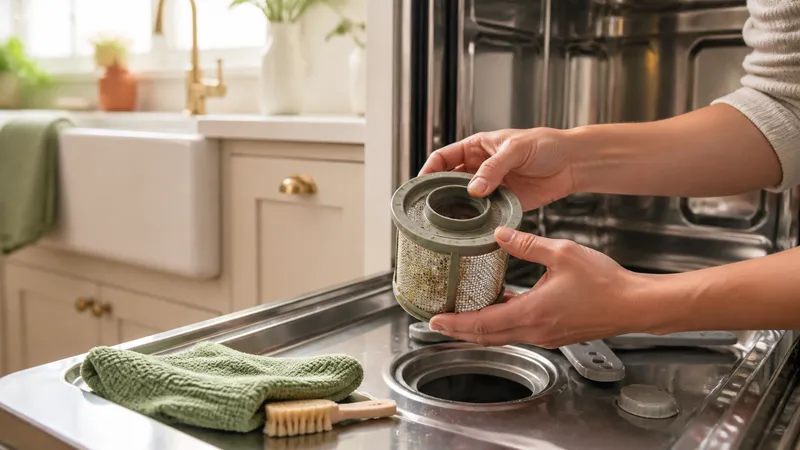
Clean a dishwasher filter about once a month: how to twist it out, rinse it, and spot the cloudy-glass signs that mean it's overdue.
Key takeaways
- Clean the filter about once a month; Whirlpool tells hard-water households (15+ grains) to do it at least monthly.
- GE recommends every other month or more, and immediately if dishes turn gritty or wash performance drops.
- Most filters twist a quarter turn counterclockwise to unlock, then lift straight out for rinsing.
- Cloudy glasses, food film, standing water at the bottom, and odor all mean the filter is overdue now, not on schedule.
- Never run dishwasher detergent on a filter outside the machine. Rinse it under hot water and use dish soap only if needed.
- A clogged filter, not a weak dishwasher, is the most common reason wash performance quietly declines.
Clean a dishwasher filter about once a month for most households—more often with heavy use, hard water, or if you scrape but don’t rinse dishes before loading. Whirlpool’s own product support tells households with hard water (15 grains or higher) to clean it at least once a month, and GE’s support guide puts the interval at every other month or more depending on usage. Your model’s manual wins over any general number. The dishwasher maintenance guide covers the whole appliance; this page is the filter deep dive it points to.
Finding and removing the filter
Open the dishwasher, pull out the lower rack, and look at the bottom of the tub, usually toward the back or center, below where the lower spray arm sits. You’re looking for a round or oval plastic assembly with a twist-lock handle, sometimes with a coarse mesh cylinder sticking up from the middle.
Most residential filters are a two-piece “upper and lower” assembly:
- Upper (fine/ultra-fine) filter — turn it about a quarter turn counterclockwise to unlock, then lift straight up and out. GE’s instructions describe twisting the ultra-fine filter counterclockwise and lifting it out, then twisting two retaining posts to free the fine filter underneath it.
- Lower (coarse) filter or screen — on many models this isn’t locked at all; it lifts straight out once the upper piece is gone. Whirlpool’s guide notes the lower filter “is not held in place by any locking mechanism.”
If it doesn’t twist and lift easily, stop and check the manual—forcing a filter that locks a different way can crack the plastic tabs.
Cleaning steps
- Rinse under hot running water. Hold the filter under the tap and let water flush through the mesh from the side facing away from normal flow, so trapped debris washes out rather than further in.
- Brush off stuck-on food. A soft brush, old toothbrush, or non-abrasive sponge handles baked-on residue. Both Whirlpool and GE specifically warn against wire brushes or scouring pads, which can scratch or tear the mesh.
- Soak occasionally for grease or hard-water film. A short soak in warm water with a little dish soap loosens grease and mineral buildup. Rinse thoroughly afterward so no soap residue is left in the mesh.
- Never use dishwasher detergent on it outside the machine. Dishwasher detergent is formulated to work in a closed, heated, rinsed cycle—not as a hand-cleaning agent. Using it directly on a filter in the sink can leave a residue or damage the mesh coating.
- Reinstall and lock it. Twist clockwise until it clicks or seats fully. Whirlpool warns that running the dishwasher with the filter improperly installed can damage the machine.
| Sign | What it usually means |
|---|---|
| Glasses come out cloudy or filmy | Recirculating dirty water instead of draining clean |
| Gritty residue or food specks on “clean” dishes | Filter is full and redistributing particles onto dishes—GE lists this as a direct cue to clean the filter |
| Standing water pooled at the bottom after a cycle | Filter or drain path is blocked; check the filter before assuming a pump problem |
| Musty or sour odor when you open the door | Trapped food is decomposing in the filter basket |
Why this is the usual fix for “my dishwasher doesn’t clean well anymore”
A dishwasher that suddenly leaves grit, film, or a smell almost always still has a working motor and pump. The far more common cause is a filter that’s been quietly filling up for months. Since the filter traps food during every cycle by design, skipping the monthly rinse doesn’t damage the machine right away—it just means dirtier water gets pushed back over the dishes on the next load. Cleaning the filter is usually the first thing to check before assuming you need a repair call or a new dishwasher.
Related guides
Frequently asked questions
How often should I clean my dishwasher filter?
About once a month for most households. Whirlpool recommends at least monthly for hard water (15 grains or higher), and GE recommends every other month or more depending on usage—clean it sooner if dishes come out gritty or water pools at the bottom.
Why does my dishwasher leave food residue or cloudy glasses even though it runs fine?
A clogged filter is the most common cause. It traps food during the cycle, and once it’s full, dirty water recirculates onto dishes instead of draining, leaving film, spots, and grit.
Can I clean the dishwasher filter with dish soap or dishwasher detergent?
Rinse it under hot running water first, and use a soft brush on stuck-on food. An occasional soak in warm water with a little dish soap is fine. Do not use dishwasher detergent on the filter outside the machine—it’s formulated for a closed, rinsed wash cycle, not hand cleaning.
Does my dishwasher even have a removable filter?
Most dishwashers made since roughly the mid-2010s do. Check under the lower spray arm for a round or oval cap with a twist-lock handle. Some older or high-end models still use a hard-food disposer with no manual filter—your owner’s manual will confirm which one you have.