
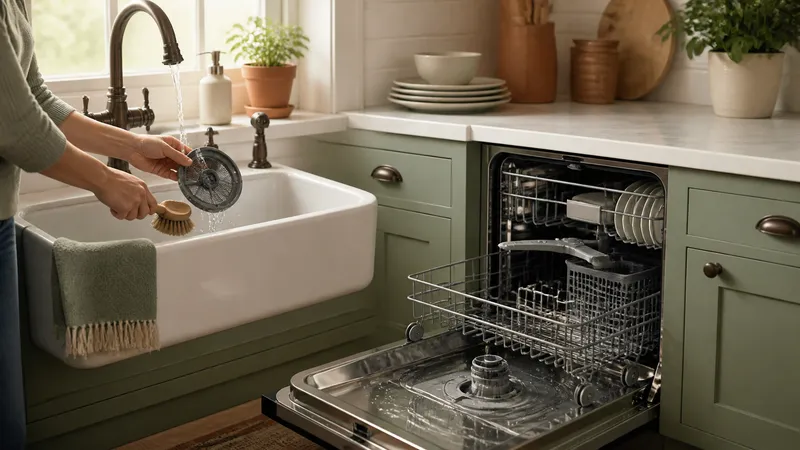
Dishwasher maintenance in one page: filter cleaning cadence, clearing clogged spray arms, monthly cleaning cycles, gasket care, and hard water fixes.
Key takeaways
- Rinse the removable filter about once a month; every two weeks for large families or daily use.
- Clear spray arm holes with a toothpick and a vinegar soak when dishes come out spotty or gritty.
- Run an empty hot cycle with a dishwasher cleaner or vinegar about once a month to cut grease film.
- Wipe the door gasket with a damp cloth regularly; leave the door cracked open to prevent mildew.
- Hard water needs rinse aid and a higher dose setting, or spotting and mineral buildup keep coming back.
- Confirm your air gap or high loop before hooking a new dishwasher to a garbage disposal.
Dishwasher maintenance comes down to four repeating jobs: rinse the filter, keep the spray arm holes clear, run an empty cleaning cycle, and wipe the door gasket. Do those on a schedule and most spotty-dish, bad-smell, and slow-drain complaints go away before they become a service call. This page is the master list for the dishwasher hub. If your filter is already gunked up or you want the full step-by-step, the dishwasher filter cleaning guide takes that one job deeper.
Dishwasher maintenance schedule at a glance
| Task | Cadence | DIY or pro | Source or rule of thumb |
|---|---|---|---|
| Rinse the removable filter | Monthly; every 2 weeks for heavy use | DIY | Whirlpool product support: clean the filter once a month, more often for large families or daily runs |
| Check and clear spray arm holes | As needed, or whenever dishes come out spotty | DIY | Manufacturer guidance and repair documentation for Whirlpool and GE dishwashers describe clearing blocked holes with a toothpick or thin wire and a vinegar soak |
| Run an empty hot cycle with cleaner or vinegar | About once a month | DIY | affresh (Whirlpool): use a dishwasher cleaner monthly for best results |
| Wipe the door gasket | Every few weeks, or when you smell mildew | DIY | GE Appliances support: wipe the gasket and leave the door cracked to air out |
| Check rinse aid level | Every load, refill when low | DIY | Whirlpool rinse aid FAQ: rinse aid reduces spotting and helps drying every cycle |
| Confirm air gap or high loop is clear | Once, then re-check after a disposal jam or drain backup | DIY inspect; plumber for a new install | Local plumbing code commonly requires an air gap or high loop to stop backflow from the sink drain |
The appliance maintenance hub has the same rhythm for other kitchen equipment if you’re setting up a whole-house schedule.
Filter cleaning: keep it brief, check it monthly
Most dishwashers built in the last 10–15 years use a manual filter that has to be pulled and rinsed by hand instead of a self-cleaning grinder. Whirlpool’s own product support says to clean it once a month as a general rule, sooner if you run the dishwasher daily or have a large household. A dirty filter is the single most common reason dishes come out with a gritty film even after a full cycle. The dishwasher filter cleaning guide has the full removal walkthrough for twist-lock and screw-in styles—this page keeps it to the cadence.
Clearing clogged spray arms
The spray arms are the plastic bars that spin under water pressure and throw water at the dishes. Each has a row of small holes, and hard water minerals or trapped food scraps block them one at a time until coverage gets patchy—clean glasses on one side of the rack, film on the other.
- Pop the arm off its post (most snap or unscrew by hand).
- Soak it 10–15 minutes in warm water and vinegar to loosen mineral deposits.
- Clear each hole with a toothpick or a straightened paper clip, pushing from the inside outward so debris doesn’t pack in deeper.
- Rinse under running water and hold it to the light to confirm every hole is open.
- Snap it back on and spin it by hand to confirm it still turns freely.
Still spotty after a clean filter and clear spray arms? Hard water and rinse aid are next—covered below.
The monthly empty cycle
Running the dishwasher empty on its hottest cycle with a dishwasher-safe cleaner or plain white vinegar cuts through grease film and mineral scale that normal loads with dishes in the way don’t fully reach. Whirlpool’s affresh brand recommends using a dishwasher cleaner monthly for best results as a recurring habit, not a one-time deep clean. Check your manual before swapping vinegar for a commercial cleaner tablet—some manufacturers caution against vinegar with certain interior finishes or rubber parts, and the manual is the tie-breaker.
Door gasket and mold or mildew prevention
The rubber gasket that seals the door traps moisture after every cycle, which is exactly the environment mold and mildew need. GE Appliances’ support documentation notes that mildew risk depends on frequency of use, kitchen humidity, and how consistently the dishwasher is cleaned, and recommends wiping the gasket down and letting the door air out. The EPA’s mold guidance backs the same principle: mold needs moisture, and drying a wet surface within 24–48 hours keeps it from taking hold.
Wipe the gasket with a damp cloth every few weeks and leave the door cracked open after a cycle instead of latching it shut on trapped humidity. Visible tears or a flattened gasket, rather than surface grime, mean a part replacement, not a cleaning.
Rinse aid and hard water
Rinse aid isn’t optional in hard water areas. It reduces the surface tension of the final rinse water so it sheets off dishes instead of drying into spots, and Whirlpool’s own FAQ page says not to skip it if you have hard water. If spotting or a chalky film persists with the reservoir full, turn the rinse aid dial up a notch—most dishwashers have a low-to-high adjustment built into the dispenser cap specifically for water hardness.
| Symptom | Likely cause | First fix |
|---|---|---|
| Cloudy film on glasses | Hard water minerals | Increase rinse aid dose; confirm detergent isn’t expired |
| Dishes not drying | Empty or low rinse aid | Refill reservoir; check dispenser cap seats fully |
| Gritty residue on plates | Clogged filter | Rinse filter now, then return to the monthly cadence |
| Patchy clean, one rack worse | Blocked spray arm | Soak and clear holes as above |
Garbage disposal, air gap, and high loop
If your dishwasher drains through the kitchen sink’s garbage disposal, most local plumbing codes require a backflow-prevention step so dirty sink water can’t siphon back in. That’s either a small air gap cylinder near the faucet, or a high loop—the drain hose routed up under the countertop before it drops to the disposal. Check that whichever one your kitchen has is clear of buildup, especially after a disposal jam or a slow-draining sink. Installing a new dishwasher without either one is a plumber question, not a DIY retrofit around code.
When to call a professional
| Situation | Why it is not DIY |
|---|---|
| Water pooling under the dishwasher or on the kitchen floor | Could be a supply line, drain, or door seal failure—needs diagnosis before it damages flooring |
| Dishwasher won’t drain even after the filter and air gap are clear | Likely a pump, drain hose clog past the trap, or disposal knockout plug left in place |
| Burning smell, tripped breaker, or a dishwasher that won’t power on | Electrical fault; do not keep resetting the breaker |
| Persistent leak at the door despite a clean, intact gasket | May need a gasket replacement or a door-latch adjustment |
| New dishwasher install without an existing air gap or high loop | Plumbing code compliance and correct drain routing |
Related guides
Frequently asked questions
Why does my dishwasher smell musty?
A musty smell is usually mold or mildew growing on the door gasket or in standing water at the bottom of the tub. Wipe the rubber gasket after cycles, run the monthly empty hot-water cleaning cycle, and leave the door cracked open between loads so the interior can dry instead of staying damp.
Why are my dishes coming out spotty or not fully clean?
A clogged spray arm is one of the most common causes. Food particles and mineral buildup block the small holes so water can’t reach every dish. Pull the arm, soak it in vinegar, and clear each hole with a toothpick or thin wire.
How often should I run an empty cleaning cycle in my dishwasher?
About once a month is the common manufacturer guidance—Whirlpool’s affresh brand recommends monthly use of a dishwasher cleaner on an empty hot cycle to remove grease and mineral film that everyday washing misses.
Do I need an air gap or high loop if my dishwasher drains through the garbage disposal?
Most local plumbing codes require an air gap or a high loop on the dishwasher drain line so dirty sink or disposal water can’t siphon back into the dishwasher. Check under the sink for a small cylinder near the faucet (the air gap) or a drain hose looped up under the counter (the high loop), and keep it clear of debris.
Can I use vinegar in my dishwasher?
Plain white vinegar in an empty hot cycle is a common homeowner method for cutting grease and mineral film, but check your manual first—some manufacturers warn against vinegar with certain rubber gaskets or stainless interiors and recommend a purpose-made dishwasher cleaner instead.