
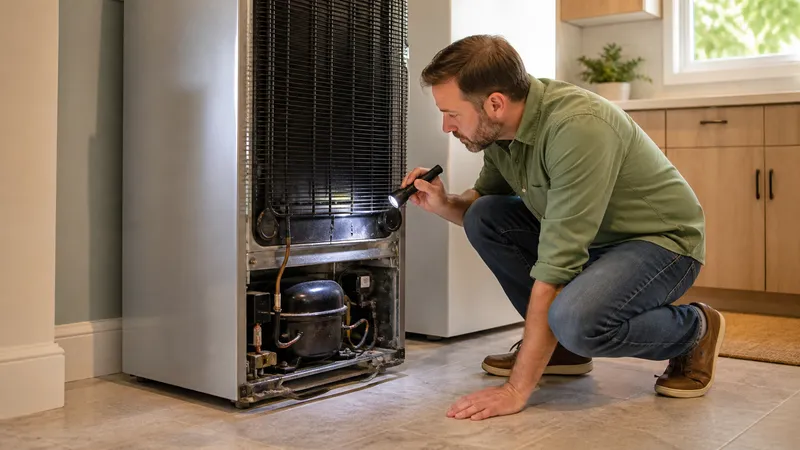
How long a refrigerator lasts, the real signs it's dying (frost, condensation, warm spots), and when a compressor repair costs more than a new fridge.
Key takeaways
- ENERGY STAR's own savings math assumes a 12-year refrigerator lifespan, and flags units over 15 years old as notably more expensive to run.
- Compressor failure is the most common way a fridge dies early, and replacing one often costs $500–$1,000—close to a new unit.
- A full sealed-system repair runs about $800–$1,200; if that's over half the price of a new mid-range fridge, replace it.
- Dirty condenser coils make the compressor work harder for years before it fails—clean them every 6–12 months to protect it.
- Frost beyond the icemaker area, warm cabinet sides, and a compressor that never shuts off are the three signs to act on now.
- A failing door seal lets in warm, humid air; ignored long enough, that moisture turns into cabinet mold, not just a warm fridge.
Most refrigerators last 10 to 20 years, and the honest answer depends more on which failure hits first than on a birthday. ENERGY STAR’s own energy-savings math assumes a 12-year product lifetime, and the program flags refrigerators over 15 years old as costing noticeably more to run. This is the lifespan and dying-signs deep dive for the refrigerator hub—for the recurring care schedule, see the maintenance schedule; for how fridges compare to other appliances, see the appliance lifespan guide.
What actually kills a refrigerator early
Three failures account for most refrigerators that die well before 15–20 years:
Compressor failure is the single most common cause. The compressor is the sealed-system component that circulates refrigerant, and it’s a wear item—motors run for years, then seize, short, or lose the ability to build pressure. Because it sits inside a sealed, brazed system, “repairing” it means a licensed technician cutting the system open, swapping the compressor, and recharging refrigerant—not a bolt-on part. That’s why compressor work is rarely cheap and rarely quick.
Door seal (gasket) failure rarely kills a fridge directly, but ignored long enough it contributes to one. A worn gasket lets warm, humid air leak in continuously; the compressor runs longer to compensate, and persistent condensation around the door frame or drain area can turn into mold if it sits unaddressed for weeks or months. The dollar-bill test and gasket steps live in the maintenance schedule—here, the point is that an ignored seal adds real, ongoing strain to the compressor.
Dirty condenser coils are the quiet, cumulative killer. Dust-insulated coils can’t shed heat, so the compressor runs longer and harder to hit the same temperature—stress that compounds over months and years. Whirlpool’s product guidance and the DOE-backed Building America Solution Center at Pacific Northwest National Laboratory both tie coil cleaning directly to compressor performance and lifespan. It’s the one prevention lever a homeowner fully controls—see how and when to clean them for the interval and steps.
Signs your refrigerator is dying
| Sign | Severity | What it usually means |
|---|---|---|
| Frost buildup in the freezer beyond the icemaker area | Watch closely | Door seal leak, blocked vent, or a failing defrost cycle |
| Condensation forming on the outside of the cabinet | Watch closely | Seal failure or a struggling compressor losing the temperature gap |
| Compressor runs constantly or louder than it used to | Act soon | Compressor or coils working overtime to hold temperature |
| Food spoiling faster than it used to | Act soon | Fridge is running warmer than the 40°F line even if the display looks normal |
| Warm spots inside the compartment | Replace or repair now | Airflow blockage, failing fan, or a compressor losing capacity |
| Motor cycles on and off rapidly, trips a breaker, or smells hot | Stop and call a tech | Electrical or motor fault—not a DIY fix |
One sign alone can be a fixable nuisance. Two or more together, especially on an older unit, is when the repair-or-replace math below actually matters.
Repair or replace: the cost math
| Repair | Typical 2026 cost | Compared to a new mid-range fridge | Source |
|---|---|---|---|
| Compressor replacement | $500–$1,000 | Often 40–60%+ of a new unit’s price | Fixr, updated Aug. 2025 |
| Full sealed-system repair | $800–$1,200 | The single most expensive repair category | Fixr |
| General repair (non-sealed-system) | $350–$500 | Usually the clearer repair case | Fixr |
| New mid-range refrigerator | $1,000–$3,000 | — | Fixr |
The rule of thumb: don’t spend more than half the price of a comparable new refrigerator on a repair. A $900 compressor job on a fridge that would cost $1,500 to replace is a coin flip once you add the risk of another failure soon after. Local labor and refrigerant cost push these numbers around—get a written quote, and ask whether it covers the compressor alone or the full sealed system.
What an aging fridge costs you in electricity
Repair cost isn’t the only number. ENERGY STAR estimates an old refrigerator uses about 20% more energy on average than a current certified model, and that a unit over 15 years old can cost roughly $95 more per year to run. Certified models are also about 9% more efficient than the federal minimum, and ENERGY STAR’s math shows about $150 in savings over a 12-year lifetime from upgrading. That won’t cover a $900 compressor repair alone, but it belongs on the replace side of the ledger for a fridge that’s already old and already showing symptoms.
When to call a professional
| Situation | Why it is not DIY |
|---|---|
| Fridge won’t hold temperature after coils, seals, and clearance are all checked | Likely compressor, sealed refrigerant, or thermostat failure |
| Refrigerant smell, hissing, or oily residue near the back panel | Sealed-system leak; requires EPA-certified refrigerant handling |
| Compressor cycles constantly, trips a breaker, or smells hot | Electrical or motor fault |
| You’re deciding between a $600+ repair quote and a new fridge | Get the quote in writing and compare it against this page’s cost table before approving |
Related guides
Frequently asked questions
How long does a refrigerator last?
Roughly 10 to 20 years depending on type and use. ENERGY STAR’s own savings math assumes a 12-year product lifetime and flags units over 15 years old as costing noticeably more to run—useful anchor points when a single fridge’s age matters more than a national average.
What is the most common reason refrigerators fail early?
Compressor failure. The compressor is the sealed-system component that moves refrigerant, and once it fails, repair means opening the sealed system rather than a simple part swap—which is why replacement is often the more practical outcome.
Is it worth repairing a refrigerator compressor?
Rarely, on cost alone. Compressor replacement commonly runs $500–$1,000, and a full sealed-system repair runs about $800–$1,200—often 40% to 60%+ of a new mid-range refrigerator’s price. If repair tops half the cost of a comparable new unit, replace instead.
What are the signs a refrigerator is dying?
Frost buildup beyond the icemaker area, condensation on the outside of the cabinet, a compressor running constantly or loudly, food spoiling faster than before, and warm spots inside the compartment. One sign alone may be minor; two or more together point to a bigger problem.
Does an old refrigerator use more electricity than a new one?
Yes. ENERGY STAR estimates an old refrigerator uses about 20% more energy on average than a current certified model, and that a unit over 15 years old can cost roughly $95 more per year to run—worth weighing alongside repair cost on an aging fridge.