
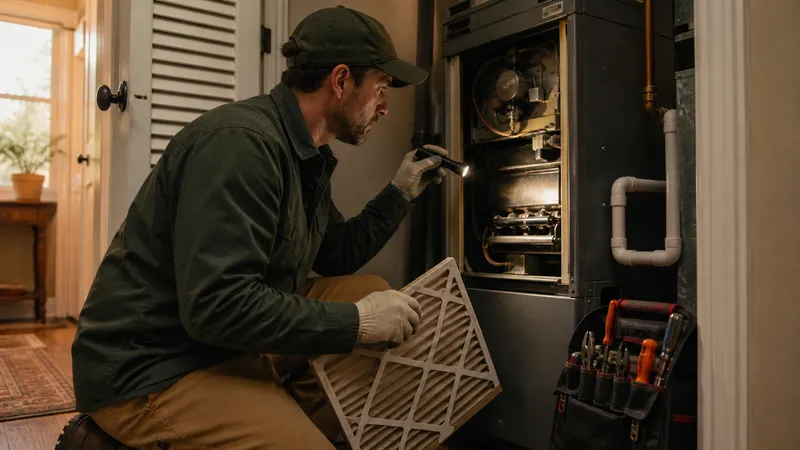
What a professional furnace tune-up inspects, homeowner-safe pre-checks, warning signs that need service now, and 2026 tune-up cost ranges.
Key takeaways
- A blue furnace flame is normal. Yellow, orange, or flickering means incomplete combustion—stop and book service.
- A cracked heat exchanger is the top furnace CO risk. It requires a combustion analyzer, not a homeowner check.
- CPSC recommends a yearly professional inspection of the furnace, its safety switches, and the chimney or flue.
- A standard furnace tune-up runs about $80–$200 in 2026; high-efficiency and oil units run higher due to extra components.
- High-efficiency condensing furnaces need a condensate line check—clogs can shut the unit down mid-winter.
- Call now (not at the scheduled visit) for a gas smell, soot, a yellow flame, or a CO alarm—these are not wait-and-see.
The fall checklist covers the whole house before winter; this page is the furnace-only deep dive it points to. If you searched “furnace maintenance before winter,” here is the direct answer: get a professional tune-up booked in September, do four homeowner-safe checks yourself (flame color, unusual sounds, filter, condensate line on high-efficiency units), and know which symptoms mean call today instead of waiting for the appointment.
Furnace type: what each needs
| Furnace type | What’s different | Fall priority |
|---|---|---|
| Standard gas (80% AFUE, single-stage) | Simplest combustion path; metal flue vents hot exhaust | Burner cleaning, heat exchanger check, flue draft test |
| High-efficiency condensing gas (90%+ AFUE) | Second heat exchanger extracts more heat; produces acidic condensate that must drain | Condensate line and trap check in addition to standard items |
| Oil | Burner nozzle, oil filter, and ignition electrodes wear faster; soot buildup is common | Nozzle replacement, oil filter change, and chimney/flue cleaning most years |
| Electric (resistance or heat pump) | No combustion, no CO risk from the heating element itself | Coil cleaning, electrical connections, and (heat pump) refrigerant-side service |
What a professional tune-up actually inspects
This is the work a licensed technician does that a homeowner cannot safely replicate—it needs a combustion analyzer, a manometer for gas pressure, and access to the sealed burner compartment.
- Heat exchanger crack check. The heat exchanger separates combustion gases from the air moving through your ducts. A crack lets carbon monoxide leak into that airstream. Technicians look for cracks (often starting at the top, near the burner) using a camera or combustion analyzer, since small cracks are invisible to the eye. The CPSC recommends a yearly professional inspection of the furnace or boiler, its electrical and mechanical components, and its safety switches, specifically to catch this before it becomes a CO hazard.
- Burner cleaning. Dust and combustion residue on the burner ports cause uneven flame and incomplete combustion—the direct cause of a yellow or orange flame instead of blue.
- Ignition system test. Hot surface igniters and electronic ignition modules degrade over years of cycling. A tech tests for reliable, consistent light-off rather than delayed ignition (which can cause a small “bang” at startup).
- Blower motor and belt. The blower moves heated air through your ducts. A tech checks belt tension and wear on older belt-drive blowers, lubricates bearings if the motor has oil ports, and listens for bearing whine that predicts failure.
- Flue and venting draft test. Exhaust gases need to draft upward and out, not spill back into the house. A draft test with a manometer confirms the flue is pulling correctly, especially after any change to nearby exhaust fans, a new water heater, or added insulation that tightened the house envelope.
- Safety switch verification. The limit switch (shuts off burners if the furnace overheats), the flame sensor (shuts off gas if no flame is detected), and the pressure switch (confirms the draft inducer is running before gas flows) are all tested, not just visually inspected.
- Thermostat calibration. A tech confirms the thermostat’s set temperature matches actual supply air temperature and that heat-mode cycling isn’t short or long relative to the equipment’s rated output.
Homeowner-safe pre-checks
These don’t require opening the sealed burner compartment. Do them before the first cold snap, whether or not the professional visit has happened yet.
Flame color (gas furnaces). Look through the sight glass or viewing port, never by removing a panel. A healthy flame is steady blue, sometimes with a small blue tip, with each burner port lit evenly. Yellow, orange, or flickering flame means the fuel isn’t burning completely—call for service before running the furnace further. Do not attempt to adjust the burner yourself.
Unusual sounds. A furnace that’s been idle since spring will run through a few dusty-smell minutes on first startup—that’s normal. Not normal: grinding or squealing (worn blower bearing or belt), a loud bang at ignition (delayed ignition—gas building up before lighting), or rattling that wasn’t there last winter (loose panel or failing component). Any of the last three warrants a call before you run the system regularly.
Filter sizing and MERV rating. Check the size printed on the filter’s cardboard frame—it must match exactly; there is no “close enough.” For the rating, ENERGY STAR-qualified filtration calls for MERV 6 or higher, while EPA’s Indoor AirPlus and DOE’s Zero Energy Ready Home programs specify MERV 8 or higher for better particle capture. Going much higher than your system was designed for is not automatically better: the Building America Solution Center notes that excessive pressure drop from an overly restrictive filter can overheat the furnace and burn out blower motors. If you want a higher MERV than MERV 8–10, confirm your furnace’s static pressure rating first or ask your technician.
Condensate line (high-efficiency condensing furnaces only). These units produce acidic condensate—up to several gallons a day at peak heating—that drains through a plastic line to a floor drain, pump, or outside. Before the season starts, look for standing water in the drain pan, confirm the line drains when the furnace runs, and pour a cup of distilled white vinegar down the line to clear early algae growth. A clogged line is a common cause of a high-efficiency furnace shutting itself down mid-winter, since most models have a safety switch that stops the burner if condensate can’t drain.
| Pre-check | What you’re looking for | Stop if |
|---|---|---|
| Flame color | Steady blue at each burner port | Yellow, orange, or flickering—call for service |
| Startup sound | Brief dusty smell, then quiet operation | Grinding, squealing, banging, or new rattling |
| Filter | Correct size, MERV 6–13 depending on system | Filter is packed with dust or visibly bowed |
| Condensate line (high-efficiency) | Drains freely when furnace runs | Water pooling in the drain pan or around the unit |
Signs your furnace needs service now, not at the scheduled visit
| Symptom | Can wait for scheduled tune-up | Call today |
|---|---|---|
| Dusty smell on first fall startup | Yes | — |
| Slightly uneven heat between rooms | Yes | — |
| Yellow, orange, or flickering flame | — | Yes |
| Gas odor near the furnace | — | Yes—leave the house, call from outside, then the gas utility |
| CO alarm sounding | — | Yes—leave and call 911 first |
| Soot on the furnace cabinet or nearby surfaces | — | Yes |
| Furnace short-cycles (on/off repeatedly) | — | Yes |
| Grinding, squealing, or banging at startup | — | Yes |
Furnace tune-up cost in 2026
Public cost estimators put a standard gas furnace tune-up at $80–$200 per visit, with a basic filter-and-visual-inspection tier around $70–$90 and a fuller cleaning-and-testing tier at $130–$180, according to HomeGuide’s 2026 furnace inspection cost data and Angi’s furnace inspection cost guide. High-efficiency condensing furnaces and oil furnaces typically run higher—often $150–$300—because of the added condensate system or the oil nozzle, filter, and electrode replacement most oil furnaces need each year. These are national ranges; your quote depends on region, whether parts are needed, and if the visit is bundled with A/C service. A no-heat emergency call in January costs more than a scheduled September visit, both in labor rate and in the wait for an open slot.
When to call a professional
| Situation | Why it is not DIY |
|---|---|
| Heat exchanger inspection | Requires a combustion analyzer; cracks are often invisible to the eye |
| Gas smell or soot near the unit | Combustion or leak hazard—leave and call before troubleshooting |
| CO alarm sounding | Emergency: leave the house and call 911 before calling a technician |
| Yellow, orange, or flickering flame | Signals incomplete combustion and rising CO risk |
| Burner adjustment or ignition repair | Requires access to the sealed combustion chamber and gas pressure tools |
| Condensate line clog that returns after cleaning | May indicate a failed trap or pump, not just biological buildup |
| Blower motor bearing noise | Motor replacement is an electrical and mechanical job, not a lubrication fix |
Related guides
Frequently asked questions
What does a professional furnace tune-up actually check?
A technician inspects the heat exchanger for cracks, tests the ignition and safety switches, cleans the burners, checks blower motor and belt condition, measures flue draft, and calibrates the thermostat—work that requires a combustion analyzer and tools a homeowner does not have.
What color should a furnace flame be?
Blue, with the burner ports evenly lit. A yellow, orange, or flickering flame signals incomplete combustion, which produces more carbon monoxide, and warrants a service call before you rely on the furnace again.
How much does furnace maintenance cost in 2026?
A standard gas furnace tune-up typically runs $80–$200. High-efficiency condensing and oil furnaces often run higher because of extra components like the condensate system or oil nozzle and filter—expect $150–$300 in many markets.
How do I know if my furnace needs service now instead of at the scheduled fall visit?
Book immediately for a gas odor, a yellow or flickering flame, soot around the unit, a sounding CO alarm, short-cycling, or burning smells that don’t clear after a filter change. Routine noise or dust after summer storage can usually wait for the scheduled visit.