
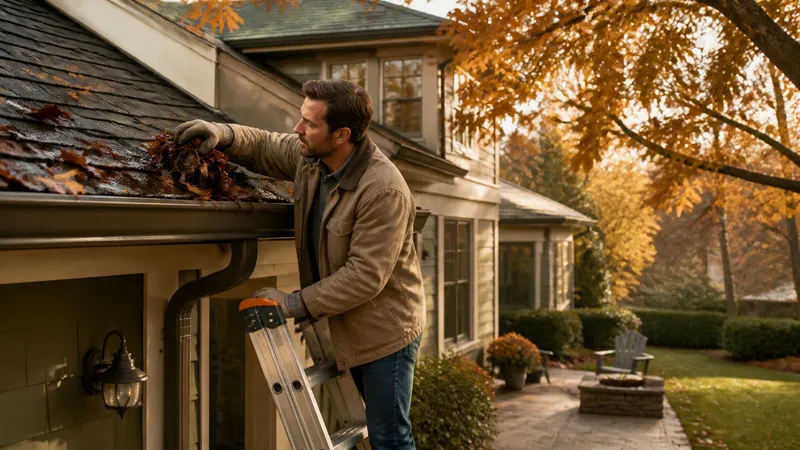
30 fall maintenance tasks to complete before the first freeze: furnace service, gutters, weatherstripping, pipe protection, and what pros handle.
Key takeaways
- Book furnace service in September. Heating techs are fully booked by mid-October in freeze-belt states.
- Disconnect and drain garden hoses before the first freeze. A connected hose traps water in the frost-free bib and can split the pipe inside the wall.
- Clean gutters after the last leaves fall—not before. One windstorm after you clean them means doing it again.
- Test smoke and CO alarms. Fall is when fuel-burning equipment turns back on; CO risk rises with the heat.
- Replace smoke alarms 10 years from manufacture, CO detectors per their label (typically 5–7 years).
- Stop for gas appliances you cannot relight from the manual, concealed dryer vents, and any roof you cannot safely reach.
Fall home maintenance is the most consequential maintenance season in cold climates. Heat, combustion, frozen pipes, and ice damage arrive together. This checklist has 30 distinct tasks to complete before the first hard freeze—organized from the jobs that need the longest lead time (furnace service) to the last-minute pipe-and-weather tasks you can finish the week before a freeze forecast. The spring checklist handles the thaw. This page handles the preparation.
The 30 fall tasks at a glance
| # | Task | DIY or pro | Timing |
|---|---|---|---|
| 1 | Book furnace or heat-pump service | Pro | September—before the booking rush |
| 2 | Replace HVAC filter | DIY | Before heating season starts |
| 3 | Check all registers are open and clear | DIY | Before first heat cycle |
| 4 | Test the thermostat on heat mode | DIY | Before you need it |
| 5 | Inspect the furnace flame (gas) | DIY observation | Blue flame is normal; yellow or orange calls for service |
| 6 | Clean gutters | DIY or pro | After the last leaves fall |
| 7 | Check downspout extensions | DIY | Confirm 6-foot discharge from foundation |
| 8 | Inspect roof from the ground | DIY (binoculars) / pro | Before winter ice can worsen damage |
| 9 | Clear debris from the roof valley | Pro if at height | Leaves in valleys cause ice dams |
| 10 | Check attic ventilation and insulation | DIY | Ice dams start with heat escaping through the roof deck |
| 11 | Disconnect and drain garden hoses | DIY | Before the first freeze—no exceptions |
| 12 | Shut off outdoor hose bib supply (if applicable) | DIY | Some frost-free bibs still need the interior valve shut |
| 13 | Drain and winterize irrigation system | DIY or pro | Before ground freeze |
| 14 | Drain the pool (if applicable) | Pro recommended | Blowing lines is equipment-specific |
| 15 | Caulk exterior gaps at windows and doors | DIY | Before cold sets in; caulk needs 50°F+ to cure properly |
| 16 | Replace weatherstripping at exterior doors | DIY | A dollar-store candle or lighter confirms drafts |
| 17 | Add door sweeps to leaking exterior doors | DIY | Cold air enters at the bottom gap |
| 18 | Insulate exposed pipes in unheated spaces | DIY | Garage, crawl space, attic: foam pipe insulation is inexpensive |
| 19 | Know where the main water shutoff is | DIY | Test that it turns; a seized valve during a burst pipe is a flood |
| 20 | Test smoke alarms | DIY | NFPA: monthly; replace if 10 years from manufacture |
| 21 | Test CO detectors | DIY | Ready.gov: especially before fuel-burning equipment starts |
| 22 | Check batteries in all detectors | DIY | Fall clock change is the standard reminder |
| 23 | Inspect and clean chimney (if used) | Pro | Annual inspection and cleaning before the burning season |
| 24 | Clean dryer vent | DIY (short run) / pro (concealed) | CPSC: lint in duct is a fire hazard; fall is a good cleaning point |
| 25 | Check outdoor dryer exhaust hood | DIY | Confirm the flap opens freely |
| 26 | Service or inspect the water heater | DIY check / pro if flagged | Confirm 120°F, look for rust, note the age |
| 27 | Reverse ceiling fans to clockwise | DIY | Pushes warm air down at low speed; most fans have a direction switch |
| 28 | Inspect the garage door seal | DIY | A cracked bottom seal lets cold air and pests in |
| 29 | Protect or store outdoor furniture | DIY | Moisture in cushions causes mold; metal corrodes faster when wet |
| 30 | Photograph model labels and service dates | DIY | Update records before winter service calls become urgent |
Heating system: the highest-stakes fall job
Furnace and heat-pump service (tasks 1–5)
Annual professional maintenance of a furnace or heat pump is what the DOE Energy Saver guide recommends—not optional service when symptoms appear. For a gas furnace, a technician checks the heat exchanger for cracks (CO risk), tests combustion safety controls, cleans the burners, and confirms the flue drafts correctly. For a heat pump, they check refrigerant, clean the coil, and test the reversing valve.
Book in September. October is fully booked in most freeze-belt markets. A no-heat call in January costs emergency-rate labor plus a wait—often days.
Before the first heat cycle, test the thermostat by setting it 5°F above room temperature and listening for the furnace to start. Give it two minutes. If nothing happens, check the filter and the circuit breaker before calling a tech.
A gas furnace flame should be blue—consistently blue, possibly with a small blue tip. A yellow, orange, or flickering flame is a sign of incomplete combustion and warrants a service call. Do not open the burner compartment yourself. Observation through the sight glass is the correct homeowner step.
HVAC filter (task 2)
Replace the filter at the start of the heating season regardless of its appearance. The Energy Saver guide: clean or replace once a month or as recommended. A clogged filter restricts airflow, makes the furnace work harder, and shortens equipment life. Write the filter size on a piece of tape stuck to the furnace; it saves a trip back to the hardware store.
| Filter type | Fall action | Notes |
|---|---|---|
| 1-inch fiberglass or pleated | Replace at season start | Check monthly during heavy-use months |
| 4-inch media filter | Replace if it has been 6–12 months | These last longer but are not immortal |
| Electronic air cleaner | Clean the plates per manufacturer interval | Usually every 1–3 months during heavy use |
| Washable filter | Clean and dry fully before reinstalling | A damp filter grows mold |
Gutters and roof (tasks 6–10)
Gutters (task 6–7)
Clean gutters after the last leaves fall in your area, not before. One major windstorm after cleaning undoes the job. In most of the Northeast and Midwest, that means November, not October. In the South, deciduous trees drop earlier; adjust accordingly.
Clogged gutters in winter are not a minor inconvenience. When meltwater cannot drain, it refreezes at the eaves and forms ice dams—thick ridges of ice that force water under shingles and into the wall cavity. Ready.gov and building-science guides consistently identify ice dams as a preventable cause of significant water damage.
Confirm downspout extensions discharge at least 6 feet from the foundation. Grade should slope away from the house. A missing splash block is a cheap fix.
Roof (tasks 8–9)
Look from the ground with binoculars before winter arrives. You are checking for curled shingles, missing shingles, and lifted flashing around chimneys and vents. Any of these, if already present, will worsen under the weight and movement of ice and snow. A roofing inspection in October costs less than an emergency repair in January.
Leaves accumulating in roof valleys (the V-shaped channels where two roof slopes meet) hold moisture and ice. If you can see leaf buildup from the ground in a valley, a roofer or gutter service can clear it during the fall gutter pass.
Attic insulation (task 10): open the hatch and look. If the insulation level is below or flush with the top of the floor joists, heat is escaping more than it should. Heat escaping through the roof deck warms the sheathing, melts snow, and refreezes at the cold eaves—the mechanism for ice dams. EPA Energy Star insulation guidance recommends R-38 to R-60 for most US attic zones.
Pipes and water (tasks 11–19)
Disconnect garden hoses (task 11)
This is the most commonly skipped task with the most predictable consequence. A garden hose left connected traps standing water in the frost-free hose bib mechanism. When the temperature drops below freezing, that water expands and can crack the valve body inside the wall—a failure you will not discover until spring when you turn the bib on and water appears in the interior wall.
Frost-free hose bibs (also called sillcocks) are designed to drain automatically when you close them—but only if the hose is disconnected. With a hose attached, the weight of the hose holds water in the valve. Disconnecting the hose is a five-second task. The repair is several hundred dollars.
Interior shutoff for outdoor bibs (task 12)
Many frost-free bibs handle freezing on their own, but older or non-frost-free bibs have an interior shutoff valve in the basement or crawl space. Turn it off and open the outdoor bib to drain the remaining water. If you do not know which type you have, look for an interior valve. If there is one, use it.
Irrigation winterization (task 13)
Sprinkler systems require blowing out the lines with compressed air—a process that requires an air compressor with specific flow rates and experience with valve-by-valve operation. Residual water in the lines will freeze and crack PVC pipe or polyethylene tubing. Most irrigation companies do winterization as a seasonal service in October. Book early; they fill up quickly.
Know the main water shutoff (task 19)
Every adult in the house should know where the main water shutoff is and confirm it actually turns. A seized shutoff valve during a burst pipe turns a contained incident into an ongoing flood. Turn it fully clockwise once, then back to open, to confirm it moves. If it is stuck or leaking around the handle, a plumber can replace the packing or the valve in a short visit.
| Water task | What to do | Stop if |
|---|---|---|
| Garden hoses | Disconnect, drain, and store | — |
| Frost-free hose bib | Confirm it drains after disconnecting hose | Valve drips inside—call a plumber |
| Interior shutoff (if present) | Close valve; open outdoor bib to drain | Valve is seized or leaking—call a plumber |
| Irrigation lines | Blow out with compressed air | You do not have the right compressor—hire it |
| Exposed pipe insulation | Wrap with foam pipe insulation | Pipes in conditioned space do not need wrapping |
| Main water shutoff | Turn and confirm it moves | Stuck or leaking—call a plumber before winter |
Weatherization: air sealing and insulation (tasks 15–18)
Air sealing is the most cost-effective cold-weather upgrade most homeowners can do themselves. DOE research consistently shows that sealing air leaks before adding insulation yields the better return. The targets in fall are exterior door and window frames, the sill plate (where the framing meets the foundation), and any penetrations (pipes, wires, ducts) that pass through exterior walls.
Caulk (task 15): Use paintable or exterior-grade silicone caulk for window and door frames. Temperature matters: most caulks need 50°F or warmer to cure properly. Apply during a warm fall day, not the night before a freeze.
Weatherstripping (task 16): Peel off compressed or torn strips and replace them. A candle or lighter held near the door edge while someone stands outside shows where air moves. V-seal (tension seal) weatherstripping at the sides of doors lasts longer than foam tape. Door sweeps at the bottom of exterior doors (task 17) handle the gap that weatherstripping misses.
Pipe insulation (task 18): Foam pipe insulation—the pre-slit tube type—costs a few dollars for 6 feet and slips over exposed pipes in garages, crawl spaces, and unheated attics. Any pipe within 6 inches of an exterior wall or in an unheated space is a freeze candidate.
Safety: detectors and chimney (tasks 20–23)
Smoke and CO alarms (tasks 20–22)
NFPA recommends monthly testing of all smoke alarms. Fall is the most important moment to run this test because fuel-burning appliances—furnaces, fireplaces, gas stoves—turn back on after months off. CO exposure risk rises in direct proportion to combustion activity.
Replace smoke alarms 10 years from the manufacture date printed on the unit’s back. Replace CO detectors per the manufacturer label—typically 5–7 years. Ready.gov specifically calls out CO risks when heating equipment restarts. Both sources recommend alarm presence on every level and outside every sleeping area.
The fall clock change (first Sunday in November) is the standard trigger for checking batteries in battery-operated units.
Chimney (task 23)
If you use a wood-burning fireplace or stove, a professional chimney inspection and cleaning before the burning season is the standard from Ready.gov and CSIA (Chimney Safety Institute of America). Creosote—a byproduct of wood combustion—accumulates on chimney walls and is flammable. A chimney fire is not a homeowner repair. The inspection also confirms the damper operates and the flue cap is intact (a missing cap lets animals in). This is not a DIY job.
Remaining tasks: dryer, water heater, and miscellaneous
Dryer vent (tasks 24–25)
CPSC identifies lint accumulation as a primary cause of dryer fires. Fall is a natural second cleaning pass (spring is the first) because winter laundry loads are heavier. Confirm the exterior exhaust hood flap opens when the dryer runs. For short, straight vent runs, a dryer vent brush kit clears lint in 20 minutes. Concealed or long vents require professional equipment.
Water heater (task 26)
Check the water heater temperature setting (should be 120°F), look at the pan and connections for rust or drips, and note the age. As a homeowner rule of thumb (not a manufacturer spec—check your unit’s data plate), tank water heaters commonly last 8–12 years. A heater approaching 10 years warrants a technician conversation about replacement—proactively replacing before failure avoids emergency costs and water damage from a tank that splits. See the water heater maintenance guide for the full flush and anode rod inspection procedure.
Ceiling fans (task 27)
Most ceiling fans have a direction switch (often a small slider on the motor housing). Set it to clockwise at low speed for winter. This pushes warm air that collects near the ceiling down into the living space without creating a cooling draft. Reverse to counterclockwise (standard summer direction) in spring.
Climate caveats
| Climate or home type | What fall changes | Priority shift |
|---|---|---|
| Freeze belt (Midwest, Northeast, Mountain) | Pipes, furnace, and gutters are all urgent | Book furnace service in September; disconnect hoses before first freeze |
| Mild climate (Pacific Coast, South) | Freeze risk is lower but not zero | Focus on weatherstripping and HVAC efficiency over pipe protection |
| Hot-humid (Gulf, Southeast) | Heating less common; air sealing still matters | Weatherstripping and filter replacement apply; pipe insulation less so |
| Older home (pre-1970) | Knob-and-tube wiring and original plumbing raise the stakes | Electrical inspection before adding insulation; no DIY panel work |
| Well and septic | Separate fall checklist applies | Pump and pressure tank need annual inspection; septic inspection per service interval |
When to call a professional
| Situation | Why it is not DIY |
|---|---|
| Gas furnace service, heat exchanger inspection | CO risk; requires combustion analysis equipment |
| Gas smell, CO alarm, or yellow furnace flame | Emergency: leave and call 911 |
| Chimney inspection and cleaning | Creosote fire risk; requires a certified chimney sweep |
| Roof inspection at height or with damage found | Fall risk; signed inspection report valuable for insurance |
| Irrigation winterization without the right compressor | Wrong pressure cracks fittings; too much airflow damages valve seats |
| Main water shutoff valve that is seized or leaking | Plumber repair before winter—not during a burst-pipe event |
| Dryer vent through walls, ceilings, or concealed runs | Fire path you cannot inspect or clear safely |
| Electrical panel, tripping breakers, or burning smell | Fire and shock risk; licensed electrician only |
Fall adds a deadline the other seasons don’t have: a furnace or chimney job booked in September beats the same call made during a cold snap, in both price and wait time.
What to record when you finish
| Record | Why |
|---|---|
| Furnace service date and tech report | Confirms heat exchanger and CO safety test for next year’s comparison |
| Filter replacement date and size | Keeps the interval honest through winter |
| Smoke and CO alarm manufacture dates | Scheduled replacement date is now visible |
| Gutter cleaning date | Tells you which pass this was and when the next one is due |
| Hose bib and irrigation winterization date | Confirms it happened before the first freeze |
Related guides
Frequently asked questions
When should I start fall home maintenance?
Begin by mid-September so furnace service, gutter cleaning, and weatherstripping are complete before the first hard freeze. In the upper Midwest and Northeast, that freeze can arrive in October. Furnace techs book out 4–6 weeks during peak demand.
How do I know if my furnace needs professional service?
Book it regardless—the DOE Energy Saver guide recommends annual professional maintenance for furnaces and heat pumps, not just when symptoms appear. A technician checks the heat exchanger for cracks, tests CO safety shutoff, and cleans the burners. You cannot do these with consumer tools.
What happens if I leave garden hoses connected in winter?
A connected hose traps water in the frost-free hose bib and prevents it from draining. When temperatures drop below freezing, that water expands and can crack the valve inside the wall—a leak you will not find until spring.
How often should gutters be cleaned in fall?
Once, after the last leaves have fallen. In areas with heavy deciduous trees, that may be November. Cleaning too early means one windstorm undoes the work.