
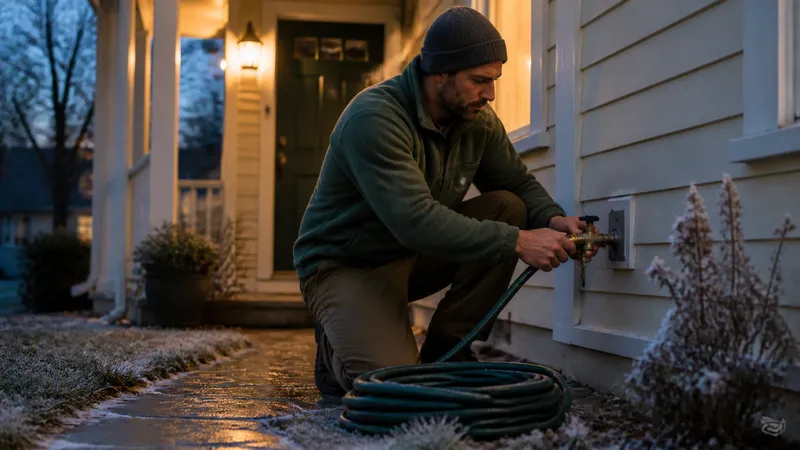
20 pre-winter tasks organized by lead time—what to book weeks out, what to weatherize this week, and what to do the day a freeze warning hits.
Key takeaways
- Book furnace service and irrigation blow-out 3–6 weeks before your area's average first freeze—both fill up fast.
- Disconnect garden hoses and drain outdoor bibs the day a freeze warning is issued, not on a weekend schedule.
- A connected hose traps water in a frost-free bib; freezing water can crack the valve inside the wall.
- During a hard freeze, drip faucets on exposed pipes overnight and open cabinet doors under exterior-wall sinks.
- Caulk needs 50°F or warmer to cure—do that task before temperatures drop, not the night before a freeze.
- Test smoke and CO alarms before the furnace's first burn; replace smoke alarms 10 years from manufacture.
The fall home maintenance checklist is the full 30-task, house-wide list. This page is the tighter, deadline-focused subset of it: the roughly 20 things that actively cause damage, cost money, or turn into an emergency once the temperature crosses freezing—hoses, exposed pipes, irrigation lines, exterior faucets, the furnace’s safety check, and sealed-up drafts. Instead of grouping by house zone, this list is organized by lead time: what you need to book weeks ahead, what to weatherize this week, and what has to happen the day a freeze warning actually hits your area.
The 20 pre-freeze tasks, by lead time
| # | Task | Lead time needed | DIY or pro |
|---|---|---|---|
| 1 | Book furnace or heat-pump tune-up | 3–6 weeks before first freeze | Pro |
| 2 | Book chimney inspection and sweep (wood-burning only) | 3–6 weeks before first freeze | Pro |
| 3 | Book irrigation system blow-out | 2–4 weeks before ground freeze | Pro or DIY with a rented compressor |
| 4 | Schedule pool closing, if you have one | 2–4 weeks before first freeze | Pro recommended |
| 5 | Get a roof inspection if you spotted damage from the ground | 2–4 weeks before winter | Pro |
| 6 | Caulk exterior gaps at windows and doors | 1–2 weeks out (needs 50°F+ to cure) | DIY |
| 7 | Replace worn weatherstripping at exterior doors | 1–2 weeks out | DIY |
| 8 | Add door sweeps to leaking exterior doors | 1–2 weeks out | DIY |
| 9 | Insulate exposed pipes in unheated spaces | 1–2 weeks out | DIY |
| 10 | Clean gutters, once, after the last leaves fall | 1–2 weeks out | DIY or pro |
| 11 | Confirm downspout extensions discharge 6 feet from the foundation | 1–2 weeks out | DIY |
| 12 | Test smoke and CO alarms; replace old batteries | 1–2 weeks out | DIY |
| 13 | Check water heater temperature (120°F) and note its age | 1–2 weeks out | DIY |
| 14 | Clean the dryer vent and check the outdoor exhaust hood | 1–2 weeks out | DIY (short run) / pro (concealed) |
| 15 | Confirm the main water shutoff turns | 1–2 weeks out | DIY |
| 16 | Reverse ceiling fans to clockwise | A few days out | DIY |
| 17 | Disconnect and drain garden hoses | Day the freeze warning is issued | DIY |
| 18 | Shut the interior valve for outdoor hose bibs, if present | Day the freeze warning is issued | DIY |
| 19 | Drain rain barrels and insulate or disconnect backflow preventers | Day the freeze warning is issued | DIY |
| 20 | Drip faucets on exposed or exterior-wall pipes overnight | Night of the freeze | DIY |
Weeks out: book the jobs that fill up (tasks 1–5)
Furnace technicians, chimney sweeps, irrigation companies, and pool closers all run on the same fall calendar as everyone else in your climate zone. Book these in September if you’re in a freeze-belt state—by mid-October, most HVAC companies are booked solid, and a no-heat call in January means emergency-rate labor plus a wait.
For the furnace or heat pump itself, this page only covers the scheduling deadline. What a technician actually inspects, homeowner-safe pre-checks, warning signs that need service now, and 2026 tune-up cost ranges are covered in the furnace maintenance before winter guide—read that one for the mechanics; this one is about not missing the booking window.
Irrigation winterization (task 3) needs residual water blown out of the lines with an air compressor. Manufacturer guidance from irrigation makers like Rain Bird recommends matching air pressure to your pipe material—commonly up to 50 PSI for polyethylene and up to 80 PSI for rigid PVC—and using enough airflow (CFM) to actually clear the lines rather than just pressurize them. That’s more compressor than most homeowners own; most irrigation companies do this as a seasonal service and fill up quickly once nights start dropping near freezing.
One to two weeks out: weatherize while it’s still above freezing (tasks 6–15)
Air sealing is the best-return cold-weather project most homeowners can do themselves, but it has its own weather requirement: most exterior caulks need 50°F or warmer to cure properly, so do this before a cold snap, not during one. Weatherstripping and door sweeps close the gaps caulk can’t reach at moving parts. For the deeper how-to on diagnosing drafts, picking weatherstripping material, and sequencing the work room by room, the fall checklist’s weatherization section covers it in more depth than this deadline-focused page needs to repeat.
Pipe insulation (task 9) is a few dollars of foam tube per 6 feet of pipe—wrap anything in a garage, crawl space, or attic that’s exposed or within about 6 inches of an exterior wall. Gutters (task 10) should be cleaned once, after the last leaves fall in your area, not before; one windstorm after an early cleaning undoes the work, and clogged gutters in winter back up into ice dams at the eaves.
Tasks 12–15—alarms, water heater temperature, dryer vent, and the main shutoff—aren’t freeze-specific, but they’re exactly the kind of “I’ll get to it” items that are much easier to finish while the weather is still mild than after the first cold snap has you focused on the furnace and the driveway. NFPA recommends testing every smoke alarm monthly and replacing units 10 years from their manufacture date—worth doing before, not after, the furnace’s first burn of the season.
| Weatherization task | What you’re checking | Note |
|---|---|---|
| Caulk | Gaps at window and door frames, the sill plate | Cures poorly below 50°F—do this on a mild day |
| Weatherstripping | Compressed or torn strips at door sides | A candle or lighter near the edge shows air movement |
| Door sweep | The gap under exterior doors | Cold air pools at floor level; sweeps close it cheaply |
| Pipe insulation | Exposed pipe in garages, crawl spaces, attics | Foam tube insulation, a few dollars per 6 feet |
Day of the freeze warning: hoses, bibs, and standing water (tasks 17–19)
This is the part of the list that genuinely can’t be done three weeks early and shouldn’t wait three days late—it’s tied to the forecast, not the calendar.
A garden hose left connected is the single most commonly skipped pre-freeze task, and it has a predictable, expensive consequence. Frost-free hose bibs are designed to drain automatically once you close them—but only if nothing is holding water in the valve. A connected hose does exactly that. When the trapped water freezes, it can crack the valve body inside the wall, a failure you won’t discover until you turn the water back on in spring and find it dripping into a wall cavity. Disconnecting the hose takes five seconds; the repair does not.
If your home has an older or non-frost-free hose bib, there’s usually an interior shutoff valve in the basement or crawl space (task 18). Close it, then open the outdoor bib to drain the remaining water. Rain barrels and backflow preventers (task 19) hold standing water outdoors year-round in warmer months—drain them, and insulate or disconnect any backflow assembly your irrigation system uses, since that’s exposed plumbing sitting right at ground level where cold hits first.
| Freeze-day task | What to do | Skip only if |
|---|---|---|
| Garden hoses | Disconnect, drain, and store | Never—do this every time, every hose |
| Frost-free hose bib | Confirm it drains fully once the hose is off | It drips after disconnecting—call a plumber, don’t wait |
| Interior hose bib shutoff | Close valve, then open the outdoor bib to drain | Your home only has frost-free bibs and no interior valve |
| Rain barrels / backflow preventer | Drain and insulate or disconnect | You’ve already removed it for the season |
The American Red Cross recommends letting cold water drip from a faucet supplied by exposed pipes during very cold weather and maintaining the same thermostat setting day and night. If you leave home during cold weather, it recommends leaving the heat on at no lower than 55°F. That away-home minimum does not guarantee that pipes in exterior walls, crawl spaces, or garages will stay above freezing. Insulate and protect vulnerable pipes, and have someone check a vacant home.
Climate and home-type caveats
| Situation | What changes | Priority shift |
|---|---|---|
| Freeze-belt (Midwest, Northeast, Mountain) | Every task on this list applies, often on a compressed calendar | Book weeks-out tasks in September; treat any freeze warning as a deadline |
| Mild climate (Pacific Coast, South) | Occasional hard freezes still happen | Watch the forecast for the rare freeze night; keep hose and pipe tasks ready even if you skip most winters |
| Hot-humid (Gulf, Southeast) | Freeze risk is low but not zero some years | Weatherstripping still pays off for AC efficiency; pipe protection matters mainly on forecast freeze nights |
| Vacant or vacation home | No one’s there to drip a faucet or notice a leak | Arrange professional winterization if needed, or leave heat no lower than 55°F with someone checking the home; exposed pipes can still freeze |
| Well and septic systems | Wellhead and exposed lines can freeze too | Insulate the wellhead and any exposed supply line the same day as the hose bib tasks |
When to call a professional
| Situation | Why it is not DIY |
|---|---|
| Furnace won’t reach temperature, short-cycles, or shows a yellow flame | Combustion and safety-switch diagnosis needs a technician and combustion analyzer |
| Gas smell or a sounding CO alarm | Emergency: leave the house and call 911 before calling anyone else |
| Hose bib drips after you’ve disconnected the hose | A cracked valve is already a repair, not a wait-and-see |
| Irrigation blow-out without the right compressor | Wrong pressure or airflow cracks fittings or damages valve seats |
| Main water shutoff is seized or leaking around the handle | Get it fixed before winter, not during a burst-pipe event |
| Chimney inspection and cleaning | Creosote buildup is a fire risk; requires a certified sweep |
| Roof access at height, or damage already found | Fall risk; a signed inspection report also helps with insurance later |
Related guides
Frequently asked questions
What’s the difference between this list and the fall home maintenance checklist?
The fall checklist is the full 30-task, house-wide list organized by zone (heating, roof, pipes, safety, appliances). This page is the tighter 20-item subset of tasks that specifically become damaging or costly once temperatures cross freezing, organized by how much lead time each one needs—not by where in the house it happens.
How many days before a freeze should I disconnect my garden hose?
Do it the day the freeze warning is issued, or as soon as overnight lows are forecast near or below 32°F. A hose left connected traps water in the hose bib; that water can freeze, expand, and crack the valve inside the wall—a repair you won’t discover until spring.
When should I book furnace service before winter?
3–6 weeks before your area’s typical first hard freeze. In freeze-belt states that usually means booking in September. Technicians are commonly booked solid by mid-October, and a no-heat call in January costs more in labor and wait time.
Do I need to winterize my irrigation system every year?
Yes, if you’re in a climate where ground temperatures drop below freezing. Residual water left in sprinkler lines or backflow preventers freezes and can crack PVC pipe or the backflow assembly. Most irrigation companies blow out lines with compressed air as a seasonal service and book up in October.