
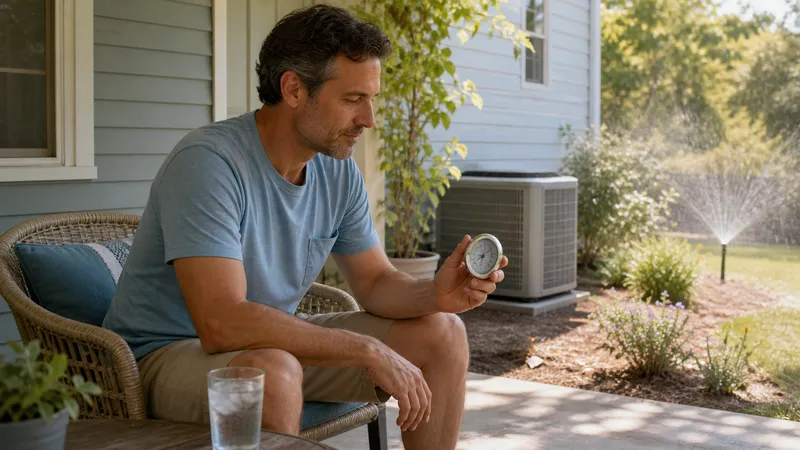
A summer home maintenance checklist: AC performance checks, humidity control, deck and siding care, yard work, pest season, grill and pool safety.
Key takeaways
- Check the AC filter monthly and watch for weak airflow, short cycling, or ice on the lines—signs to call a technician, not open the unit.
- Keep indoor relative humidity between 30% and 50% to limit mold and dust mites, per EPA guidance.
- DOE uses 78°F as a cooling-efficiency example, not a universal target; choose a setting appropriate for household health, humidity, and comfort.
- Keep grills at least 10 feet from the house—CPSC logs roughly 13 grill-related deaths and thousands of ER burn visits most years.
- Watch for winged termite swarmers near the foundation in warm, humid weather. Confirm with a licensed pest professional, not a DIY spray.
- Coastal homes: clear drains and confirm flood coverage before hurricane season peaks, typically August through October.
A summer home maintenance checklist covers what changes once the heat and humidity actually arrive: watching AC performance day to day, keeping indoor moisture under control, protecting a deck and siding from UV and heat cycling, yard and irrigation upkeep, pest swarm season, and grill, pool, and storm safety. This page is the season-wide list. If you haven’t had the AC serviced yet, the AC tune-up guide covers that pre-season job in depth, and the spring checklist already walks through booking it. This page picks up once the system is running.
The summer checklist at a glance
| Task | Cadence | DIY or pro | Why it matters |
|---|---|---|---|
| Check the AC filter | Monthly | DIY | DOE Energy Saver: clean or replace once a month or as recommended. Heavy summer runtime loads filters fast |
| Watch AC performance | Ongoing | DIY watch; pro if flagged | Weak airflow, ice on the lines, or short cycling means a service call, not a DIY fix |
| Review cooling settings for health and comfort | Daily | DIY | DOE Energy Saver uses 78°F rather than 72°F as an efficiency example; it is not a universal comfort or safety threshold |
| Clear the outdoor condenser | Monthly | DIY (exterior only) | Leaves and grass clippings block airflow; never unbolt or open the unit |
| Confirm the condensate drain flows | Monthly | DIY | A clogged drain backs up and can flood the air handler or ceiling below |
| Monitor indoor humidity | Weekly | DIY | EPA: keep relative humidity 30–50% to limit mold |
| Run bath and kitchen exhaust fans | Every use | DIY | Vents moisture before it condenses on cool surfaces |
| Inspect the deck for heat and UV wear | Once, early summer | DIY inspection | Sun and heat cycling dry out wood and loosen fasteners faster than winter cold does |
| Re-seal or stain an exposed deck | As needed | DIY or pro | Water beading test tells you if the old sealant has failed |
| Check caulk and paint on sun-facing siding | Once, early summer | DIY | UV breaks down caulk and paint faster on south- and west-facing walls |
| Adjust irrigation for real rainfall | Monthly | DIY | Overwatering in a wet summer wastes water and stresses turf roots |
| Inspect sprinkler heads and drip lines | Monthly | DIY | Clogged or broken heads waste water and miss dry spots |
| Watch for ant trails and wasp nests | Weekly | DIY (ants) / pro (nests near entries) | Wasp season peaks in mid-to-late summer; nests near doors are a sting risk |
| Watch for winged termite swarmers | Warm, humid days | Pro for identification and treatment | EPA: confirm species before any treatment |
| Inspect grill hoses and connections | Before first use, then monthly | DIY | CPSC: cracked or leaking hoses are a common cause of grill fires |
| Check pool or spa barrier and alarms | Monthly | DIY | Self-closing, self-latching gates and working alarms are the core of a layered pool-safety plan |
| Clear gutters after summer storms | After major storms | DIY (ground) / pro (height) | Wind-blown debris clogs gutters outside the normal fall cleaning cycle |
| Update home inventory photos and records | Once, mid-summer | DIY | Storm and heat damage are easier to prove with a recent “before” photo set |
The seasonal hub indexes all four season pages, and the summer hub is the index for this season specifically.
AC performance: what to watch once the tune-up is done
The pre-season tune-up checks refrigerant, coils, and safety controls once. Summer performance monitoring is what catches the problems that show up under real heat load. Check the filter monthly regardless of how it looks—DOE Energy Saver calls for cleaning or replacing filters once a month or as recommended, and a summer’s worth of daily runtime loads a filter faster than any other season.
Between filter changes, watch for three things: airflow that feels weaker than it used to at the same vents, a system that starts and stops in short bursts instead of running a full cooling cycle, and visible ice or frost on the refrigerant line outside. Any of those three is a reason to call an HVAC technician, not to open the unit. Ice on the lines in particular usually means restricted airflow or low refrigerant—both are technician diagnostics, and refrigerant work requires EPA 608 certification.
The DOE’s 2012 summer efficiency example compares 78°F with 72°F to illustrate possible cooling-energy savings. It is not a universal safe or comfortable indoor temperature. Choose settings for the people and pets in your home, account for humidity, and follow any individual health advice. Fans can improve comfort while a room is occupied, but they do not replace adequate cooling. See the HVAC maintenance hub for filter sizing and the ac-tune-up guide for the service visit itself.
Humidity and indoor moisture control
Summer heat brings summer humidity, and humidity is what turns a small leak or a poorly vented bathroom into a mold problem. EPA guidance is specific: keep indoor relative humidity below 60%, ideally between 30% and 50%. Above that range, condensation starts forming on cool surfaces—window frames, cold water pipes, the inside of exterior walls—and mold can begin growing within 24 to 48 hours on a damp surface.
A hygrometer costs $10–$50 at a hardware store and tells you where your house actually sits instead of guessing. If humidity runs high even with the AC working, run bathroom and kitchen exhaust fans during and after showers or cooking, and consider a portable or whole-house dehumidifier for spaces the AC doesn’t reach well, like a finished basement. Musty odors, fogged interior windows, or a fine gray or black film on grout and drywall are signs humidity is already too high—not a “wait and see” situation.
Deck, siding, and exterior care in the heat
Summer sun does different damage than winter cold: UV breaks down sealants, caulk, and paint, and repeated heating-cooling cycles work fasteners loose faster than a static winter freeze does. A quick water-bead test tells you if deck sealant has failed—splash water on the boards; if it beads up, the seal is still working, and if it soaks in immediately, it’s time to clean and reseal.
Walk the deck and look at the connection where it meets the house (the ledger board), the fasteners at each post, and the railings. Loose railings, rusted or missing fasteners, or soft or splintering wood at ground contact points are homeowner rules of thumb worth acting on, not a code citation—when in doubt about a deck’s structural condition, a contractor or building inspector can evaluate it properly. South- and west-facing siding takes the most UV exposure; check caulk at trim and window frames on those walls first, since it fails there before anywhere else on the house.
Yard and irrigation
Summer yard work is mostly about not wasting water and not letting a small irrigation problem run for weeks unnoticed. Check sprinkler heads and drip-line emitters monthly for clogs, breaks, or heads that have sunk below grade and stopped covering their zone. Adjust the watering schedule after real rainfall—an irrigation controller running on a fixed schedule through a rainy week wastes water and can overwater turf and garden beds. A simple rain sensor or smart controller add-on pays for itself in a wet summer.
Keep trees and shrubs trimmed back from the house, roofline, and AC condenser. Overhanging branches drop debris into gutters outside the normal fall cleaning window, and vegetation growing against siding traps moisture against the wall.
Pest season: ants, wasps, and termite swarms
Warm, humid weather is peak activity season for the pests that matter to a homeowner: ants finding a way in, wasps building nests near entries, and termites swarming to start new colonies. Ant trails are usually a DIY problem—find the entry point and seal it, and use bait rather than spray for an established trail. Wasp and hornet nests near doors, porches, or high-traffic areas are worth hiring out if you have any sting sensitivity, since disturbing an active nest at close range is when most stings happen.
Termite swarmers are the one to take seriously. EPA’s termite guidance recommends confirming the species and choosing treatment with a licensed pest control professional rather than DIY termiticide application—termite treatment products are restricted-use in many cases, and misapplication doesn’t solve the underlying colony. Termite swarmers have straight antennae, a thick waist, and four equal-length wings; flying ants have bent antennae, a pinched waist, and two longer front wings. If you see discarded wings on a windowsill or near the foundation, that’s worth a professional inspection even if you no longer see live insects.
Grill and outdoor fire safety
Grilling season means checking equipment that sat idle since last summer. Inspect propane hoses and connections for cracking, brittleness, or leaks before the first use—CPSC points to hose and connection failures as a recurring cause of grill fires, especially right after reconnecting a refilled tank. Store propane tanks outdoors, away from the grill and any other heat source, never in a garage or shed.
Keep the grill at least 10 feet from the house, deck railings, eaves, and overhanging branches, and keep children and pets at least 3 feet back while it’s in use, per NFPA. Never leave a lit grill unattended, and clean grease buildup from grates and drip trays regularly—accumulated grease is its own fire risk. Charcoal and gas grills are outdoor-only equipment; never run one in a garage, breezeway, carport, or under a covered porch.
Pool and hot tub basics
If the house has a pool or spa, summer is when it gets used most and when barrier maintenance matters most. A residential pool barrier plan has layers: a fence that fully encloses the pool with a self-closing, self-latching gate; door alarms where the house opens directly onto the pool area; and a working pool or spa cover. This layered approach is the standard homeowner guidance from Pool Safely, the federal pool-safety campaign backed by the Virginia Graeme Baker Pool and Spa Safety Act. Check monthly that gate latches still self-close and that any door or pool alarms still function—batteries die, hinges sag, and a barrier that worked in May can fail silently by August.
Beyond barriers, test pool or spa water chemistry regularly per the product instructions on your sanitizer, and never leave children unsupervised near open water, even briefly. Designate a specific adult as the “water watcher” during pool time rather than assuming someone is keeping an eye on it.
Hurricane and severe storm prep (coastal and storm-prone homes)
Atlantic hurricane season runs June through November, with peak activity typically August through October. Ready.gov recommends starting home prep before a storm is in the forecast: clear gutters and drains so rainfall has somewhere to go, secure or bring in outdoor furniture and anything that can become wind-blown debris, and close storm shutters if the house has them—taping windows does not meaningfully protect the glass.
Documentation matters as much as physical prep. Save digital copies of your insurance policy, deeds, and a current home inventory, and know that standard homeowners insurance typically does not cover flood damage—that’s a separate policy through the National Flood Insurance Program or a private flood carrier, worth confirming before storm season rather than after. The home inventory guide covers what to photograph and where to keep the backup copy.
Heat safety for the people in the house
This is a homeowner maintenance page, not a medical guide, but a few home-level habits reduce heat risk directly. Ready.gov recommends checking weatherstripping on doors and windows so cool air stays in, using the oven less during heat advisories so you’re not adding heat load to the house, and knowing where the nearest cooling center is if the AC fails during a heat wave. Fans move air and improve comfort but don’t reduce core body temperature the way air conditioning does—don’t treat a fan as a substitute for AC repair during a heat emergency. Stay hydrated and watch for signs of heat exhaustion (heavy sweating, weakness, nausea) in anyone doing yard work in direct sun.
Climate and house-type caveats
| Home situation | What summer changes | Prioritize |
|---|---|---|
| Hot-humid / coastal | Humidity control is the primary job, not just cooling | Dehumidification, condensate drain checks, hurricane prep by June |
| Dry / wildfire-prone | Low humidity, high fire risk outdoors | Defensible space around grills and fire pits; filters load faster during smoke events |
| Heavy tree cover | More debris in gutters and on the deck mid-season | Off-cycle gutter checks after storms, not just fall cleaning |
| Homes with a pool or spa | Barrier and supervision routines need monthly checks | Gate latches, alarms, and water-watcher habits, not just water chemistry |
| Northern / short cooling season | AC gets hard, sudden use after months idle | Watch performance closely in the first two weeks of real heat |
When to call a professional
| Situation | Why it is not DIY |
|---|---|
| AC ice on the lines, short cycling, or no cooling | Refrigerant and sealed-system work requires EPA 608 certification |
| Termite swarmers or discarded wings near the foundation | Species identification and treatment decisions are a licensed pest control job |
| Wasp or hornet nest near an entry, or any sting allergy in the household | Removal at close range risks multiple stings |
| Deck showing loose railings, soft wood, or ledger-board concerns | Structural evaluation needed before continued use |
| Gas grill leak you can smell or hear hissing | Turn off the tank and do not attempt to light it until the leak is fixed |
| Pool barrier gate that won’t self-close or latch | A layered safety system with a failed layer needs a real fix, not a workaround |
| Storm shutter installation or structural bracing before a hurricane | Correct anchoring is a specialized install, not a same-day DIY job |
Related guides
Frequently asked questions
When should I check my AC’s performance during summer?
Check the filter monthly and watch performance all season—weak airflow, longer run times, ice on the refrigerant lines, or a system that short-cycles are signs to call an HVAC technician. The pre-season tune-up is a separate job; summer monitoring catches problems the tune-up couldn’t predict.
What indoor humidity level prevents mold in summer?
The EPA recommends keeping indoor relative humidity below 60%, ideally between 30% and 50%. A $10–$50 hygrometer from a hardware store tells you where your house actually sits.
How far should a grill be from my house?
At least 10 feet from the house, deck railings, eaves, and overhanging branches, per NFPA. Keep children and pets at least 3 feet from the grill area while it’s lit.
How do I tell termite swarmers from flying ants?
Termite swarmers have straight antennae, a thick waist, and four wings of equal length; flying ants have bent antennae, a pinched waist, and two longer front wings. If you’re unsure, a licensed pest control professional can identify the species and recommend treatment—EPA does not recommend DIY termiticide application.
What should I do before a hurricane or tropical storm?
Clear gutters and drains so water has somewhere to go, bring in or secure outdoor furniture, close storm shutters if you have them, and save digital copies of your insurance policy and home inventory. Ready.gov has the full pre-storm and evacuation checklist.