
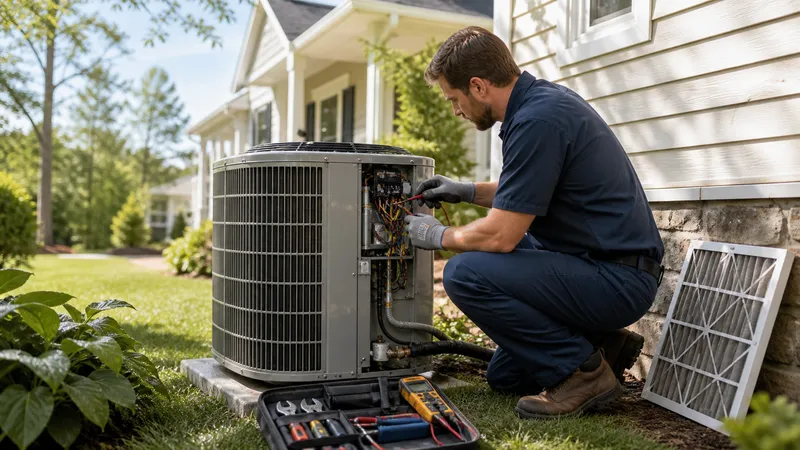
What a professional AC tune-up actually checks, homeowner pre-checks you can do safely, 2026 cost ranges, and the warning signs that mean call now.
Key takeaways
- A professional tune-up checks refrigerant level, coils, electrical connections, the condensate drain, and thermostat operation—not just the filter.
- Refrigerant level checks and coil access require EPA Section 608 certification by law; that is not a DIY step.
- Keep 2 feet of clearance around the outdoor unit and check filters monthly—MERV 6 is ENERGY STAR's minimum, MERV 8+ is the stronger baseline.
- A 2026 tune-up runs roughly $175–$350 (up to $550 for a premium visit); a mid-summer emergency call often runs $300–$1,500+.
- Short-cycling, warm air from vents, ice on the lines, hissing, or rising indoor humidity are signs to call now, not wait for the season to end.
- Central AC, heat pumps, and ductless mini-splits share the annual professional visit but differ on what needs monthly homeowner attention.
The spring checklist covers the whole house before summer; this page is the AC-only deep dive it points to. If you already cleared the condenser and booked service off that 25-task list, this is what happens next: what a technician actually inspects, what you can safely check yourself, and the cost and warning-sign numbers that tell you whether to wait for your appointment or call today.
What a professional AC tune-up actually checks
ENERGY STAR’s maintenance checklist lists the core tasks for a central air conditioner tune-up. Here is what each one means and why it’s on the list.
| Step | What the technician does | Why it matters |
|---|---|---|
| Refrigerant charge check | Measures pressure and refrigerant level against the manufacturer’s spec | Low refrigerant means a leak; overcharging or undercharging both cut cooling capacity and can damage the compressor |
| Coil cleaning (evaporator and condenser) | Cleans both coils, inside the air handler and inside the outdoor unit | Dirty coils block heat transfer, forcing the system to run longer for the same cooling |
| Electrical and capacitor testing | Tightens connections, measures voltage and current on motors, tests the run and start capacitors | A weak capacitor is one of the most common causes of a compressor that hums but won’t start |
| Condensate drain and pan | Clears the drain line and inspects the pan | A clogged drain backs up into the air handler or the ceiling below it |
| Thermostat calibration | Confirms the thermostat reads and controls temperature accurately | A thermostat reading a few degrees off runs the system longer than needed |
| Blower and airflow | Cleans and adjusts blower components, checks airflow through the ducts | Weak airflow from a dirty blower or blocked duct undercuts everything else on this list |
| System start-up and controls | Runs the full start-stop cycle and checks safety controls | Confirms the unit starts, runs, and shuts off correctly rather than just “sounds fine” |
The refrigerant and coil-access steps are why this is a professional job, not an owner’s-manual project. EPA Section 608 of the Clean Air Act requires certification to buy refrigerant or open a sealed refrigerant circuit — Type II for the high-pressure systems used in home central AC. A technician without that certification legally cannot touch your refrigerant charge, and neither can you.
What you can safely check before the appointment
None of this opens the sealed refrigerant system. All of it takes under 30 minutes and can shorten your appointment or catch a problem early.
| Pre-check | How to do it | Stop if |
|---|---|---|
| Clearance around the condenser | Clear leaves, mulch, and grass clippings to at least 2 feet on all sides | You’d need to move anything bolted down or buried, like a fence or deck post |
| Fins on the outdoor coil | Look for bent aluminum fins; straighten gently with a fin comb or a butter knife, working with the natural direction of the fin | Fins are crushed over a wide area — that’s a coil-cleaning job, not a straightening job |
| Filter size and type | Confirm the filter size printed on the frame matches what’s installed; hold it to a light — if you can’t see light through it, replace it | You’re unsure of the correct MERV rating for your system |
| Outdoor unit level | Confirm the pad hasn’t settled or tilted since last season | The unit is visibly tilted or sitting in standing water |
| Circuit breaker and disconnect | Confirm the outdoor disconnect and breaker aren’t tripped before assuming the unit is broken | You smell burning or see scorch marks near the disconnect — stop and call an electrician |
Filter specifics
“Check the filter” isn’t specific enough to act on. ENERGY STAR requires MERV 6 or higher as its baseline; DOE’s Zero Energy Ready Home program and EPA’s Indoor AirPlus set the bar at MERV 8 or above. A 1-inch filter typically needs changing every 30–90 days depending on type and household (pets and smokers push toward the shorter end); check monthly regardless of the printed interval — a heavy pollen season or a renovation can load a filter in weeks. A filter rated above what your system was designed for restricts airflow and forces the blower to work harder; check your manual before jumping straight to MERV 13.
Warning signs your AC is close to a breakdown
These are the signs that mean call now, not wait for your scheduled tune-up.
| Sign | What it usually means |
|---|---|
| Short-cycling — on and off within a few minutes | Low refrigerant, a dirty filter restricting airflow, or a failing capacitor tripping the system’s safety switch |
| Warm air from the vents | Low refrigerant from a leak, a failed compressor, or a frozen evaporator coil |
| Ice on the indoor refrigerant lines or coil | Restricted airflow or low refrigerant causing the coil to run too cold |
| Hissing or bubbling near the indoor unit | A possible refrigerant leak — this is a call-now sign, not a wait-and-see |
| Rising indoor humidity with the system running | The system is short-cycling before it can pull moisture out of the air, even if the temperature feels close to target |
Short-cycling is worth stopping for specifically: it strains the compressor — the most expensive single part in the system — every restart under load.
Central AC vs. heat pump vs. ductless mini-split: what changes
All three systems need the annual professional visit. What differs is the homeowner-side maintenance between visits.
| System | Annual pro visit | Homeowner-side difference | Extra consideration |
|---|---|---|---|
| Central AC | Yes — refrigerant, coils, electrical, drain, airflow | Monthly filter check at the air handler | Ductwork should be inspected periodically for leaks or damage; duct cleaning is occasional, not annual |
| Heat pump | Yes — same list, plus reversing valve and defrost cycle | Same filter routine as central AC | Runs a cooling and a heating cycle, so a fall check of defrost operation matters before heating season, not just a spring cooling check |
| Ductless mini-split | Yes — professional service on the outdoor compressor and refrigerant lines | Each indoor head has its own washable filter; clean roughly monthly, more with pets or wildfire smoke | No ductwork to maintain or leak, but every indoor head needs its own attention — a 3-head system is three filters, not one |
2026 cost: tune-up vs. emergency repair
Public cost estimators put a 2026 professional AC tune-up around $175–$350 for basic service, up to $550 for a premium visit that includes a full inspection report (Today’s Homeowner, updated 2026). A mid-summer emergency repair call — the kind that happens when a system fails on a 95°F day — commonly runs $300 to $1,500 or more, depending on the failed part and whether the visit falls after hours (HomeGuide). These are national estimates; your local quote depends on system age, access, and regional labor rates.
The “book early costs less” logic is a homeowner rule of thumb, not a published discount policy: technicians have open calendars and standard rates in late winter and early spring, before no-cooling calls spike demand and push emergency and after-hours rates higher. The savings come from avoiding the emergency-rate call entirely, not from a lower listed tune-up price in March versus July.
When to call a professional
| Situation | Why it is not DIY |
|---|---|
| Refrigerant check, adding refrigerant, or any coil access inside the cabinet | Requires EPA Section 608 certification by law |
| Capacitor testing or replacement | Capacitors can retain a dangerous charge even with power off |
| Short-cycling, warm air, ice on the lines, or hissing | These point to a refrigerant or electrical fault, not a filter problem |
| Bent fins over a wide area or a visibly damaged coil | Straightening beyond a light touch-up risks tearing the coil |
| Thermostat reading correctly but the house won’t reach temperature | Points to airflow or refrigerant, not a thermostat setting |
| Breaker trips repeatedly when the AC starts | Electrical fault — stop resetting it and call an electrician or HVAC technician |
Booking the visit and clearing the pre-checks above is the homeowner’s job here. The rest is licensed work by design — refrigerant handling is federally regulated, not just cautious advice.
Related guides
Frequently asked questions
What does a professional AC tune-up actually include?
Per ENERGY STAR’s maintenance guidance, a tune-up checks the condensate drain, system controls and start-up cycle, evaporator and condenser coils, refrigerant level, blower components and airflow, and filters. Most technicians also test capacitors and electrical connections and calibrate the thermostat.
Why can’t I check my own refrigerant level?
EPA Section 608 (Clean Air Act, 40 CFR Part 82) requires certification to purchase refrigerant or open a sealed refrigerant circuit. Opening the unit without that certification is illegal and can vent ozone-depleting refrigerant, beyond the safety and warranty risk.
How much does an AC tune-up cost in 2026, and is booking early actually cheaper?
Industry cost estimators put a 2026 tune-up around $175–$350, up to $550 for a premium visit, versus $300–$1,500+ for a mid-summer emergency repair call. Off-season booking is a homeowner rule of thumb, not a guaranteed discount: technicians have open calendars and standard rates before demand spikes, and emergency or after-hours calls commonly cost more.
What are the warning signs my AC is about to break down?
Short-cycling (on and off in a few minutes), warm air from the vents, ice on the indoor refrigerant lines or coil, hissing or bubbling near the indoor unit, and rising indoor humidity despite the system running are the signs to call a technician before the system fails outright.
Do heat pumps and ductless mini-splits need the same tune-up as central AC?
All three need an annual professional visit, but the homeowner-side work differs. Central AC needs monthly filter checks and occasional ductwork attention. Mini-splits need each indoor head cleaned roughly monthly. Heat pumps need the same annual visit as central AC, plus a check that the reversing valve and defrost cycle work correctly before heating season.