
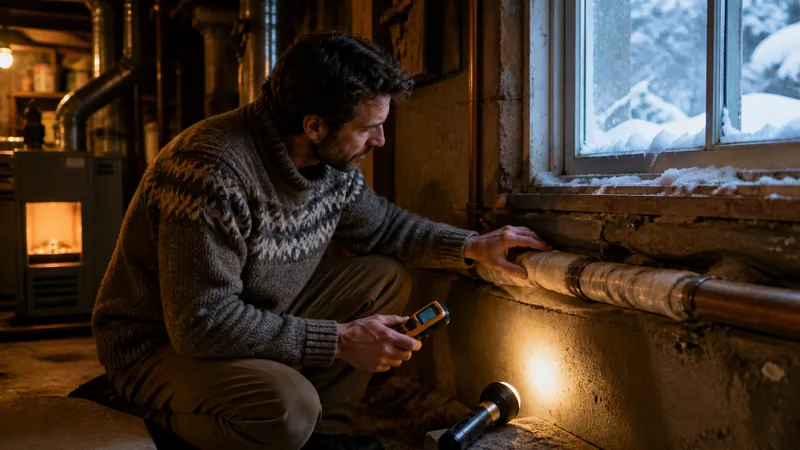
A winter home maintenance checklist for once cold weather hits: safety checks, ice dam and frozen-pipe warning signs, and post-storm steps.
Key takeaways
- When away in cold weather, leave heat no lower than 55°F; this does not guarantee exposed pipes are protected. Follow Red Cross guidance for vulnerable pipes.
- Test smoke and CO alarms monthly; heating equipment causes the winter spike in home fires and CO poisoning.
- Run portable generators outdoors, at least 20 feet from the house, away from windows and doors.
- Keep space heaters 3 feet from anything flammable and never leave one running unattended.
- A steady drip line of icicles or ice buildup at the eaves is an ice dam forming, not decoration—clear roof snow before it melts and refreezes.
- After a storm, photograph any damage before you touch it and check attic insulation if you see icicles or ice ridges.
Winter home maintenance, once the cold has actually arrived, is less about a task list and more about a daily habit: watch the alarms, watch the pipes, watch the roof, and watch how the heat is performing. This page covers what to do during winter itself—indoor safety checks, frozen-pipe and ice-dam warning signs, space-heater and generator safety, and what to check after a storm or a deep freeze. If you still need to winterize before the first freeze—disconnecting hoses, booking furnace service, sealing drafts—that prep work lives in Pre-Winter Home Prep: 20 Things to Do Before the First Freeze and the broader fall checklist. This page picks up once winter is already here.
Winter home maintenance at a glance
| Cadence | What you’re watching | Typical action | Call a pro when |
|---|---|---|---|
| Daily during a hard freeze or storm | Pipes, heat, ice | Drip exposed faucets, confirm the furnace is holding temperature, watch for icicle ridges | No heat, a burst pipe, or a sagging ceiling |
| Weekly through winter | Alarms, space heaters, drafts | Test smoke/CO alarms if not already monthly, confirm space heaters are clear and off when unattended | An alarm fails or a CO alarm sounds |
| After every storm or power outage | Roof, generator exhaust, snow load | Photograph damage from the ground, clear vents of snow, run generators outdoors only | Ice dams, structural sag, or CO symptoms |
| Ongoing | Energy use | 68°F while home and awake, setback while away/asleep, reverse ceiling fans clockwise | Heat won’t reach set temperature or short-cycles |
The winter hub rounds up this season’s guides, and the seasonal hub is the year-round index if you want the full-year layers.
Indoor safety checks (do these every week of winter)
Heating equipment fires and carbon monoxide poisoning both spike in winter because furnaces, space heaters, and fireplaces are running for the first time in months—often with a fault no one caught. The National Fire Protection Association reports that home heating equipment fires and their associated deaths concentrate heavily in the December–February window, and portable space heaters and heating stoves account for the large majority of heating-fire deaths despite being a small share of heating equipment in use (NFPA home heating fires).
| Check | How often | What you’re looking for |
|---|---|---|
| Smoke and CO alarms | Monthly (test button) | Alarm sounds; replace units past their manufacture date—commonly 10 years for smoke alarms, 5–7 years for CO |
| Space heater placement | Every time you use one | At least 3 feet clear of furniture, bedding, curtains, and paper; plugged directly into the wall, not an extension cord or power strip |
| Furnace/heat pump filter | Monthly or as recommended | Gray or clogged filter restricts airflow and stresses the system |
| Fireplace/wood stove | Each burn, visually | Damper open, no smoke backing into the room, ash removed to a metal container |
| Fuel-burning appliance vents | After snow or ice | Exterior vents clear of snowdrift so exhaust doesn’t back up into the house |
CPSC’s winter guidance is direct: never use a gas range or oven to heat a home, and portable heaters need three feet of clearance from anything that can burn. The agency also flags that space heaters and heating stoves cause a disproportionate share of heating-related deaths and injuries relative to central furnaces (CPSC winter storm safety tips). Never leave a space heater running in a room you’ve left or while you sleep—unattended use is one of the leading causes of space-heater fires.
Frozen-pipe warning signs and what to do
The American Red Cross recommends maintaining the same thermostat setting day and night during very cold weather. If you leave home, leave heat on at no lower than 55°F. This away-home minimum does not guarantee that pipes in an unheated space or exterior wall will stay above freezing. Protect vulnerable pipes, let cold water drip from the faucet supplied by exposed pipes as recommended, and open sink cabinet doors so room air can reach plumbing. Move household chemicals out of children’s reach first.
| Warning sign | What it means | Do this |
|---|---|---|
| Faucet flow drops to a trickle or stops | Ice is forming somewhere in that line | Keep the faucet open, apply gentle heat (hair dryer, not open flame) to accessible exposed pipe, and call a plumber if you can’t reach the frozen section |
| Frost visible on an exposed pipe | The pipe is at or below freezing | Treat it as a possible freeze: assess safely, protect the pipe, and call a plumber if you cannot locate or safely thaw the frozen section |
| Forecast of a hard freeze (commonly cited around 20°F or below) | Highest-risk window for pipes in unheated areas | Drip faucets on exterior walls, open cabinet doors, confirm the furnace is running |
| Bulging pipe or a hissing/dripping sound behind a wall | A pipe may already be cracked, not yet leaking visibly | Shut off the water at the main and call a plumber before it thaws and floods |
| Water where it shouldn’t be after a thaw | A pipe froze, cracked, and is now leaking as it warms | Shut off the main water valve immediately; this is not a wait-and-see situation |
Know where your main water shutoff is and confirm it turns before you need it in an emergency—that’s the single fastest way to limit damage from a pipe that does fail.
Ice dams: what to watch for and the in-season fix
An ice dam is a ridge of ice that builds up at the roof’s edge. It forms when heat escaping from the living space into the attic warms the underside of the roof deck, melting the snow above it; that meltwater runs down the roof and refreezes when it reaches the colder eave, where there’s no warm attic below to keep it from freezing. Water then backs up under the shingles behind the dam and can leak into the wall or ceiling. The Department of Energy’s Building America program identifies the same three ingredients every time: snow on the roof, a poorly insulated or poorly air-sealed attic, and freezing temperatures at the eaves (DOE Building America Solution Center: ice dam prevention).
| What you see | What it tells you | In-season action |
|---|---|---|
| A line of icicles along the gutter | Meltwater is refreezing at the eave—an ice dam may already be starting | Use a roof rake from the ground to remove snow load before it melts; don’t chip at the ice |
| A visible ridge of ice at the roofline | An ice dam has formed | Clear roof snow above the dam with a roof rake; call a professional for steam-based ice removal if water is already entering the house |
| Warm patches or bare spots on an otherwise snow-covered roof | Heat is escaping through the roof deck at that spot—often over a poorly insulated area | Note the location; have the attic insulation and air sealing checked once the weather allows |
| Water staining on a ceiling or exterior wall during a thaw | Water backed up under shingles and found a path inside | Photograph it, contain any active drip, and call a roofer—this is not a re-shingle-yourself situation |
A roof rake—a flat blade on a long pole, used from the ground—removes snow before it has a chance to melt and refreeze, and it’s the practical in-season tool. It does not fix the underlying cause. The lasting fix is attic insulation and air sealing so the attic stays close to outdoor temperature, which is prep-season work covered in the pre-winter prep guide and the HVAC hub for anything tied to duct leakage into the attic.
Space heaters, generators, and staying warm without a fire risk
If a storm knocks out power, the two biggest winter risks move indoors fast: carbon monoxide from a generator, and fire from a space heater used the wrong way.
| Equipment | Safe placement | Never do this |
|---|---|---|
| Portable space heater | On a hard, level, non-flammable surface, 3+ feet from anything that burns | Leave it running unattended, plug it into an extension cord or power strip |
| Portable generator | Outdoors, at least 20 feet from the house, with exhaust pointed away from doors and windows | Run it in a garage, carport, porch, or basement—open doors and windows don’t provide enough ventilation |
| Gas range or oven | Cooking only | Never use it to heat the house |
| Fireplace/wood stove as backup heat | With the damper open and a working CO alarm nearby | Burn anything but seasoned wood or the fuel it’s rated for |
CPSC’s winter safety guidance is specific on the generator distance and the reasoning: opening a door or window near a running generator does not move enough air to prevent a lethal CO buildup indoors, and roughly 100 people die each year in the US from generator-related CO poisoning (CPSC winter storm safety tips). If you lose heat during a storm and use a backup source, keep a battery-powered CO alarm running and check on it, not just the smoke alarm.
Monitoring heat performance through the season
A furnace or heat pump that’s serviced and running is still worth watching. A system that used to reach the thermostat’s set point in 15–20 minutes and now takes twice that, or short-cycles (turns on and off repeatedly), is telling you something before it fails outright.
| Symptom | Likely cause | Homeowner step |
|---|---|---|
| Rooms far from the thermostat stay cold | Duct leakage, closed registers, or airflow blocked by furniture | Confirm all registers are open and unblocked; check accessible duct joints for obvious gaps |
| System runs constantly without reaching set temperature | Dirty filter, undersized system for the cold snap, or a mechanical fault | Replace the filter first; call for service if that doesn’t help |
| Short-cycling (on/off every few minutes) | Thermostat placement, airflow restriction, or a control fault | Note the pattern and timing, then call a technician—this is diagnostic, not DIY |
| Musty or burning smell on startup | Dust burning off (usually normal, briefly) or a wiring/component issue | Brief dust smell at first fall startup is common; a smell that persists or smells like plastic warrants a service call |
See the HVAC maintenance hub for filter intervals and the annual service cadence; this section is about noticing a change in performance mid-winter, not the maintenance schedule itself.
Energy-efficiency habits worth keeping through winter
None of these replace the pre-freeze weatherization work, but they matter every day the heat is running. DOE’s Energy Saver program frames 68°F as a reasonable daytime setting while you’re home and awake, with a lower setting while you’re asleep or away—a thermostat setback of 7–10°F for eight hours can save as much as 10% a year on heating and cooling (Energy Saver: thermostat settings).
| Habit | Why it helps | Note |
|---|---|---|
| 68°F while home/awake, lower while asleep or away | DOE estimates up to 10% annually for a 7–10°F setback over eight hours; suitability varies by equipment and household | A programmable or smart thermostat automates this without you remembering nightly |
| Reverse ceiling fans to run clockwise at low speed | Pushes warm air that collects at the ceiling back down into the room | Most fans have a small direction switch on the motor housing |
| Keep curtains open on sunny, south-facing windows during the day; closed at night | Free solar heat gain during the day; reduces heat loss at night | Doesn’t replace weatherstripping if the window itself is drafty |
| Don’t block registers or returns with furniture | Restricted airflow makes the system work harder for the same result | Applies to both forced-air heat and central AC returns |
After a storm or a deep freeze
| Check | What to do |
|---|---|
| Roof and gutters | Photograph from the ground before clearing anything; look for new ice ridges, sagging, or missing shingles |
| Exterior vents (dryer, furnace, water heater) | Clear snowdrift so exhaust isn’t blocked |
| Attic (if accessible safely) | Look for water staining or new frost on the underside of the roof deck—a sign of an ice dam or ventilation issue |
| Water pressure and visible pipes | Confirm normal flow at every faucet before assuming pipes came through fine |
| Power-outage equipment | Log the generator run time, refuel outdoors only, and let the engine cool before refueling |
| Trees and branches | Note any limbs hanging over the roof or power line for spring removal, or call now if one is already resting on the structure |
When to call a professional
| Situation | Why it is not DIY |
|---|---|
| No heat, or a furnace that short-cycles or won’t reach temperature | Diagnosing combustion, control, or airflow faults needs equipment and training you don’t have |
| A CO alarm sounds, or anyone has headache/dizziness/nausea during heating season | Medical and fire-department response first, diagnosis second |
| A pipe has already burst or you can’t locate a frozen section | Water damage compounds by the hour; a plumber can thaw and repair safely |
| An ice dam is already pushing water into the house | Steam-based removal and roof access at height are professional work |
| A generator, its wiring, or its transfer switch needs setup | Improper backfeed into house wiring can electrocute utility workers |
| Structural sag, a leaning chimney, or a roof that looks like it’s holding standing snow load unevenly | Structural risk, not a maintenance task |
Related guides
Frequently asked questions
How do I know if my pipes are about to freeze?
Watch for drastically reduced or no water flow at a faucet, frost on exposed piping, or a hard freeze forecast (below 20°F) combined with pipes in an unheated space. During very cold weather, maintain heat day and night and follow Red Cross advice for exposed pipes. When away, leave heat no lower than 55°F; vulnerable pipes can still freeze.
What is an ice dam and how do I stop it from forming?
An ice dam is a ridge of ice at the roof’s edge that forms when heat escaping through the attic melts roof snow, which then refreezes at the colder eaves and backs water under shingles. Keeping the attic well insulated and ventilated so it stays close to outdoor temperature is the long-term fix; a roof rake to remove snow before it melts is the in-season stopgap.
Is it safe to run a generator in the garage during a power outage?
No. CPSC guidance is to run portable generators outdoors only, at least 20 feet from the house, doors, and windows, with exhaust directed away from the home. Opening the garage door is not enough ventilation to prevent lethal carbon monoxide buildup.
How close can a space heater be to furniture or bedding?
Keep space heaters at least 3 feet from anything that can burn—furniture, curtains, bedding, and paper—and never leave one running in an empty room or while you sleep, per CPSC and NFPA guidance.