
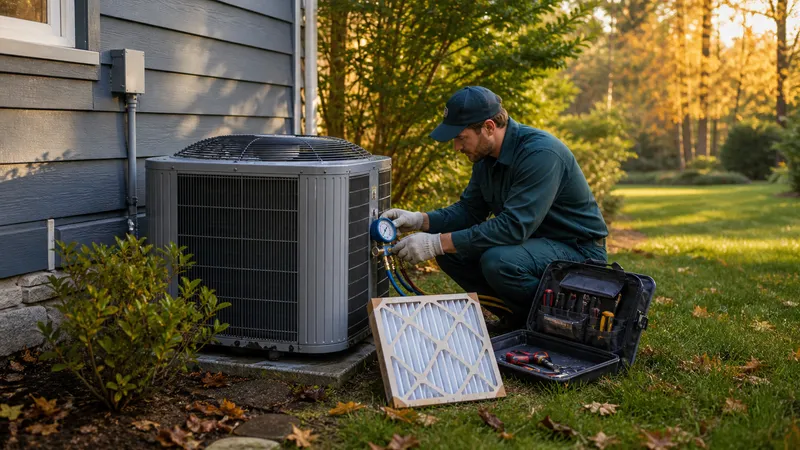
The full-year HVAC maintenance schedule: monthly filter checks, spring/fall pro tune-ups, and how central AC, heat pumps, and mini-splits differ.
Key takeaways
- Check or change the filter monthly year-round; DOE calls this the floor, not a seasonal task.
- Central AC plus furnace needs two pro visits a year: cooling in spring, heating in fall.
- Heat pumps run both modes on one system, so one annual visit usually covers it—ask your tech to confirm.
- Ductless mini-splits need homeowner filter cleaning every 2–4 weeks plus one annual professional visit.
- Window and portable units skip the professional tune-up; clean the filter and check drainage each season of use.
- A tune-up checks coils, refrigerant, the condensate drain, electrical connections, and (for furnaces) the heat exchanger.
An HVAC maintenance schedule has two speeds: a monthly filter check you do yourself, and a professional tune-up scheduled once or twice a year depending on what equipment sits in the house. Central air conditioning paired with a furnace needs two visits—cooling service in spring, heating service in fall. A heat pump usually needs one, since it runs both modes through the same equipment. Ductless mini-splits and window units follow a different rhythm again. This page ties all of that together. For the pre-summer AC checklist, see AC Tune-Up Before Summer. For the pre-winter furnace checklist, see Furnace Maintenance Before Winter.
The year-round HVAC schedule at a glance
| Cadence | Who does it | What happens |
|---|---|---|
| Monthly, year-round | Homeowner | Check the filter; clean or replace if it blocks light. DOE Energy Saver: “once a month or as recommended.” |
| Spring (central AC) | Licensed technician | Cooling-system tune-up before the first hot stretch |
| Fall (furnace) | Licensed technician | Heating-system tune-up before the first hard freeze |
| Once a year (heat pump) | Licensed technician | One visit covers both heating and cooling components |
| Every 2–4 weeks in season (mini-split) | Homeowner | Rinse or vacuum the washable indoor filter |
| Each season of use (window/portable unit) | Homeowner | Clean filter, check drainage, confirm the seal at the window frame |
ENERGY STAR recommends “an annual pre-season check-up: check the cooling system in the spring and the heating system in the fall,” and notes that contractors get busy fast once the season actually turns—booking early gets you a standard rate instead of an emergency one.
What a professional tune-up actually checks
“Tune-up” is vague until you see the task list. ENERGY STAR’s HVAC maintenance checklist and the DOE Energy Saver guide describe the same core visit, split by season:
| Task | Cooling visit (spring) | Heating visit (fall) |
|---|---|---|
| Coil cleaning | Evaporator and condenser coils | Not applicable (no refrigerant coil in a gas furnace) |
| Refrigerant check | Level checked, adjusted or leak-tested if low | N/A unless a heat pump runs the same refrigerant circuit |
| Combustion / heat exchanger | N/A | Gas/oil connections, burner combustion, and heat-exchanger inspection for cracks that can leak carbon monoxide |
| Condensate drain | Inspected and cleared | Inspected and cleared (furnaces with a secondary heat exchanger also condense) |
| Electrical & safety controls | Connections tightened, voltage and current measured on motors | Same, plus the CO safety shutoff and flame sensor |
| Blower and ductwork | Components cleaned and adjusted | Airflow verified; ducts inspected for obvious leakage |
A cracked heat exchanger is the reason furnace service isn’t optional the way a filter swap is: it can leak carbon monoxide into the house while the furnace still runs and heats normally. That inspection requires opening the burner compartment—homeowner tools stop at listening for a rough start and watching the flame through the sight glass.
Equipment-type variation
The twice-a-year rule assumes the most common US setup: a separate central air conditioner and a gas or electric furnace. Other equipment runs on a different clock.
| Equipment | Professional visits | Homeowner filter cadence | Notes |
|---|---|---|---|
| Central AC + furnace | 2 per year: spring cooling, fall heating | Monthly | The default schedule this page is built around |
| Heat pump (air-source) | 1 per year, per DOE | Monthly | One system handles both seasons; some owners in extreme climates still book two |
| Ductless mini-split | 1 per year for coils and refrigerant | Every 2–4 weeks in heavy use | Washable indoor filters need far more frequent homeowner attention than a 1-inch furnace filter |
| Window / portable AC | Rarely professional; DIY service only | Each season of use, more often with heavy use or pets | No ducts or refrigerant service to schedule; failure usually means replacement, not repair |
| Geothermal heat pump | 1 per year, ground loop excluded | Monthly | Ground loop itself needs almost no service; the indoor unit follows standard heat-pump rules |
Mini-split filter cadence varies by manufacturer—check the unit’s manual for the exact interval, since some indoor heads specify cleaning as often as every two weeks during peak season and others stretch to monthly.
Thermostat and duct considerations
A tune-up only pays off if the rest of the delivery system works with it. Two things worth checking alongside the seasonal visit:
- Thermostat. ENERGY STAR’s maintenance guidance includes checking thermostat settings as part of the seasonal visit—confirm the system responds within a couple of minutes when you change the setpoint 5°F. A thermostat that doesn’t communicate with a newer multi-stage heat pump can undercut the tune-up entirely.
- Ducts and registers. DOE notes that a technician should verify airflow by measurement and check for obvious duct leakage during annual service. At home, keep supply and return registers clear of furniture and rugs, and don’t close more than a couple of registers permanently—it unbalances the system’s static pressure.
Climate and equipment caveats
| Situation | What changes |
|---|---|
| Freeze-belt climate | Book the fall furnace visit in September; October appointments fill fast and a no-heat call in January runs at emergency rates |
| Hot-humid / coastal climate | Book the spring AC visit in March; confirm the condensate drain flows before daily cooling season starts |
| Mixed climate, heat pump only | One visit still covers both seasons, but ask the technician to check the reversing valve, which only central heat pumps use |
| Dry or wildfire-prone area | Filters load with ash and dust faster; check monthly even with a thick media filter |
| Older ductwork (pre-1990) | Duct leakage is common enough that a technician’s airflow measurement is worth asking for explicitly |
When to call a professional
| Situation | Why it is not DIY |
|---|---|
| Refrigerant charge, leak repair, or any sealed-system access | Requires EPA Section 608 certification; DIY access can void the equipment warranty |
| Yellow, orange, or flickering furnace flame | Sign of incomplete combustion and possible carbon monoxide risk |
| Heat exchanger inspection | Requires opening the burner compartment with combustion-testing tools |
| Electrical panel, motor, or capacitor work inside the unit | Shock risk; also often disconnected power that needs to be locked out correctly |
| Reversing valve or defrost-cycle issues on a heat pump | Diagnostic work specific to heat-pump refrigerant cycles |
| Ducted airflow or static-pressure problems | Needs a manometer and duct-leakage testing equipment most homeowners don’t own |
Keep the schedule from slipping
The schedule only works if the next due date lives somewhere you’ll actually see it before the season turns, not after.
| Record | Why it matters |
|---|---|
| Filter size and last-changed date | Stops the “wrong filter in the truck” trip and shows if monthly checks actually happened |
| Last spring/fall service date and technician notes | Confirms whether refrigerant, coils, or the heat exchanger were flagged |
| Equipment type and age | Tells you whether you’re on a once- or twice-a-year schedule and when replacement conversations start |
| Filter or coil photos | A gray filter or a dirty coil is a better record than “I think I changed it” |
Related guides
Frequently asked questions
How often should HVAC be serviced—once or twice a year?
If you have a central air conditioner and a separate furnace, twice a year: cooling service in spring, heating service in fall. A heat pump that handles both heating and cooling on one system typically needs one annual visit, though some owners in year-round climates schedule two.
What does a professional HVAC tune-up actually include?
A cooling tune-up cleans the evaporator and condenser coils, checks refrigerant charge, and inspects the condensate drain and electrical connections. A heating tune-up adds a heat-exchanger and combustion inspection, burner cleaning, and a carbon monoxide safety check. Both check the thermostat and airflow.
Do ductless mini-splits and window units need the same maintenance as central HVAC?
No. Mini-splits need more frequent homeowner filter cleaning—every 2–4 weeks in heavy use—plus one annual professional visit for the coils and refrigerant. Window and portable units rarely get a professional visit at all; clean the filter and check the drain each season you run them.
What’s the difference between this page and the spring or fall checklist?
This page is the year-round HVAC schedule across every equipment type. The spring and fall checklists cover a full season of home tasks, of which HVAC is one row. The AC tune-up and furnace maintenance guides go deeper on the single seasonal service call for that specific equipment.