
How often to replace 1-inch, 2-inch, and 4-5 inch HVAC filters, what MERV rating actually changes, and how to tell a filter is overdue between checks.
Key takeaways
- A standard 1-inch filter typically needs changing every 30-90 days; a 4-5 inch media filter often lasts 6-12 months.
- Thickness buys time, not a free pass: more media surface area holds more dust before airflow drops, per PNNL's filter guidance.
- Check monthly regardless of thickness—DOE and ENERGY STAR both set that as the baseline habit, not the replacement date.
- Never install a MERV rating higher than your system was designed for; PNNL warns it raises pressure drop and can strain the blower.
- Printed filter size is nominal, not exact—measure the old filter's actual dimensions before buying a replacement.
- Gray, matted media, weak airflow at the vents, or a rising energy bill mean it's overdue, whatever the calendar says.
An HVAC filter’s replacement schedule depends mostly on its thickness: a standard 1-inch filter commonly needs changing every 30 to 90 days, a 2-inch pleated filter stretches to about 60 to 90 days, and a 4-5 inch media filter can often go 6 to 12 months between changes. The U.S. Department of Energy’s Energy Saver guide sets the baseline habit underneath all three: check the filter once a month or as recommended, and replace it sooner if it looks dirty. This page is the filter-only deep dive—for the rest of the HVAC calendar (professional tune-ups, equipment-type differences, thermostat checks), see HVAC Maintenance Schedule: Spring & Fall Tune-Ups Explained.
Filter thickness comparison: 1”, 2”, and 4-5”
| Thickness | Typical replacement interval | Why | Check anyway |
|---|---|---|---|
| 1 inch | 30-90 days | Least surface area; loads with dust fastest. ENERGY STAR says inspect monthly regardless | Pets, allergies, or a dusty renovation push this toward 30 days |
| 2 inch (pleated) | 60-90 days | More folded media area than a 1-inch filter, so it holds more debris before restricting airflow | Homes running the system 6-12 months a year should check mid-cycle |
| 4-5 inch media | 6-12 months | Deep pleated cartridge with the most surface area of the three; common in a media cabinet added to the return duct | Still worth a visual check every few months—these sit out of sight and get forgotten |
These ranges are the ones filter manufacturers and HVAC contractors commonly quote for each thickness class; your specific filter’s box or your system’s manual is the final word. The one number that comes from a federal source is the check-in cadence: DOE and ENERGY STAR both land on once a month as the inspection baseline, whatever the filter’s expected lifespan.
MERV rating: what the number means and what it costs you
MERV stands for Minimum Efficiency Reporting Value, and it measures how well a filter captures particles between 0.3 and 10 microns. Per the EPA, “the higher the MERV rating, the better the filter is at trapping specific sizes of particles,” on a scale that runs from roughly 1 to 16 (HEPA filters, at the very top, capture 99.97% of particles at 0.3 microns).
The tradeoff is airflow. A denser filter medium blocks more small particles, but it also resists air moving through it more than a coarse one does. PNNL’s Building America Solution Center is direct about the limit: “Do not install filters with MERV ratings higher than that for which the HVAC system was designed. Higher-than-specified MERV filters will increase air resistance, increasing energy usage and possibly contributing to equipment failure.” The EPA echoes the same caution from the buyer’s side, recommending you “choose a filter with at least a MERV 13 rating, or as high a rating as your system fan and filter slot can accommodate”—and to consult an HVAC technician if you’re not sure which is which.
In practice: check your furnace or air handler’s manual (or the sticker inside the filter slot) for a maximum MERV rating before buying a filter marketed as “allergy” or “high-efficiency.” A blower rated for a MERV 8 filter can end up working harder, running longer, and pulling less air through a MERV 13 swapped in without checking first.
Reading your filter size correctly
The number printed on a filter’s cardboard frame—say, 16x25x1—is a nominal size, not the exact measured dimension. Manufacturers round the true size down for a standard labeling convention, so the actual filter you pull out of the slot commonly measures around 1/4 to 1/2 inch smaller than the printed number in at least one direction (a “16x25x1” might measure closer to 15.5x24.5x1 inches).
That gap matters most the first time you replace a filter in a house you didn’t build. Before ordering:
- Pull the current filter and measure it directly with a tape measure—length, width, and thickness—rather than trusting only the printed size.
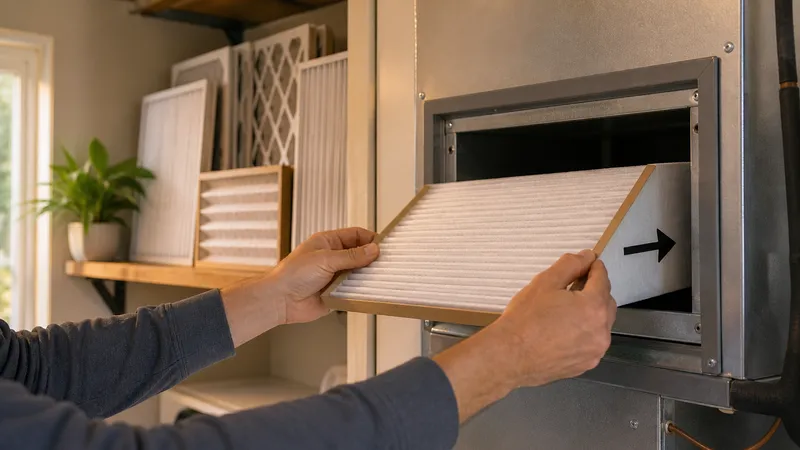
- Note the airflow-direction arrow printed on the frame; it should point toward the furnace or air handler, not back toward the room.
- If the slot is bare metal with no filter in it, measure the slot opening itself and buy to that measurement, sizing down slightly for a snug (not forced) fit.
Buying strictly off the printed number is the most common reason a “correct size” filter arrives loose enough to let air bypass it around the edges.
Signs it’s overdue, regardless of the calendar
A filter can need replacing before its typical interval is up, and the tell isn’t a date—it’s the filter and the system telling you directly:
| Sign | What it means |
|---|---|
| Visibly gray or matted, blocks light held up to it | The media is loaded with dust; airflow is already restricted |
| Noticeably weaker airflow at supply vents | The system is working harder to pull air through a clogged filter |
| Energy bill creeping up with no change in usage | ENERGY STAR notes dirty filters raise energy costs and can strain equipment |
| Musty smell when the system runs | Moisture or debris buildup on the filter or coil downstream |
| System short-cycling or running longer than usual | Reduced airflow can trip high-limit switches or just take longer to satisfy the thermostat |
When to call a professional
| Situation | Why it’s not a filter fix |
|---|---|
| Airflow stays weak after a confirmed fresh filter | Points to ductwork, blower, or refrigerant issues that need diagnostic tools |
| You’re unsure what MERV rating your system can handle | Requires checking equipment specs a technician has quick access to; guessing risks the blower motor |
| The filter is clean but the system still short-cycles | Likely a thermostat, sizing, or electrical issue unrelated to filtration |
| A media cabinet filter housing is damaged or won’t seal | An unsealed housing lets unfiltered air bypass the filter entirely |
Related guides
Frequently asked questions
How often should I replace a 1-inch HVAC filter?
Commonly every 30-90 days depending on filter type, pets, and allergies, but check it monthly. The U.S. Department of Energy’s Energy Saver guide and ENERGY STAR both recommend inspecting furnace, AC, or heat pump filters once a month and replacing sooner if they look dirty.
How long do 4-inch or 5-inch media filters actually last?
Typically 6 to 12 months in a normal household, because the pleated media has far more surface area than a 1-inch filter and takes longer to load up with dust before it restricts airflow. Households with pets, smokers, or renovation dust should still check partway through that window.
What does a higher MERV rating actually do?
A higher MERV number means the filter traps smaller particles more effectively, according to the EPA’s MERV rating guidance. The tradeoff is airflow resistance—the EPA and PNNL’s Building America Solution Center both note that installing a MERV rating higher than your system was designed for increases pressure drop and can strain the blower, so check your system’s maximum before upgrading.
Why doesn’t my new filter fit even though the size printed on it matches my old one?
The printed size is a nominal size, not the exact measured dimension—manufacturers round it for labeling. Filters usually run about 1/4 to 1/2 inch smaller than the number printed on the frame in at least one dimension, so measure the actual filter you’re replacing before ordering, not just the number on the frame.
How do I know a filter is overdue even if I haven’t hit the calendar date?
Look for a filter that’s visibly gray or matted enough to block light, noticeably weaker airflow at the supply vents, or a heating and cooling bill that’s crept up without a change in usage. Any of those means the filter is restricting airflow now, regardless of how many days it’s been.