
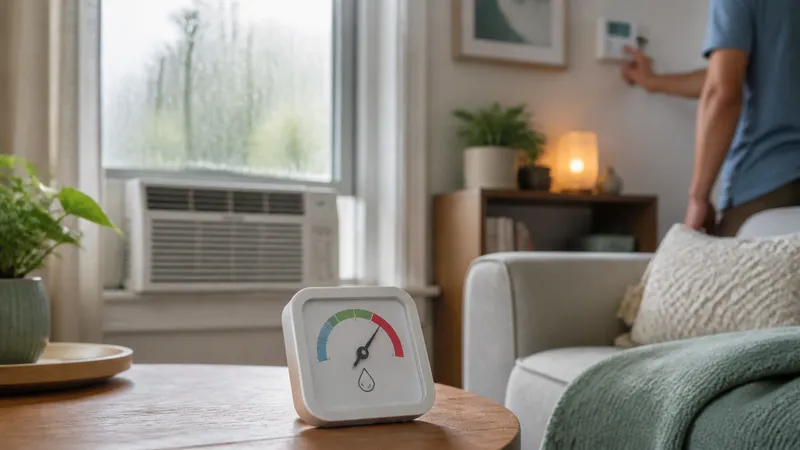
An AC dries air only as a side effect of cooling it. An oversized unit, a dirty coil, low refrigerant, or leaky ducts can all cut that side effect short.
Key takeaways
- EPA guidance: keep indoor relative humidity below 60%, ideally between 30% and 50%, to discourage mold and dust mites.
- An AC only removes moisture while its coil runs cold and wet long enough to condense it—ACCA puts that at roughly 10-15 minutes per cycle.
- An oversized AC cools the room and shuts off before that window closes, leaving you cold but clammy. This is short-cycling, not a broken unit.
- A dirty or frozen evaporator coil, low refrigerant, or leaky/undersized ducts can cut dehumidification even on a correctly sized system.
- If humidity stays above 55% with the AC running normally, ENERGY STAR-aligned guidance points to a dedicated or whole-home dehumidifier, not a colder thermostat setting.
- Stop and call an HVAC technician for suspected low refrigerant, a frozen coil, or persistent humidity despite a system that looks like it's working.
An air conditioner only removes moisture from indoor air as a side effect of cooling it—so a house can feel cold and still be humid if that side effect isn’t happening well. The EPA recommends keeping indoor relative humidity below 60%, ideally between 30% and 50% to discourage mold and dust mites. If your hygrometer reads higher than that with the AC running, the most common causes are an oversized unit that short-cycles, a dirty or frozen evaporator coil, low refrigerant, or leaky or undersized ductwork—each one cuts how much water the system actually pulls out of the air, even while the thermostat looks satisfied.
Why a cold house can still be humid
Cooling and dehumidifying are two different jobs that happen to share one machine. As air passes over the AC’s cold evaporator coil, water vapor condenses onto the coil and drains away—that’s the dehumidification. But the coil only gets cold and wet enough to condense much water after it’s been running for a while. ACCA-aligned HVAC guidance puts that ramp-up at roughly 10 to 15 minutes of continuous run time before a coil is pulling meaningful moisture out of the air. A system that satisfies the thermostat and shuts off before that point cools the room without drying it.
Likely causes, ranked by how common they are
| Cause | What you’ll notice | Fix |
|---|---|---|
| Oversized AC (short-cycling) | Cold air, but clammy skin and sticky floors; cycles under ~10 minutes even on mild days | Confirm with a timed cycle test below; often needs a right-sizing evaluation, not a repair |
| Dirty evaporator coil or clogged filter | Weaker airflow, longer cycles than usual, humidity creeping up over weeks | Replace the filter; a technician can clean the coil if airflow doesn’t recover |
| Low refrigerant / frozen coil | Ice visible on the indoor coil or refrigerant line, weak or warm-ish airflow, water pooling near the unit | Not a DIY fix—refrigerant work requires a licensed technician |
| Leaky or undersized ductwork | Some rooms cool fine, others stay warm and humid; attic or crawlspace ducts feel hot to the touch | Duct sealing/insulation or a duct redesign, usually by an HVAC contractor |
| Thermostat fan set to “on” instead of “auto” | AC blower runs constantly, even when the compressor is off, re-evaporating condensed water back into the air | Switch the fan setting to auto |
| Humid climate outpacing AC capacity alone | Muggy feeling in shoulder seasons (spring/fall) when the AC barely runs at all | A standalone or whole-home dehumidifier, not a colder thermostat setting |
Is it short-cycling, or a mechanical problem?
These two causes get confused because they can look similar—cold air, high humidity—but they call for opposite next steps.
Short-cycling test: Time a full cooling cycle with your phone. If the compressor kicks on, the room reaches the setpoint, and the unit shuts off in 5-10 minutes, and this repeats every few minutes on a mild day, that’s the signature of an oversized system. ENERGY STAR’s guidance on right-sizing air conditioners notes that a correctly sized unit runs longer, steadier cycles that both cool and dehumidify—an oversized one does neither well because it’s always shutting off early. ACCA’s Manual S limits single-stage equipment to roughly 15% above the Manual J calculated load; much more than that and dehumidification measurably suffers.
Mechanical fault signs: Ice on the indoor coil or the refrigerant line, airflow that feels weak or lukewarm instead of cold, hissing or bubbling sounds, or water pooling near the indoor unit. These point to low refrigerant or a coil that’s frozen over—not sizing—and they get worse, not better, if you keep running the system.
Dehumidifier vs. AC service call
| Situation | Best move |
|---|---|
| AC cools normally, cycles aren’t obviously short, but humidity stays above 55% | Standalone room dehumidifier, or a whole-home unit tied into the ductwork if it’s a whole-house problem |
| Timed cycles are consistently under 10 minutes and the AC feels “cold but clammy” | Get a right-sizing evaluation—a smaller or variable-speed replacement will dehumidify better than adding a dehumidifier on top |
| Ice on the coil, weak airflow, or suspected low refrigerant | Service call first. A dehumidifier can’t fix a mechanical fault, and it won’t stop ice from re-forming |
| Humidity is high but the AC barely runs (mild/shoulder-season weather) | Dehumidifier—there isn’t enough cooling load to run the AC long enough to dry the air |
| Specific rooms or the basement stay damp while the rest of the house is fine | A dedicated dehumidifier for that space, or a duct-leak check if it’s ducted to the same system |
ENERGY STAR’s dehumidifier sizing guidance recommends units sized by room size and how damp the space is measured in pints removed per 24 hours, and notes it’s better to size up than down. Whole-home systems tie into existing ductwork and run on a humidity sensor rather than the thermostat, so they can dry the house during shoulder-season weather when the AC has little reason to run. This page covers whole-house humidity specifically; if the real complaint is condensation on the glass itself, that’s a window and vapor-barrier issue, not an AC-sizing one.
For routine filter and coil maintenance that keeps a correctly sized system performing, see the HVAC maintenance hub—this page is about diagnosing why humidity stays high despite the AC running, not the maintenance schedule itself.
When to call a professional
| Situation | Why it is not DIY |
|---|---|
| Suspected low refrigerant charge | Sealed system; only a licensed technician can locate the leak and recharge it |
| Ice visible on the evaporator coil or refrigerant lines | Running a frozen system risks compressor damage; diagnosing the cause requires gauges |
| AC is significantly oversized for the space | Needs a Manual J load calculation and a right-sizing evaluation, not a DIY guess at “one size down” |
| Persistent mold, musty smell, or condensation despite normal-looking AC operation | Points to a hidden moisture source (crawlspace, duct leak, grading) that needs a professional assessment |
| Some rooms stay humid while ducts elsewhere feel scorching hot to the touch | Duct sealing and balancing is a specialized repair, not a filter-and-thermostat fix |
Related guides
Frequently asked questions
Why is my house humid even though the air conditioner is running and the thermostat says it’s cold?
The AC is doing its main job—cooling the air—but not its side job of removing moisture from it. That happens when the unit is oversized and shuts off before the coil runs cold long enough to condense water, or when a dirty coil, low refrigerant, or leaky ducts reduce how much moisture the system actually pulls out per cycle.
What indoor humidity level should I be aiming for?
The EPA recommends keeping indoor relative humidity below 60%, and ideally between 30% and 50%, to discourage mold growth and dust mites. A cheap digital hygrometer will tell you where your house actually sits.
How do I know if my AC is short-cycling versus actually broken?
Time a cooling cycle with a phone timer. If the compressor runs for 5-10 minutes, satisfies the thermostat, and shuts off repeatedly—especially on a mild day—that’s short-cycling from an oversized unit. If cycles run long but humidity still climbs, or you notice reduced airflow, ice on the indoor coil, or hissing, that points to a mechanical fault instead.
Should I buy a dehumidifier or get the AC serviced?
If your AC cools well, cycles look normal (not obviously short), and humidity still sits above 55%, a dedicated or whole-home dehumidifier is usually the right add-on. If the AC struggles to cool, ices up, or you suspect low refrigerant, book a service call first—a dehumidifier won’t fix a mechanical problem.
Can a bigger AC unit make humidity worse?
Yes. A unit sized beyond what ACCA’s Manual J load calculation calls for cools a room faster than it can dehumidify it, so it shuts off sooner and leaves more moisture behind each cycle. Manual S allows only about 15% over the calculated load for single-stage equipment before this becomes a real problem.