
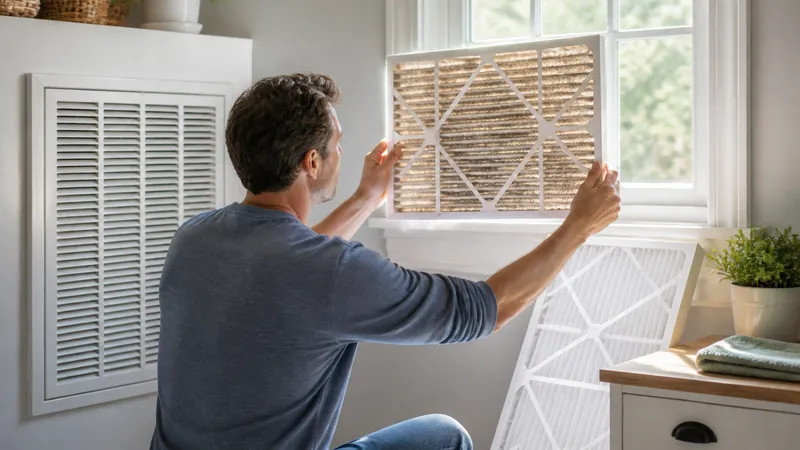
The short answer: monthly checks, 30–90 day changes for most 1-inch filters. A decision table for pets, smokers, and heavy summer use.
Key takeaways
- DOE's rule: check the filter monthly, change it monthly or as the manufacturer recommends.
- No pets, no allergies, running the AC normally: most 1-inch filters last 60–90 days.
- Pets, smokers, or renovation dust: change every 30–45 days instead.
- Hold the filter up to a light. If you can't clearly see light through it, replace it now.
- Running the AC nonstop in a heat wave pulls more air through the filter than occasional use, so it clogs faster.
- Skip the taxonomy: the filter-type and MERV-rating breakdown lives in the companion guide, linked below.
Check your AC filter once a month and replace it every 30 to 90 days, per the U.S. Department of Energy’s Energy Saver guide, which puts it plainly: “once a month or as recommended” by the manufacturer. For most homes running a standard 1-inch filter, that lands around 60–90 days if nobody smokes, nobody has pets, and the system isn’t running constantly. Add a dog, a cat, a smoker, or a heat wave, and that window shrinks fast.
This page is the quick answer. If you want the full breakdown by filter thickness (1-inch vs. 4-inch vs. 5-inch) and MERV rating, see HVAC Filter Replacement Schedule: 1”, 2”, 4” Filters Explained.
How often to change your AC filter, by household
| Household situation | Typical interval |
|---|---|
| No pets, no allergies, normal use | 60–90 days |
| One pet, mild shedding | 45–60 days |
| Multiple pets or an allergy sufferer in the house | 30–45 days |
| Smokers in the home | 30 days |
| Recent renovation, drywall, or sanding dust | 2 weeks, then reassess |
| Running the AC nearly nonstop (heat wave, always-on setpoint) | Shorten whatever interval above applies by about a third |
These are rule-of-thumb ranges, not a manufacturer spec — your filter’s packaging and your system’s manual override this table if they disagree.
The 10-second check: hold it up to a light
You do not need to guess. Pull the filter out, face a window or a lamp, and hold it up.
- Light passes through evenly — it’s fine, check again in a few weeks.
- Light is dim or patchy, or the filter looks gray/matted — replace it now, even if it’s early.
- You can’t see light at all — it should have been changed a while ago; airflow is already restricted.
This visual check works regardless of filter thickness, and it’s faster than tracking exact days on a calendar.
Why summer use changes the math
A filter only collects dust while air is actually moving through it. A system that runs nearly continuously during a heat wave pushes far more total air — and far more dust, pollen, and pet dander — through the filter than one that cycles on and off occasionally in mild weather. Two households with identical filters and identical air quality can be on completely different replacement schedules just based on how many hours the blower actually ran that month. If your thermostat has a runtime log, or your Housetto maintenance log shows the AC running most of the day for a week or more, treat that as a signal to check the filter early rather than wait for the next scheduled date.
For the hub covering AC and furnace maintenance more broadly, see the HVAC maintenance hub.
Related guides
Frequently asked questions
How often should you change your AC filter?
Check it every month. For most 1-inch filters, that means changing it every 30–90 days depending on pets, allergies, and how much the system runs. ENERGY STAR’s minimum is every 3 months even in light-use homes.
Can you tell if an AC filter needs changing just by looking at it?
Yes, mostly. Hold it up to a light source. A clean filter lets light pass through evenly. If it looks gray, matted, or blocks most of the light, replace it regardless of how many days it’s been.
Does running the AC all summer wear out the filter faster?
Yes. A filter only loads up with dust and debris while air is moving through it, so a system running nonstop in a heat wave reaches its dirt limit faster than one used occasionally in mild weather.
Do pets or smokers really need to change filters more often?
Yes. Pet dander and smoke particles are exactly the fine debris filters are built to catch, so homes with pets, smokers, or multiple allergy sufferers should plan on 30–45 day changes instead of the 60–90 day interval for a low-dust household.