
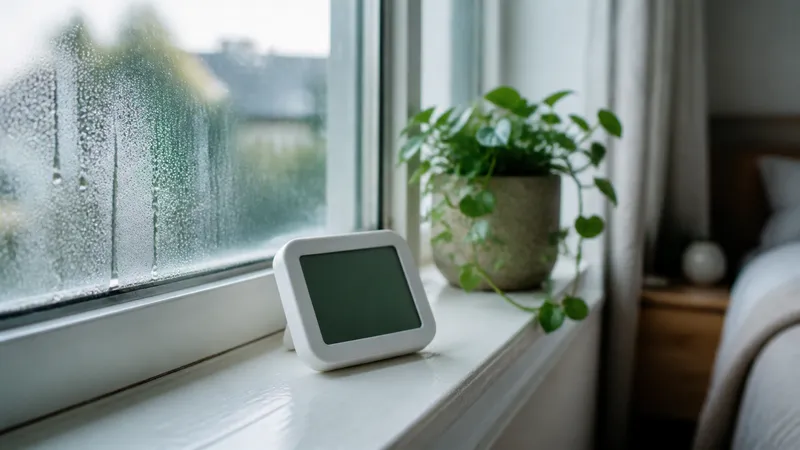
EPA guidance puts the mold risk line at 60% relative humidity, with 30-50% as the safer target. Here's the science behind that specific number.
Key takeaways
- The EPA sets 60% relative humidity as the threshold above which condensation and mold risk climb; it recommends staying between 30-50% when possible.
- The CDC recommends an even tighter target: no higher than 50% relative humidity, all day, not just at its lowest daily reading.
- Mold doesn't need standing water — sustained moisture and oxygen on an organic surface are enough, per EPA's mold science course.
- A cold surface (a basement wall, an uninsulated duct) can hit condensation-level moisture even when the room's overall air humidity reads fine.
- Wet materials need to dry within 24-48 hours to avoid mold growth starting, according to EPA — the threshold is about sustained exposure, not a single humid day.
- Humidity above 60% doesn't just risk mold — the EPA also links it to increased dust mite activity, a separate indoor air quality concern.
The EPA sets 60% relative humidity as the threshold above which condensation and mold growth become likely indoors, and recommends keeping indoor humidity below that — ideally between 30% and 50% — according to its guide “A Brief Guide to Mold, Moisture and Your Home.” The CDC’s mold guidance is stricter still, recommending no higher than 50% relative humidity all day. Neither number is arbitrary: above roughly 60% RH, warm indoor air is close enough to its dew point that it condenses on cooler surfaces — windows, basement walls, uninsulated ducts — and that condensation, not a flood or a leak, is often what feeds mold that homeowners can’t explain.
The two agency numbers, side by side
| Agency | Recommended ceiling | Ideal range | Source |
|---|---|---|---|
| EPA | Below 60% | 30-50% | A Brief Guide to Mold, Moisture and Your Home |
| CDC | No higher than 50%, all day | 30-50% (implied by the 50% ceiling) | CDC: Mold |
The practical read: treat 60% as the line you should never sit at continuously, and 50% or below as the actual day-to-day target — especially in a basement, bathroom, or humid climate where the air near a cold surface runs higher than what your hygrometer reads in the middle of the room.
Why 60%, specifically — the condensation mechanism
Mold doesn’t need a leak or standing water. EPA’s mold science course states plainly that mold can grow on virtually any organic material as long as moisture and oxygen are present — drywall paper, wood framing, and dust on a surface all qualify. The 60% number matters because of dew point: as relative humidity climbs, indoor air holds less of a temperature buffer before it reaches the point where water condenses out of it onto a cooler surface. Above roughly 60% RH, that buffer gets thin enough that ordinary cold spots in a house — a basement wall backed by cooler soil, an uninsulated duct, a window frame, a cold water pipe — start collecting condensation even though nothing “leaked.”
That’s also why a room can read an acceptable humidity on a hygrometer and still grow mold in one corner: the hygrometer measures the air in the middle of the room, not the surface temperature where warm air actually meets something cold. A basement wall a few degrees colder than the room air is exactly where condensation shows up first, independent of what the room’s overall reading says.
What pushes a room over the threshold
| Situation | Why it raises humidity or condensation risk |
|---|---|
| Basement or below-grade room | Cooler surface temperature than the rest of the house means condensation forms at a lower air humidity than upstairs |
| Bathroom or laundry room without exhaust venting outside | Steam and moist air have nowhere to go, spiking local RH well above the whole-house average |
| Humid climate, especially in summer | Outdoor dew point stays high, so AC or dehumidification has to work harder to hold the indoor target |
| Uninsulated cold-water pipe or duct | Cold surface temperature meets warm room air directly, producing condensation even in a room reading under 60% |
| A home closed up with cooking, showering, and no makeup air | Everyday moisture-generating activity accumulates without anywhere to vent |
When to call a professional
| Situation | Why it’s not DIY |
|---|---|
| Visible mold covering more than about 10 square feet | EPA guidance treats larger mold areas as a job for a professional remediation contractor, not a homeowner cleanup |
| Humidity stays above 60% even after running a dehumidifier and fixing obvious leaks | Points to a building-envelope issue (insulation, vapor barrier, grading) that needs an inspection, not just more dehumidifying |
| Condensation is forming inside wall cavities, not just on visible surfaces | Hidden moisture behind drywall needs a moisture meter and often thermal imaging to locate and assess |
| Mold returns repeatedly in the same spot after cleaning | The underlying moisture source — not just the mold — hasn’t been fixed; a building science or remediation pro can trace it |
| You have respiratory symptoms tied to a specific room | A doctor and a qualified indoor air quality assessment, not a DIY guess, are the right next step |
For the deeper dive into a specific musty-basement smell, see Why Does My Basement Smell Musty?, and for telling an existing spot apart, see How to Tell Mold from Mildew.
Related guides
Frequently asked questions
What exact humidity percentage causes mold to grow?
The EPA’s guidance sets 60% relative humidity as the level above which condensation and mold growth become likely, and recommends keeping indoor RH below that — ideally between 30% and 50% — as a working target. There isn’t a single universal percentage where mold switches on; 60% is the practical ceiling agencies use because condensation risk rises sharply above it.
Why does the CDC recommend 50% instead of the EPA’s 60%?
The CDC’s mold guidance recommends keeping humidity no higher than 50% all day, which is stricter than the EPA’s 60% ceiling but consistent with the EPA’s own 30-50% ideal range. Treat 60% as the outer limit you should never sit at continuously, and 50% or below as the safer day-to-day operating target, especially in humid climates or moisture-prone rooms like basements and bathrooms.
Does mold need standing water to grow, or is high humidity alone enough?
High humidity alone is enough. EPA’s mold science guidance states mold can grow on virtually any organic material as long as moisture and oxygen are present — it doesn’t require a flood or a visible leak. Sustained relative humidity above roughly 60%, especially against a porous surface like drywall or wood, can supply enough moisture on its own.
Why does mold grow on a basement wall even though my hygrometer reads under 60%?
Because a hygrometer measures air humidity in the room, not the surface temperature of a cold wall. When warm, humid air meets a colder surface, condensation forms right at that surface even if the room’s overall reading looks acceptable. Basement walls, uninsulated ducts, and cold water pipes are common spots where local condensation runs ahead of what your room’s hygrometer shows.
How fast does mold grow after a surface gets wet?
EPA guidance says materials need to dry within 24-48 hours to avoid mold growth starting. That window is the reason a sudden leak or spill is manageable if you dry it fast, but the same materials sitting at sustained high humidity day after day — even without a single dramatic wet event — cross the same threshold more slowly and less obviously.