
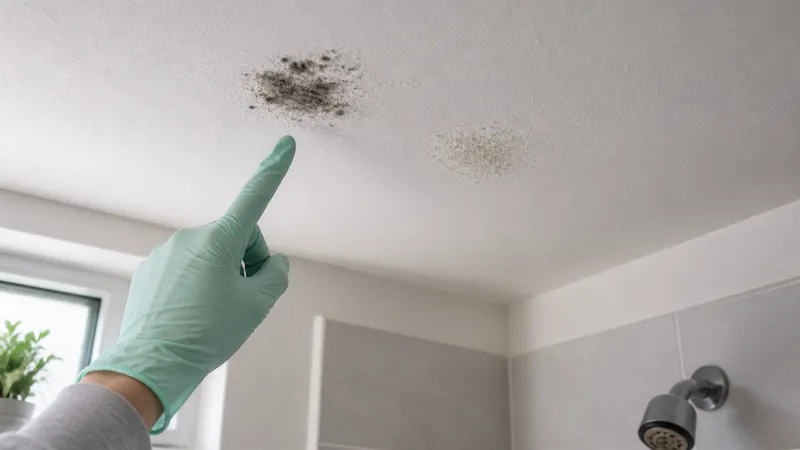
EPA guidance on the real difference between mold and mildew, how to tell them apart by sight, and when a patch is worth calling a pro.
Key takeaways
- The EPA defines mildew as certain kinds of mold with a flat growth habit—there's no separate species line between the two words.
- Mildew usually looks white, gray, or pale yellow and powdery, sitting on the surface of tile, grout, or fabric.
- Mold usually looks darker—black, green, or blue—and can look fuzzy or raised as it grows into a porous material like drywall or wood.
- A patch that wipes off easily with soap and water and doesn't return within days behaves like surface mildew, not established mold.
- Color and texture are a first read, not a lab result—when it matters (health-sensitive household, large area), treat the visual call as provisional.
- Stop guessing and call a professional past roughly 10 square feet of growth, per EPA cleanup guidance, or when it's inside HVAC ductwork.
There’s no real scientific line between mold and mildew—the EPA describes mildew as “certain kinds of mold or fungus,” with the term commonly used for mold growth that stays flat on a surface rather than growing into it. In practice, that difference is still useful to a homeowner: mildew usually reads as a thin, pale, powdery patch you can wipe off, while what people call “mold” usually reads as darker, thicker, and rooted into whatever it’s growing on. Neither word tells you the exact species, and neither changes the first step—find the moisture, then clean what’s there.
The quick visual sort
| Trait | Typically “mildew” | Typically “mold” |
|---|---|---|
| Color | White, gray, or pale yellow | Black, green, blue, or dark brown |
| Texture | Flat, dry, powdery | Fuzzy, raised, sometimes slimy |
| Where it sits | On top of the surface (tile, grout, fabric) | Grows into porous material (drywall, wood, carpet backing) |
| Common locations | Shower tile, window sills, damp fabric | Basement walls, behind drywall, under carpet, in ductwork |
| How it responds to a soap-and-water wipe | Usually comes off and doesn’t return within a few days if the surface stays dry | Often lightens but returns, or the material stays discolored and stained |
| Smell | Mild, musty | Often stronger and more persistent |
Treat this as a sorting tool, not a verdict. A patch that looks like mildew on drywall—porous, not tile—can still mean deeper growth than the surface shows, because drywall doesn’t behave like tile or grout.
What each one usually means for your next step
| What you see | Likely situation | Do this |
|---|---|---|
| Small, flat, white or gray patch on shower tile or a window sill | Surface mildew from routine condensation | Clean with detergent and water; run the bathroom fan longer or crack a window afterward |
| Dark, fuzzy patch on drywall, wood trim, or a basement wall | Mold established in a porous material | Assess the size (below), clean if it’s a small, hard-surface-adjacent patch, or call a pro if it’s spreading into drywall |
| Any patch, regardless of color, that’s grown since you last looked | Active, ongoing moisture source | Trace the moisture before cleaning again—see why your basement smells musty if there’s an odor with no clear visible source |
| Patch returns within days of cleaning, same spot | Moisture source untouched | Find and fix the leak, condensation, or ventilation gap, not just the visible spot |
| Musty smell with nothing visible anywhere | Could be either, hidden behind a surface | See why your basement smells musty for how to trace an odor with no visible source |
Cleaning what you can, safely
For a small, contained patch on a hard, non-porous surface, EPA cleanup guidance treats areas under about 10 square feet—roughly a 3-foot by 3-foot patch—as generally homeowner-manageable:
- Wear gloves and, if you’re sensitive, an N95-style mask. You don’t need a hazmat suit for a shower-tile patch, but don’t scrub it bare-handed either.
- Clean with detergent and water, not bleach as a first choice—EPA guidance doesn’t require bleach for a basic cleanup, and it can bleach or damage some surfaces without killing growth below the surface.
- Dry the area completely afterward. A clean-but-still-damp surface just regrows.
- Fix what made it damp—a fan that doesn’t vent outside, condensation on a cold pipe, a slow leak—or the same spot returns.
- Discard porous material that stayed wet for more than about 48 hours (drywall, carpet padding, insulation)—cleaning the surface won’t reach growth that’s already inside it.
When to call a professional
| Situation | Why it is not DIY |
|---|---|
| Growth covers more than roughly 10 square feet | Past the size EPA considers homeowner-manageable; disturbing a larger area risks spreading spores through the house |
| It’s inside HVAC ductwork or keeps returning near a supply vent | Can recirculate spores through the whole house; needs HVAC-specific remediation |
| You can’t tell if it’s surface mildew or growth that’s penetrated drywall or wood | Guessing wrong means cleaning the surface while the real problem keeps growing underneath |
| It followed a flood, sewage backup, or a long-term leak | Water damage at that scale usually means contaminated, saturated materials beyond a surface cleanup |
| A household member has asthma, allergies, or a compromised immune system | Health risk changes the acceptable timeline and thoroughness of the fix |
Related guides
Frequently asked questions
Is there an actual scientific difference between mold and mildew?
Not really. The EPA describes mildew as certain kinds of mold or fungus, using the term generically for mold growth with a flat growth habit. Both are fungi; “mildew” is common usage for a surface-level appearance and behavior, not a separate biological category from mold.
How can I tell mold from mildew just by looking at it?
Mildew tends to look white, gray, or pale yellow, dry, and powdery, staying flat on the surface of tile, grout, or fabric. Mold tends to look darker—black, green, or blue—and can appear fuzzy, slimy, or raised, especially where it’s grown into a porous material like drywall, wood, or carpet backing rather than just sitting on top of it.
Does mildew turn into mold if I don’t clean it?
Since mildew is a type of mold rather than a separate organism, an established colony that isn’t cleaned and dried out tends to spread and can start to penetrate the material it’s on rather than staying a thin surface layer. The distinction matters less than getting to the moisture source before either one spreads.
Can I clean mold or mildew myself, or do I need a professional?
A small, contained patch—under roughly 10 square feet, per EPA cleanup guidance—on a hard, non-porous surface is generally homeowner-manageable with detergent, water, and gloves. Larger areas, porous materials with heavy growth, HVAC ductwork, or a household member with asthma or a compromised immune system are reasons to bring in a professional instead.
Why does my bathroom keep getting the same spot back after I clean it?
If the surface growth keeps returning in the same place, the moisture source—condensation, a slow leak, or a fan that isn’t venting outside—was never fixed, only the visible growth was. Cleaning without addressing the humidity or water behind it is a temporary fix, not a real one.