
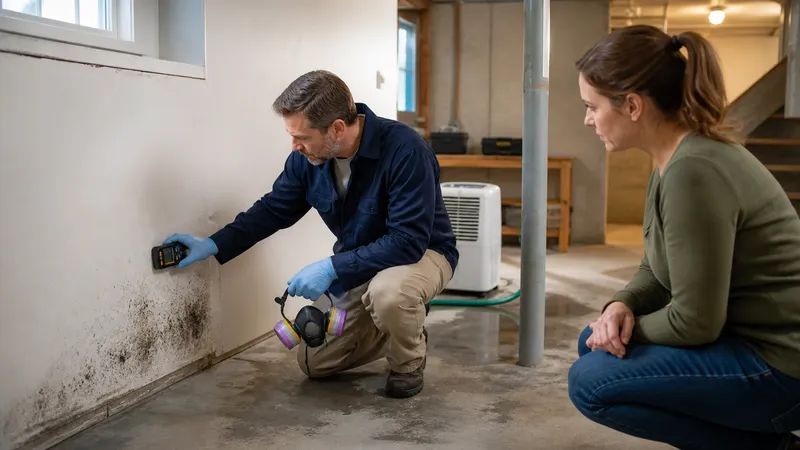
Visible mold on an inspection report is rarely an automatic dealbreaker. Here's how to weigh testing, remediation cost, and what to negotiate before closing.
Key takeaways
- EPA says small mold areas may be suitable for homeowner cleanup in some circumstances; that threshold does not determine whether a home is safe to buy.
- Standard ASHI-style inspections identify visible mold but do not test for it or determine air quality; testing is a separate, optional step.
- Professional mold remediation runs roughly $1,200-$3,800 nationally in 2026, or about $10-$25 per square foot, before any drywall or flooring replacement.
- Negotiate a credit or a seller-completed fix with a signed clearance, not just 'seller will clean it'—get the remediation scope in writing before closing.
- Treat mold as a symptom: if it shows up near a roof leak, crawlspace, or basement wall, get the moisture source diagnosed, not just the mold removed.
- Stop and get a specialist assessment for mold near HVAC ductwork, mold covering a large wall or ceiling area, or a household member with asthma or a compromised immune system.
A mold finding needs a clear picture of the moisture source, the extent of damage, and the cost and scope of the fix before you decide whether to proceed with a purchase. A repair or credit may be an option, but that is a transaction decision to discuss with your inspector, agent, and any relevant specialist.
The EPA’s mold cleanup guidance says homeowners can often clean areas smaller than about 10 square feet themselves, with important exceptions. That is a cleanup guideline, not an endorsement of a property purchase or a measure of health risk. Suspected HVAC contamination, contaminated water, significant water damage, hidden spread, or health concerns need appropriate specialist advice regardless of patch size.
This page is the transaction-specific piece: what to do when mold turns up mid-purchase, on an inspection report, with a closing date on the calendar. It doesn’t cover ongoing homeowner moisture management once you own the house—see basement waterproofing and leak prevention and why a house stays humid even with the AC running for that. For everything else an inspector might flag on the report, see the new homeowner hub.
Is it a dealbreaker or a negotiable item?
Most mold findings sort into one of three buckets. Use this to figure out which conversation you’re about to have with the seller or agent.
| What the report shows | What it usually means | Your move |
|---|---|---|
| A small, visible patch (roughly under 10 sq ft) tied to an obvious cause—condensation on a window, a slow supply line leak | A contained, fixable cleanup, per EPA guidance | Negotiate a credit or ask the seller to remediate before closing; not a reason to void the contract |
| Mold on multiple surfaces, a large wall or ceiling area, or a strong musty odor with no visible source | Likely a bigger moisture problem than the visible patch suggests—could be behind walls or under flooring | Request a mold inspection and a moisture-source diagnosis before deciding; don’t accept a surface-only cleanup quote |
| Mold in or near HVAC ductwork, or reported after a flood, sewage backup, or long-term roof leak | Contaminated air handling or a moisture source that’s been active for a long time | Get a specialized HVAC and remediation assessment; this is a bigger scope and cost than a wall patch |
| Mold disclosed by the seller but not found by your inspector, or vice versa | A documentation gap that can complicate your contingency timeline | Get it in writing either way—what was seen, where, and what (if anything) was done about it |
| Cosmetic dark staining that a moisture meter shows is dry and inactive | Old moisture event, not active growth | Confirm with a moisture meter reading before paying for remediation on something already resolved |
Severity, not the word “mold” on the page, is what should drive your next call. A one-square-foot bathroom ceiling spot behind a small vent fan is a different conversation than a musty crawlspace nobody has looked at in years.
Testing vs. relying on the visual finding
EPA says sampling is usually unnecessary when mold is visible. There are no federal airborne mold limits that a test can use to certify a home as safe. If sampling would answer a specific assessment or cleanup question, a professional with relevant sampling experience should design and interpret it. Fixing the moisture source and assessing the extent of damage remain essential.
| Situation | Test for mold? | Why |
|---|---|---|
| Small, clearly identified patch with an obvious moisture cause | Usually skip it | You already know it needs cleanup; a species ID won’t change that |
| Seller disputes the inspector’s finding or claims it’s “just dirt” | Ask a qualified assessor whether sampling helps | Sampling may clarify the material, but does not settle the scope of damage or a contract dispute |
| Strong musty smell with no visible mold | Start with a moisture and building assessment | Identify the source; the assessor can decide whether sampling would add useful evidence |
| A household member has asthma, allergies, or a weakened immune system | Consult a health professional and qualified building assessor | EPA recommends health advice when there are health concerns; a sampling result alone cannot establish safety |
| Buying based on a seller’s remediation claim from months earlier | Arrange an independent review of the work and documentation | The assessor can decide whether surface sampling or other checks would help evaluate cleanup |
A basic visual/moisture inspection from a mold professional typically runs $200-$600; adding lab sampling for species identification or air quality usually adds another $200-$400. Get a quote local to your market rather than assuming a national figure applies.
What remediation actually costs
| Scope | Typical 2026 cost | Notes |
|---|---|---|
| Professional remediation, national average | ~$2,400, typical range $1,200-$3,800 | Angi’s 2026 cost data; containment and removal, not rebuild |
| Per square foot | $10-$25/sq ft | Scales with affected area; small bathroom job lands at the low end |
| Drywall, insulation, or flooring replacement | Added on top of remediation | Porous materials with heavy growth usually have to be cut out and replaced, not just cleaned |
| Small DIY-scale patch (under ~10 sq ft, non-porous surface) | Cleaning supplies only, often under $50 | Only appropriate for the size and surface EPA describes as homeowner-manageable |
| Post-remediation clearance test | ~$200-$400 | Confirms the area passed before you rely on a seller’s “it’s fixed” claim |
What moves the number: the affected square footage, whether porous materials (drywall, carpet, insulation) have to be torn out, whether the mold is in a hard-to-access spot like a crawlspace or attic, and whether the underlying moisture source—a roof leak, a crawlspace vapor barrier, grading, or a plumbing leak—also needs a separate repair. A remediation quote that doesn’t mention fixing the moisture source is an incomplete quote.
Negotiating: credit vs. seller-fixes-before-close
| Approach | What it looks like | Watch for |
|---|---|---|
| Price reduction / closing credit | Seller lowers the price or gives cash at closing equal to a contractor quote you obtain | You take on the remediation after closing—get at least one written quote before agreeing to an amount |
| Seller completes remediation before closing | Seller hires and pays a remediation company; you require proof before closing | Ask for the contractor’s invoice, scope of work, and a post-remediation clearance test, not just a verbal “it’s handled” |
| Escrow holdback | Funds held by the title/escrow company until remediation is completed and verified, sometimes after closing | Needs a written agreement on the amount, the deadline, and who verifies completion |
| Request for repair as part of your inspection contingency | Formal request through the purchase contract, with a deadline for the seller to respond | Your contract’s inspection contingency window is what gives you leverage—check the deadline before it lapses |
A credit is usually simpler for you: you control the contractor and the timeline instead of trusting the seller’s contractor. Seller-completed remediation only makes sense with real verification—an invoice, a scope of work, and ideally a clearance test—attached to the closing paperwork. “The seller says it’s fixed” is not verification.
When mold signals a bigger moisture problem
Mold itself is a symptom. The EPA’s core guidance is direct: “the key to mold control is moisture control.” Before you sign off on a cleanup-only fix, ask where the moisture is coming from and whether that source needs its own repair:
- Basement or crawlspace mold often traces back to grading or downspouts dumping water at the foundation, or high indoor humidity with no dehumidification—see basement waterproofing and leak prevention for how that gets diagnosed.
- Bathroom or laundry room mold is frequently a ventilation problem—no exhaust fan, or a fan venting into the attic instead of outside.
- Whole-house musty smell with no single visible patch can point to chronically high indoor humidity; see why a house stays humid even with the AC running for the mechanical causes.
- Mold near a window or exterior wall often means a roof or flashing leak upstream, not a problem with that wall itself.
If the remediation quote only addresses the mold and not the moisture source, you’re paying to solve the same problem again in a year or two. Ask the contractor to name the source in the scope of work, not just the surface treatment.
When to call a professional
| Situation | Why it is not DIY |
|---|---|
| Mold covering more than roughly 10 square feet, or on multiple surfaces | EPA directs readers to more detailed remediation guidance; a qualified assessment can establish the appropriate scope and controls |
| Mold in or near HVAC ductwork | Can recirculate spores through the whole house; requires HVAC-specific remediation, not a wipe-down |
| Mold following a flood, sewage backup, or long-term leak | Water damage of that scope usually means contaminated materials and hidden moisture beyond what’s visible |
| A household member with asthma, severe allergies, or immune compromise | Health risk changes the acceptable timeline and thoroughness of the fix |
| You can’t identify or reach the moisture source (behind a finished wall, under flooring) | Diagnosing hidden moisture is a specialized job—guessing risks missing the real cause |
| Seller disputes the finding or its cause | An independent mold inspector’s report is stronger negotiating ground than a disagreement in email |
A visual check, a photo for the file, and a written quote are the right next step once a finding is past small-and-obvious. That’s not overreacting—it’s what turns “there’s mold” into a number you can actually negotiate.
Related guides
Frequently asked questions
Is finding mold during a home inspection a dealbreaker?
Usually not by itself. A small, visible patch tied to an obvious, fixable moisture source (a leaky supply line, a clogged gutter) is a common, negotiable finding. It becomes a bigger issue when it’s extensive, hidden behind walls or in HVAC ducts, or tied to a moisture source the seller can’t or won’t fix before closing.
Does a home inspector test for mold?
Not as part of a standard visual inspection. ASHI’s Standards of Practice explicitly exclude mold and other biological substances, along with broader indoor air quality and environmental hazards, from what a general inspector is required to determine. An inspector can flag what they see and smell, but confirming mold type or airborne spore levels requires a separate mold inspector or industrial hygienist.
Who pays for mold remediation when buying a house?
It’s negotiated case by case, usually as a credit at closing, a price reduction, or the seller completing remediation before closing with proof of clearance. There’s no standard rule—it depends on your contract’s contingency terms and how much leverage the finding gives you.
How much does mold remediation cost before closing?
Professional remediation runs roughly $1,200 to $3,800 nationally as of 2026, or about $10 to $25 per square foot, according to Angi’s cost data. That estimate covers containment and removal only—if drywall, insulation, or flooring has to come out, the total climbs, and a contractor’s on-site quote is the number to negotiate with, not a national average.
Should I get a mold test before closing?
EPA says sampling is usually unnecessary when visible mold is present. Ask a qualified mold professional whether a specific sampling question would change the assessment; a test is not a general certificate of safety. If a household member has health concerns, consult a health professional before cleanup or move-in.