
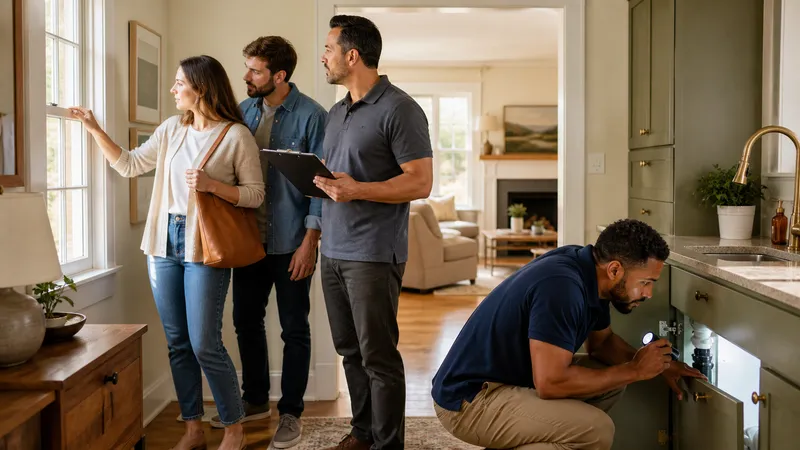
A room-by-room home inspection checklist: what to personally check in each room during the showing or walkthrough, and what your inspector won't test.
Key takeaways
- Walk the exterior, roof line, attic, basement or crawlspace, every room, the garage, and the electrical panel yourself—your inspector's report and your own eyes should cover the same ground independently.
- A general home inspection under the ASHI or InterNACHI Standards of Practice does not include mold, radon, pests, water quality, or a sewer-line camera scope. Arrange radon testing regardless of zone; ask about other assessments based on the property.
- HUD is explicit: an appraisal is not a home inspection. An appraisal protects the lender's loan amount; only an inspection evaluates the home's condition for you.
- Bring a flashlight, phone camera, and outlet tester; test every faucet, flush every toilet, and open every window and door yourself during the showing.
- Homes with mature trees or clay/cast-iron sewer lines, older homes, and homes with wells or septic systems need add-on inspections a standard visual inspection won't cover.
- Stop and call a licensed pro for anything involving the gas line, the electrical panel's interior, a steep roof, or a sewage or active water leak—these aren't homeowner-level checks.
A home inspection checklist for a first-time buyer has two separate jobs: what the professional inspector checks against a formal standard, and what you personally look at during the showing or the inspection walkthrough. The HUD “For Your Protection: Get a Home Inspection” notice is direct about this split—a home inspection “evaluates the physical condition” and “estimates the remaining useful life” of the home’s systems, and it explicitly warns that a mortgage appraisal is not a home inspection and does not protect you the same way. This page is your own room-by-room list to work alongside a licensed inspector, not a substitute for hiring one. If you already have an inspection report in hand and are trying to weigh which findings are serious, that’s a different job—this one is about what to look at yourself, room by room, before you’re staring at a 40-page PDF. Start with the first-time homeowner hub for the rest of the buying-to-moving-in sequence.
The room-by-room checklist at a glance
| Area | What you personally check | Why it matters |
|---|---|---|
| Exterior & grounds | Grading, siding, foundation cracks visible at grade, driveway, gutters | Water direction and structure are the two most expensive categories to get wrong |
| Roof & attic | Roofline sag, missing shingles from ground level, attic for stains, insulation, and daylight through the roof deck | Roof replacement is one of the largest line-item costs on a home |
| Basement / crawlspace | Moisture, efflorescence (white mineral crust), musty smell, foundation cracks | Early water intrusion signs are easy to miss and expensive to ignore |
| Kitchen | Every faucet, disposal, dishwasher, cabinet under the sink, GFCI outlets | High-traffic plumbing and electrical concentration |
| Bathrooms | Flush every toilet, run every faucet and shower, check caulk and grout, test the fan | Small leaks here cause the most common water-damage claims |
| Bedrooms & living areas | Windows open and lock, outlets work, ceiling and wall stains, floor level | Cheap items to check, expensive to discover after closing |
| Garage | Door opener and auto-reverse safety, floor cracks, if converted living space, permits | Auto-reverse safety is a real injury risk if it’s not working |
| Mechanical systems | Electrical panel exterior, water heater age tag, HVAC filter and age, main shutoffs | These carry the biggest deferred-maintenance costs in the first year |
Exterior, roof, and attic
Start outside, before you’re distracted by paint colors and countertops.
| What to check | Look for | If you find it |
|---|---|---|
| Grading around the foundation | Soil sloping toward the house instead of away from it | Water pooling at the foundation is a common cause of basement leaks—flag it for the inspector |
| Siding and trim | Soft spots, peeling paint at specific spots (not overall wear), gaps at window and door trim | Localized soft or peeling areas often mean water is getting behind the material there |
| Foundation at grade | Cracks wider than a quarter-inch, horizontal cracks, or a crack that’s visibly stepped | Ask your inspector to assess directly—this is a case where you note it and let a professional call it |
| Roofline (from the ground or a low ladder) | Sagging ridge line, missing or curled shingles, visible patch repairs | A sagging ridge line can mean structural movement, not just an old roof |
| Gutters and downspouts | Downspouts that dump water right at the foundation instead of extending away | An easy, cheap fix that prevents a much more expensive foundation problem |
| Attic (if accessible) | Water stains on the underside of the roof deck, daylight coming through, matted-down insulation | Any of these point to an active or past roof leak worth asking about directly |
The ASHI Standard of Practice requires the inspector to walk the visible and accessible roof, exterior, and structure—but they’re not required to walk on the roof itself, enter an attic with less than 30 inches of clearance, or determine the cause of a crack. That’s exactly the gap your own eyes and questions fill.
Basement, crawlspace, and foundation
| What to check | Look for | Why it matters |
|---|---|---|
| Walls and floor | Efflorescence (a white, chalky mineral crust), staining, or a musty smell | Classic signs of past or ongoing moisture, even if it looks dry today |
| Sump pump (if present) | Presence of a pit and pump, whether it looks recently used | A sump pump that’s clearly been running hard is a clue the lot has a water problem |
| Support posts and beams | Visible cracking, rot, or a post that isn’t plumb | Structural issues here are not DIY territory—flag for your inspector |
| Crawlspace access | Standing water, exposed dirt with no vapor barrier, pest droppings | These conditions feed mold and pest problems even when the rest of the house looks fine |
Kitchen, bathrooms, and living spaces
This is the room-by-room part most first-time buyers skip because it feels rude to open cabinets at a showing. Do it anyway—so does the inspector.
| Room | What to personally test | What it tells you |
|---|---|---|
| Kitchen | Run every faucet, run the disposal, run the dishwasher a few minutes, open the cabinet under the sink | Weak flow, slow drains, or a damp cabinet floor are all worth a follow-up question |
| Every bathroom | Flush every toilet, run every faucet and the shower, check caulk lines and grout for gaps or dark stains, test the exhaust fan | A toilet that runs constantly or a fan that doesn’t pull air are common, inexpensive fixes—but ask if there are more of them |
| Bedrooms & living areas | Open and close every window, test every outlet you can reach, look at ceilings and walls at the corners for stains, check that floors feel level | Windows that won’t open easily often mean a settling frame, not just paint buildup |
| Laundry area | Check the dryer vent path and washing machine supply hoses | Rubber supply hoses over 5 years old are a leading cause of appliance-related water claims |
Garage and mechanical systems
| Area | What to check | Why it matters |
|---|---|---|
| Garage door | Auto-reverse safety (place a paper towel roll under the closing door—it should reverse) | A door that doesn’t auto-reverse is a real entrapment hazard, not a minor deficiency |
| Garage floor and walls | Cracks, water stains, and whether any living space conversion looks permitted | Unpermitted conversions can affect insurance and resale, worth asking the listing agent directly |
| Electrical panel (exterior only) | Panel brand, any obvious rust or scorch marks around it, whether it’s labeled | Note the brand and age for the inspector—some older panel brands (like Federal Pacific or Zinsco) carry known safety concerns worth a direct question |
| Water heater | Age on the manufacturer’s data tag, visible rust at the base or fittings | Tank water heaters typically run 8–12 years; know what you’re inheriting |
| HVAC | Filter condition, unit age on the data tag, whether it’s running when you visit | Confirms the system actually cycles, not just that it’s installed |
| Main shutoffs | Locate the main water shutoff and the electrical panel location | You’ll need to find these fast on day one regardless of what the inspection finds |
What a standard inspection does not cover
This is the part most first-time buyers get wrong: they assume “home inspection” means everything. It doesn’t. Under ASHI’s Standard of Practice, a general home inspector is not required to test or determine several things that matter a lot to a buyer.
| Not included in a standard inspection | What to do instead |
|---|---|
| Mold, radon, or other environmental hazards | Ask about separate assessments. Test for radon regardless of zone; other environmental tests depend on the finding and local requirements |
| Wood-destroying insects and pests | A separate termite/pest inspection, often required by some lenders in certain regions |
| Water quality or septic system function | Needed for any home on a well or septic system—not part of a general inspection |
| Sewer line condition (a camera scope) | ASHI’s Standard specifically lists “cameras or other equipment used to inspect the interior of a drain or sewer line” as not required—ask for a sewer scope separately, especially with mature trees nearby |
| Code compliance, permits, or the age/remaining life of systems | The inspector reports condition as observed, not compliance history or a guaranteed lifespan |
| Testing smoke or CO alarms | The Standard doesn’t require the inspector to test them—NFPA recommends testing every alarm yourself monthly and replacing any alarm 10 years from its manufacture date |
Homes that need more than the standard checklist
| Situation | What to add | Why |
|---|---|---|
| Home is 20–30+ years old | Sewer scope, and a closer look at panel brand and knob-and-tube or aluminum wiring | Older infrastructure ages out of its useful life around this range |
| Mature trees near the sewer line | Sewer scope | Root intrusion is one of the most common causes of a collapsed or blocked lateral line |
| Well water | Water quality test | Not covered by a standard inspection at all |
| Septic system | Septic inspection and pump-out history | Also outside the standard inspection’s scope |
| Any home, regardless of its EPA radon zone | Radon test | EPA recommends testing homes regardless of zone; confirm transaction-specific testing requirements |
| Condo or multi-unit | Confirm what the HVAC and common elements are covered by an inspection—ASHI’s Standard excludes common elements in multi-unit housing | Your unit-only inspection may not cover shared systems |
When to call a professional
| Situation | Why it’s not DIY |
|---|---|
| Any crack, gap, or stain at the foundation | Only a professional should determine whether it’s cosmetic settling or structural |
| A gas odor, gas appliance, or gas line | Combustion and leak risk—stop and let the inspector or utility handle it |
| Anything inside the electrical panel | Risk of shock; the panel interior is inspector territory, not buyer territory |
| A roof you can’t see from the ground or a low, stable ladder | Fall risk—your inspector has the training and equipment for this |
| Suspected mold, sewage odor, or standing water | These need specialized testing and remediation, not a visual guess |
| Anything the inspector flags as “further evaluation recommended” | That phrase means a specialist, not a second opinion from a friend who “knows houses” |
Related guides
Frequently asked questions
What should a first-time buyer personally check during a home inspection?
Walk the same path as your inspector: test every faucet and flush every toilet, open and close every window and door, look under sinks and around the water heater for stains, check the attic and basement or crawlspace for moisture or sagging, and test GFCI outlets in the kitchen and bathrooms. Bring a flashlight and take photos of anything questionable to ask the inspector about directly.
Can I attend my own home inspection?
Yes, and you should. Most inspectors expect and encourage the buyer to walk through with them, especially near the end, when the inspector points out and explains anything significant in person—photos in a PDF report are harder to fully understand than seeing the issue and asking a question on the spot.
What does a standard home inspection not cover?
Under the ASHI Standard of Practice, a general home inspection does not test for mold, radon, wood-destroying insects, water quality, or septic function, and it does not include a camera scope of the sewer line. It’s also not required to identify age or remaining useful life of components, or determine code compliance. These require separate assessments; radon can be measured with a homeowner kit unless the transaction or local rules require a qualified tester.
Do I need a separate sewer scope inspection?
It’s not part of a standard inspection, so you have to ask for it and pay separately, typically $100–$300. It’s worth it for homes over 20–30 years old, homes with mature trees near the sewer line, or homes on clay or cast-iron sewer pipe—those are the situations where a camera scope catches root intrusion or a collapsed line that a visual inspection can’t see.
How long does a home inspection take, and should I be there the whole time?
Plan for two to four hours depending on the size and age of the home. You don’t need to shadow the inspector for every minute—many buyers arrive partway through and focus on being present for the roof, attic, basement, electrical panel, and final walkthrough, where the inspector explains the findings in person.