
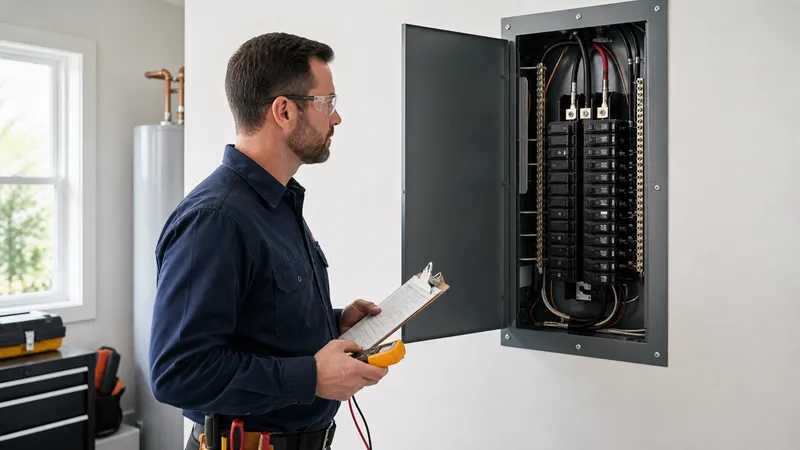
The specific triggers that call for a paid electrical panel inspection or load calculation, what the visit covers, and 2026 upgrade cost ranges.
Key takeaways
- Buying a home with no panel history, adding an EV charger or hot tub, an insurer flagging your panel, or a house over 40 years old with no upgrade record all justify a paid inspection.
- A real inspection includes a load calculation under NEC 220.82, not just a look at the breakers—ask for it by name when you get a quote.
- A 100A-to-200A upgrade runs about **$1,300–$3,000** for panel and labor in 2026; a full service upgrade with a new mast and meter can run **$5,000–$12,800**.
- Federal Pacific Stab-Lok and Zinsco panels get flagged by many insurers during underwriting—some carriers decline or non-renew a policy until the panel is replaced.
- Your existing load already at or near 80% of the panel's rated capacity is the code-level trigger for an upgrade, not a guess about how many things are plugged in.
- This is a decide-if-you-need-a-pro article, not a DIY checklist—every trigger below ends in the same phone call.
If you’re asking whether to pay for an electrical panel inspection or upgrade, the short answer is: get one before you buy a house with an unknown panel history, before you add a major load like an EV charger or hot tub, if your insurer flags the panel during underwriting, or if the house is over 40 years old with no record of a panel upgrade. Those four triggers cover most of the reasons a homeowner ends up calling an electrician about the panel specifically, rather than doing the monthly visual checks that catch problems early. This page covers what a professional inspection or load calculation actually involves and what a panel upgrade costs in 2026, so you can tell a thorough quote from a rushed one.
When a professional panel inspection is worth paying for
| Trigger | Why it matters | Typical scope of the visit |
|---|---|---|
| Buying a home with no panel history | A general home inspection is visual only—it won’t run a load calculation or confirm the panel’s actual condition inside | Panel brand/model ID, dead-front removal, a load calculation, and a written condition report |
| Planning a renovation or adding a major load (EV charger, hot tub, induction range, heat pump, room addition) | New fixed loads can push total demand past what the existing service was sized for | A load calculation under NEC Article 220, plus a recommendation on whether the existing service supports the addition |
| Your insurer flags the panel during underwriting or a renewal inspection | Many carriers won’t write or renew a policy on a Federal Pacific Stab-Lok or Zinsco panel; Florida carriers reject Federal Pacific panels at high rates, and some require replacement within 30 days | Panel ID and condition assessment, often followed by a same-brand replacement quote to satisfy the carrier |
| Home is over 40 years old with no upgrade record | Panels from that era are commonly rated under 100 amps and weren’t sized for central AC, an electric range, and EV charging together | Load calculation compared against the panel’s rated capacity, with a pass/fail-style recommendation |
| A four-point inspection is required (common for homes 20+ years old in some states, including Florida) | Insurers use these to underwrite older homes; the electrical section specifically checks panel brand and wiring type | A licensed inspector or electrician documents panel condition, wiring type, and any visible hazards for the carrier |
What a professional inspection or load calculation actually involves
A homeowner can look at the panel from outside—rust, a burning smell, a breaker that won’t stay reset—but that’s not what you’re paying an electrician for. A proper professional visit removes the dead front (the inner cover) and does three things a visual check can’t:
- Identifies the panel by brand, model, and rated amperage, and checks it against known problem brands (Federal Pacific Stab-Lok, Zinsco/Sylvania, some Challenger models).
- Runs a load calculation. NEC Article 220 gives the method: add up the connected loads (general lighting, small-appliance circuits, the range, water heater, HVAC, and any planned additions like an EV charger), apply the code’s demand factors, and compare the result against the panel’s rated capacity. If the calculated load approaches or exceeds about 80% of the panel’s main breaker rating, that’s the code-relevant signal that an upgrade is warranted—not a homeowner’s guess about how many things are plugged in.
- Documents the wiring behind the panel—branch circuit type, grounding, and any knob-and-tube or aluminum wiring feeding into it—since the panel condition and the wiring condition are usually evaluated together.
That written result—panel ID, load calculation, and any code violations found—is what you should expect back from a paid inspection. If a quote only says “panel looks old, recommend replacement” with no calculation attached, ask what the calculated load actually was before you approve the work.
Panel upgrade cost ranges (2026)
Costs vary by region, panel size, and whether the job is a straight panel swap or a full service upgrade that also touches the meter and utility connection. These are 2026 estimator ranges; get a local, itemized quote before you commit.
| Job | Typical 2026 range | Source |
|---|---|---|
| 100A panel replacement (same amperage, panel + labor) | $800–$1,500 | This Old House, updated 3/31/2026 |
| 100A to 200A upgrade (panel + labor, most common upgrade) | $1,300–$3,000 | This Old House, updated 3/31/2026 |
| 200A to 400A upgrade | $2,000–$4,000 (panel + labor); up to $6,000 for new installation | This Old House, updated 3/31/2026 |
| Full service upgrade: new mast, meter socket, and utility coordination on top of the panel | $5,000–$12,800 | HomeAdvisor, 2026 cost guide |
The gap between the first row and the last matters: a straightforward panel swap and a full service upgrade (new mast, meter, and a utility crew involved) are different jobs at very different prices. Ask explicitly which one your quote covers, and confirm whether the utility’s own service-drop or transformer work is included or billed separately—that’s the line item that most often surprises homeowners.
Caveats that change the answer
| Situation | How it changes the decision |
|---|---|
| You’re closing on a house in the next few weeks | Ask for the panel brand and amperage from the inspection report now; a load calculation can often be added before closing or negotiated as a repair credit |
| You’re planning an EV charger or hot tub install | Get the load calculation done as part of that project’s quote, not as an afterthought—many electricians will run it free as part of an install estimate |
| Your insurer already sent a non-renewal or 30-day notice | Treat the timeline as real. Get quotes immediately; a lapsed policy is a bigger problem than the panel cost |
| You live somewhere with real utility lead times for a new service drop | A full service upgrade can take weeks longer than the electrician’s own labor schedule because the utility has to schedule its part separately |
Keep the record
Visit the home systems maintenance hub for the rest of the electrical and systems cluster, and see the home electrical maintenance checklist for the monthly and quarterly checks that come before any of this.
Related guides
Frequently asked questions
How do I know if my panel needs a load calculation?
You need one whenever you’re adding a major fixed load—an EV charger, hot tub, heat pump, induction range, or a room addition—or whenever a lender, inspector, or insurer asks for proof the panel can handle the home’s total demand. An electrician runs the calculation under NEC Article 220; you don’t do this yourself.
Will my homeowners insurance company make me upgrade my panel?
Possibly. Many insurers flag Federal Pacific Stab-Lok, Zinsco, and Challenger panels during underwriting or a renewal inspection, and some decline new policies or give a 30-day window to replace the panel before non-renewing. Ask your agent directly whether your panel brand is on their carrier’s list before you buy or renovate.
How much does it cost to upgrade a 100-amp panel to 200 amps?
A panel-and-labor upgrade from 100 amps to 200 amps typically runs $1,300–$3,000 in 2026, according to This Old House’s cost guide. If the job also requires a new service mast, meter socket, and utility coordination, the total can run $5,000–$12,800, per HomeAdvisor’s 2026 estimate. Get a written, itemized quote—those two jobs are priced very differently.
Do I need a panel inspection before buying a house?
Yes, if the general home inspector’s report doesn’t already include a panel brand, amperage, and a load estimate. A standard home inspection is visual; it won’t run a load calculation or open every breaker. If the panel is unlabeled, over 40 years old, or an unfamiliar brand, ask for a licensed electrician’s evaluation before closing, not after.
What’s the difference between this page and the electrical maintenance checklist?
The maintenance checklist covers the monthly and quarterly visual checks any homeowner can do—GFCI tests, looking at the panel from outside, spotting aging-wiring signs. This page is narrower: it’s for the moment you’re deciding whether to pay an electrician for a full inspection or upgrade, and what that visit and invoice should include.