
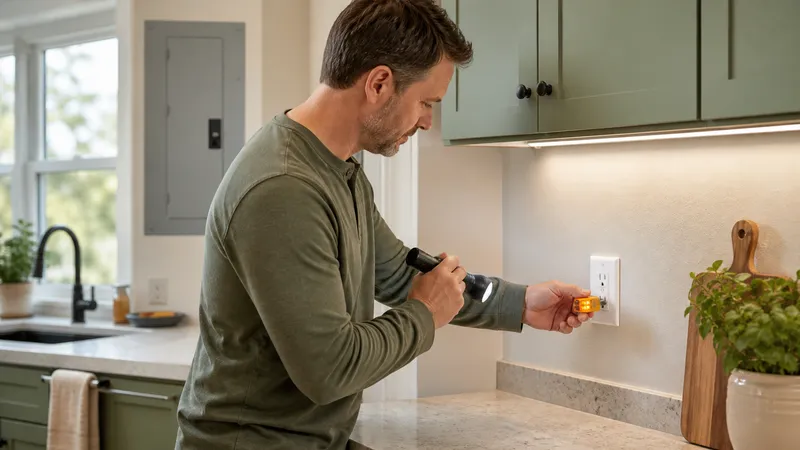
A home electrical maintenance checklist: monthly GFCI tests, panel and outlet inspections, cord habits, and signs your wiring or panel is aging out.
Key takeaways
- Test every GFCI outlet monthly with TEST and RESET—ESFI and CPSC both recommend it, and a unit that fails should be replaced.
- Look at the panel from the outside monthly: rust, a burning smell, or a breaker that won't stay reset are stop-and-call signs. Don't open the dead front.
- A warm or discolored outlet or switch plate is CPSC's own listed warning sign of a wiring hazard—not something to keep using.
- Extension cords and power strips add outlets, not capacity. Never chain them together or run one under a rug.
- Knob-and-tube wiring, aluminum wiring, and a panel under 100 amps in a modern household are all reasons for a licensed inspection, not a DIY judgment call.
- CPSC recommends a licensed electrician check your home's wiring if it's been more than 10 years since the last inspection, or sooner if you notice any hazard sign.
Home electrical maintenance is mostly a monthly habit, not an annual project: test GFCI outlets, look at the panel and outlets for warning signs, and use cords and power strips the way they’re rated to be used. Add a licensed inspection every 10 years, or sooner if anything on the warning-sign list shows up. This page is the checklist and the “is this normal” reference. If you already have a specific symptom—a breaker that keeps tripping, a GFCI that won’t reset, one dead outlet, or lights that flicker when the AC or fridge starts—those have their own dedicated pages linked below, because the fix depends on which one you’re looking at.
The electrical maintenance checklist at a glance
| Task | Frequency | Why it matters |
|---|---|---|
| Test GFCI outlets (TEST, then RESET) | Monthly | ESFI recommends monthly testing; a unit that fails should be replaced, not ignored |
| Test AFCI breakers, if your panel has them | Monthly | Same self-check logic as GFCI—press the breaker’s own test button per the panel manual |
| Look at outlets and switch plates for warmth or discoloration | Monthly | CPSC lists hot switch plates and outlet covers as an electrical hazard warning sign |
| Look at the panel from outside (rust, smell, loose knockouts) | Monthly to quarterly | Visible corrosion or heat damage points to a problem before it trips anything |
| Inspect cords, extension cords, and power strips for damage | Monthly | Cracked insulation, pinched cords, or overloaded strips are a common fire-starting point |
| Confirm smoke and CO alarms still test fine | Monthly | Electrical faults are a common fire cause; alarms are the backstop—see the full alarm schedule |
| Full licensed electrical inspection | Every 10 years, or after major renovation/appliance additions | CPSC’s own recommendation, sooner if any warning sign appears |
Testing GFCI and AFCI protection
GFCI outlets protect kitchens, bathrooms, garages, and outdoor circuits from ground faults—current finding an unintended path, often through water or a person. They only work if they’re actually functioning, and the only way to know is to test them. Press TEST, confirm the outlet loses power, then press RESET and confirm it comes back. ESFI recommends doing this once a month, and says any GFCI that fails the test should be replaced.
If your panel uses AFCI breakers—required by code on most living-area circuits in newer construction—they have a similar built-in test button at the breaker itself; check your panel’s manual for the exact steps.
This page covers the test-it-monthly habit. If a GFCI outlet or breaker won’t reset, or a breaker keeps tripping on its own, those are troubleshooting jobs with their own causes and fixes: see Why Won’t My GFCI Reset? and Why Does My Breaker Keep Tripping for No Reason?
Checking the panel without opening it
You do not need to remove the panel cover to catch most early warning signs. From the outside, once a month or so, look for:
| What you see | What it can mean |
|---|---|
| Rust or water staining on the panel box | Moisture intrusion near live components |
| A burning-plastic or ozone smell near the panel | Overheating at a connection—stop and call an electrician |
| A breaker that won’t stay reset, or feels hot to the touch | Failing breaker or a fault behind it |
| A cover or knockout plate that isn’t seated flush, or a gap around a cable entry | Improper install or a panel that’s been opened and not closed correctly |
| Panel labeled with an unfamiliar or older brand you don’t recognize | Worth identifying—see the aging-panel section below |
If you’ve had a specific breaker trip repeatedly, that’s diagnosed in Why Does My Breaker Keep Tripping for No Reason?, not by opening the panel yourself.
Outlets and switch plates: what “warm” actually means
CPSC’s own electrical hazard warning-sign list includes hot switch plates and outlet covers, plugs that pull out of the receptacle easily, and dimming or flickering lights alongside sizzling sounds and the smell of overheated plastic. None of these are cosmetic. A warm plate usually means a loose connection generating resistance heat behind it; a loose-fitting plug means the receptacle’s internal contacts have worn out and can arc under load.
Run a hand near (not directly on, if you’re unsure) outlets and switch plates in heavy-use rooms once a month—kitchen, laundry, home office, anywhere with space heaters or high-draw devices. Discoloration or a brownish stain at the faceplate edge means heat damage has already happened, not that it’s about to.
If only one outlet in a room is dead rather than warm, that’s usually a different, more common cause—see Why Is One Outlet Dead When the Others Work? And if lights dim briefly when the AC or fridge compressor kicks on, that’s typically normal motor startup current, not a wiring fault—Why Do My Lights Flicker When the AC or Fridge Kicks On? covers how to tell the two apart.
Extension cords and power strips: habits that prevent fires
A cord or power strip doesn’t add electrical capacity—it just adds outlets. Everything plugged into it still shares the same circuit rating, commonly 15 or 20 amps in most homes. ESFI specifically flags extension cords and power strips as an overload risk: moving several appliances onto a strip just moves the overload, it doesn’t remove it.
| Habit | Why |
|---|---|
| Never plug a power strip into another power strip | Compounds the same circuit’s load and daisy-chains failure points |
| Use extension cords as temporary, not permanent, wiring | A cord run for months under a rug or through a doorway gets pinched, worn, and hidden from view |
| Match cord gauge to the load, especially for space heaters | An undersized cord heats up under sustained high draw |
| Inspect cords for cracked insulation, exposed wire, or a loose plug before each use | A damaged cord is a direct shock and fire path |
| Use GFCI-protected outlets or a GFCI cord for anything outdoors or near water | Matches the same ground-fault protection your outdoor receptacles are required to have |
Smoke and carbon monoxide alarms are the backstop for any electrical fault that gets past this checklist. This page doesn’t re-cover alarm testing and replacement in depth—the full home maintenance checklist has the monthly test and 10-year replacement schedule.
Signs your home’s wiring or panel is aging out
Some electrical problems aren’t about maintenance at all—they’re about wiring or a panel that was never built for how a modern house draws power.
| Sign | Why it matters | Source |
|---|---|---|
| Knob-and-tube wiring (visible ceramic tubes/knobs, common in pre-1930s homes) | Ungrounded, and original cloth insulation degrades with age and can’t handle modern loads | ESFI |
| Aluminum branch wiring (common 1962–1972) | CPSC found aluminum wire from before 1972 is 55 times more likely to reach fire-hazard conditions at a connection than copper | CPSC Publication #516 |
| A panel rated under 100 amps in a household running central AC, an electric range, and multiple large appliances | Frequent nuisance trips and no headroom for added circuits are common; a licensed electrician can assess actual load | Homeowner rule of thumb—get a load calculation, don’t guess |
| A Federal Pacific Stab-Lok or Zinsco panel | CPSC investigated Stab-Lok breakers in the early 1980s after lab tests found a large share failed to trip under load, but closed the inquiry in 1983 without ordering a recall due to budget, not a safety clearance. Many electricians and insurers still flag these brands during inspections and may require replacement | CPSC 1983 closing statement, as documented by InspectAPedia |
| Only two-prong (ungrounded) outlets throughout the house | Signals older wiring that predates grounded circuits, common alongside knob-and-tube | ESFI |
| Home is over 40 years old with no record of a wiring update | Insurers increasingly ask about wiring age and knob-and-tube/aluminum wiring specifically during underwriting | ESFI |
None of these are DIY findings to act on yourself—they’re reasons to schedule a licensed electrician’s evaluation. Two of them (aluminum wiring, an FPE or Zinsco panel) are specifically not “wait and see”: CPSC’s own repair guidance for aluminum wiring says twist-on wire connectors alone are not an approved permanent fix, and a panel with a documented history of breakers that don’t trip is a functional safety device that may not work when you need it to.
When to call a licensed electrician
| Situation | Why it’s not DIY |
|---|---|
| Any work inside the panel, including breaker replacement | The panel carries lethal voltage even with the main breaker off |
| Knob-and-tube or aluminum branch wiring anywhere in the house | Requires evaluation and CPSC-approved repair methods (COPALUM or AlumiConn connectors, or a full rewire)—not a twist-on connector fix |
| A panel under 100 amps serving a modern household’s full load | Needs an actual load calculation, not a guess, and any upgrade is licensed work |
| A Federal Pacific Stab-Lok, Zinsco, or other panel with documented reliability issues | The concern is breakers that may not trip when they should—diagnosing that safely requires a professional |
| Warm or discolored outlets, switch plates, or a warm panel exterior | Sign of an existing loose connection generating heat—fire risk |
| Any DIY work beyond swapping a device (outlet, switch, GFCI) on a circuit you’ve confirmed is de-energized at the breaker | Anything involving new wiring, panel connections, or work you can’t verify is dead is outside safe homeowner scope |
| It’s been more than 10 years since your last whole-house electrical inspection | CPSC’s own recommended inspection interval |
Keep a record of what you find
Visit the home systems maintenance hub for the rest of the electrical and systems cluster.
Related guides
Frequently asked questions
How often should I check my home’s electrical system?
Test GFCI outlets monthly, do a quick visual walk of outlets, switch plates, and the panel exterior monthly to quarterly, and have a licensed electrician inspect the full system if it’s been more than 10 years since the last inspection—per CPSC guidance—or sooner if you notice any warning sign like flickering, burning odor, or hot switch plates.
Can I inspect my own electrical panel?
You can and should look at the panel from the outside: check for rust, a burning smell, a breaker that won’t stay reset, or a cover that isn’t seated flush. Do not remove the dead front (the inner cover) or touch anything inside—the panel carries live voltage even with the main breaker off. That inspection belongs to a licensed electrician.
Is aluminum wiring or knob-and-tube wiring dangerous?
Both are considered fire-hazard risks by CPSC and ESFI. CPSC found homes wired with aluminum manufactured before 1972 are 55 times more likely to reach fire-hazard conditions at a connection than copper-wired homes. Knob-and-tube wiring is ungrounded and its original insulation degrades with age. Neither is a DIY repair—both call for a licensed electrician’s evaluation.
How many things can I plug into one power strip?
A power strip adds outlets, not electrical capacity. The total draw of everything plugged into it still has to stay under the circuit’s rating—commonly 15 or 20 amps for household circuits. Never plug one power strip into another, and never run a strip or extension cord under a rug or through a doorway where it can be damaged.
Do I need a bigger electrical panel if mine is under 100 amps?
A panel under 100 amps is often undersized for a modern household running central AC, an electric range, and multiple large appliances at once. That’s a judgment call for a licensed electrician, not a DIY panel swap—working inside a panel means working near live, potentially lethal voltage.