
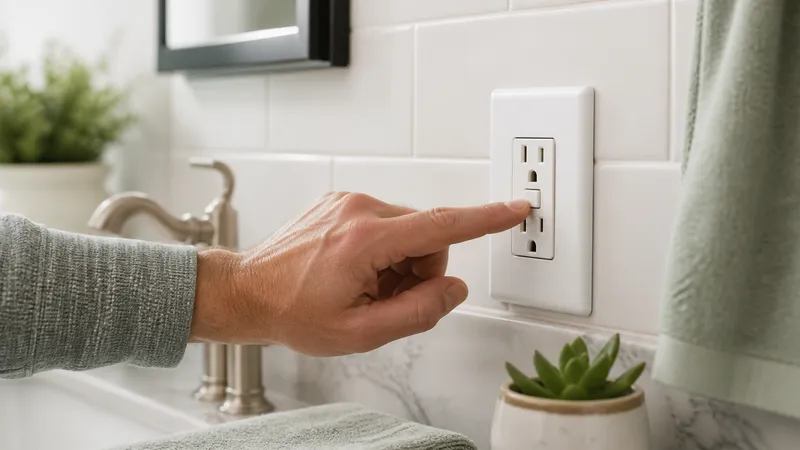
A GFCI that won't reset is usually sensing a real ground fault—often moisture—or has worn out. Here's the test sequence and when to call an electrician.
Key takeaways
- A GFCI that won't reset is either sensing a real ground fault or has failed internally—it is not being stubborn.
- Unplug everything on that outlet and on any downstream outlets first, then try RESET again.
- Moisture is the most common cause in bathrooms, kitchens, and outdoor GFCIs—dry the box and terminals before retesting.
- Test every GFCI monthly. ESFI and CPSC both recommend it, and units that fail the test should be replaced, not ignored.
- A GFCI that trips again immediately with nothing plugged in almost always means a wiring fault, not a bad appliance.
- Self-test GFCIs (required since 2015 under UL 943) check themselves automatically and show a red LED when they need replacing.
A GFCI outlet that won’t reset is doing its job: it is either detecting a real ground fault somewhere on the circuit—most often moisture—or the device itself has worn out and needs to be replaced. It is not stuck, and forcing the button harder does not fix either cause. The fix depends on which one you have, and the outlet won’t tell you directly—you have to work through it.
The test/reset sequence, first
Before troubleshooting further, run the outlet through its actual test cycle. This confirms whether the GFCI is functioning at all, not just whether it’s tripped.
| Step | What to do | What it tells you |
|---|---|---|
| 1 | Plug in a lamp or nightlight and turn it on | Confirms the outlet has power to begin with |
| 2 | Press TEST | The light should go off. If it doesn’t, power isn’t reaching the outlet or the device has failed |
| 3 | Press RESET | The light should come back on. If RESET won’t click in or the light stays off, you have a fault or a dead unit |
| 4 | If RESET fails, unplug everything on that outlet and any downstream outlets, then try RESET again | Isolates whether a plugged-in device or a wiring fault is the cause |
The Electrical Safety Foundation International recommends this test/reset cycle once a month, and says a GFCI that fails it should be replaced. That’s a good baseline even outside a troubleshooting session—monthly testing catches a failing unit before it fails silently.
Moisture is the most common cause
If the GFCI is in a bathroom, kitchen, garage, or outdoors, moisture is the first thing to suspect. GFCIs trip on a current imbalance as small as 4–6 milliamps, and water inside the box, behind the faceplate, or in a downstream outlet is enough to cause that imbalance. Eaton’s troubleshooting guidance for its GFCI receptacles specifically calls out accumulated moisture as a common reason a unit trips or won’t reset, and recommends cutting power at the breaker, opening the box, and letting it dry out before trying RESET again.
Common moisture sources worth checking:
- An outdoor GFCI cover left open in rain, or a cover that doesn’t seal against the gasket
- A bathroom GFCI near a sink splash zone or shower steam
- A kitchen GFCI near a sink, dishwasher, or a spill that got behind the plate
- Condensation inside an outdoor box during a temperature swing
A downstream device or outlet can be the real fault
Many GFCI outlets protect one or more standard (non-GFCI) outlets wired further down the same circuit—this is “downstream protection.” If any of those downstream outlets or a device plugged into them has a fault, the upstream GFCI trips and won’t reset until that fault clears, even though the GFCI itself is fine.
To check this:
- Find every outlet that lost power when the GFCI tripped—those are the downstream outlets.
- Unplug every device on the GFCI outlet and on all of those downstream outlets.
- Try RESET again with nothing plugged in anywhere on the circuit.
- If it resets now, plug devices back in one at a time to find the one causing the fault (a frayed cord, a wet appliance, or a space heater with internal moisture are common culprits).
- If it still won’t reset with everything unplugged, the fault is in the wiring itself—a loose connection, damaged insulation, or moisture in a downstream box—not a device you can unplug your way out of.
The GFCI itself has failed
GFCI outlets contain electronic sensing components that wear out. There’s no universal lifespan number from a code body, but manufacturers and electricians generally treat 15–25 years as the outer range for a standard GFCI, and any unit that fails its monthly test/reset cycle should be replaced immediately regardless of age. Leviton’s own lockout troubleshooting guide lists internal device damage—along with age, moisture intrusion, and reversed line/load wiring—as a cause of a GFCI that won’t reset, and says a unit with visible discoloration, cracking, or warping should be replaced rather than repaired.
If you’ve unplugged everything, ruled out downstream faults, confirmed the box is dry, and the GFCI still won’t reset, the device has likely failed internally. Replacing a GFCI outlet is a moderate DIY job for someone comfortable killing power at the breaker and working inside a box—but if you’re not certain the wiring is correct, especially on an older home without a ground wire, that’s a reasonable point to call an electrician instead of guessing.
What self-test GFCIs do differently
Since June 2015, UL 943 has required every new GFCI to include a self-test function and a reverse line-load misfire feature—so any GFCI installed in roughly the last decade already has this built in, whether you knew it or not. Instead of relying only on you pressing the test button, a self-test GFCI automatically and periodically checks its own tripping mechanism and reports status through an LED:
| LED status | What it means |
|---|---|
| Green, solid | Working normally and providing protection |
| No light | No power reaching the outlet, or the GFCI is currently tripped |
| Red (steady or blinking) | The internal self-test has failed—replace the device |
The reverse line-load feature is separate: it refuses to supply power at all if the outlet was wired backwards (line and load reversed), which is one of the most common installation mistakes and a frequent reason a brand-new GFCI won’t work correctly out of the box. If you just installed a GFCI and it won’t reset or has no LED at all, reversed wiring is worth checking before assuming the unit is defective.
Self-test doesn’t replace your monthly manual test—it catches failures between your checks, not instead of them.
When to call a professional
| Situation | Why it’s not DIY |
|---|---|
| GFCI trips immediately with nothing plugged in anywhere on the circuit | Points to a wiring fault at the outlet or in a downstream box, not a device—needs a meter and an electrician to trace |
| Visible scorching, melting, or a burning smell at the outlet | Fire risk; stop and don’t touch the outlet again until it’s inspected |
| The outlet or cover plate is warm or hot to the touch | Sign of a loose connection arcing under load |
| GFCI still won’t reset after you’ve replaced the GFCI itself | The fault is upstream in the wiring, not the device—needs diagnosis, not another new outlet |
| No ground wire in an older home’s outlet box | GFCI protection still works without a ground, but wiring changes in that box should go through an electrician |
| You’re not sure which outlets are downstream of this GFCI | Guessing at wiring on a live circuit risks shock; an electrician can trace it safely |
Related guides
Frequently asked questions
Why won’t my GFCI outlet reset even though nothing is plugged in?
If nothing is plugged in anywhere on the circuit and it still won’t reset, the fault is in the wiring itself—often moisture in a downstream box or a loose connection—not a device. That points toward an electrician rather than more troubleshooting at the outlet.
Is a GFCI outlet the same as a circuit breaker?
No. A GFCI outlet protects against ground faults (current leaking to a path other than the neutral wire, like through a person or water) at the outlet or downstream from it. A circuit breaker protects against overloads and short circuits for the whole circuit. A tripped breaker and a tripped GFCI need different fixes.
How often should I test my GFCI outlets?
Test every GFCI outlet monthly using the TEST and RESET buttons. The Electrical Safety Foundation International recommends monthly testing, and any outlet that fails the test—the light doesn’t go off on TEST or doesn’t come back on RESET—should be replaced.
Can moisture really stop a GFCI from resetting?
Yes. GFCIs trip on current imbalances as small as 4–6 milliamps, and water inside the box or behind the faceplate is enough to cause that. Cut power at the breaker, let the box dry out fully, and then try resetting it.
Do I need to replace a GFCI outlet on a schedule, like a smoke alarm?
There’s no fixed replacement age set by a code body the way there is for smoke alarms. Manufacturers and electricians generally treat 15–25 years as the outer range for a standard GFCI, but the real signal is the monthly test: any unit that fails TEST/RESET should be replaced regardless of age.