
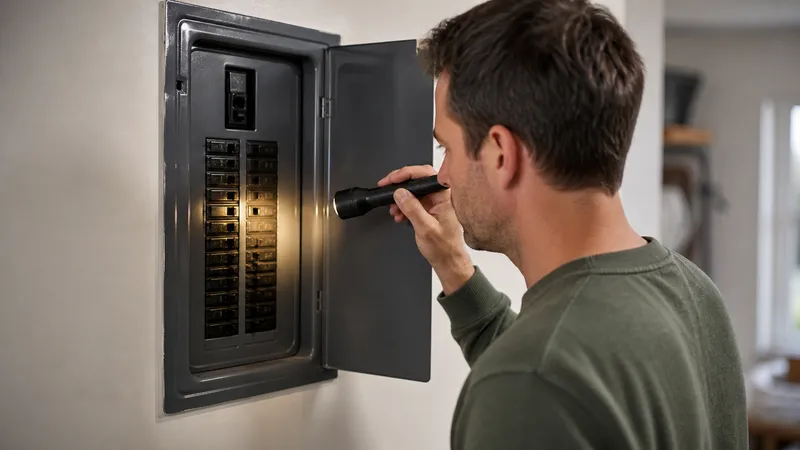
A breaker never trips for no reason—it's stopping an overload, a short, or a fault. Here's how to tell which, a safe reset sequence, and when to stop.
Key takeaways
- A breaker trips for one of four reasons: overload, a short circuit, a worn-out breaker, or (on AFCI/GFCI models) an arc or ground fault.
- The CPSC says investigate why a breaker trips before you reset it—don't just flip it back and move on.
- Test by unplugging everything on that circuit, resetting, then adding devices back one at a time until it trips again.
- AFCI nuisance trips are often triggered by normal electrical noise from vacuums, power tools, or dimmers—not always a real fault.
- If the breaker trips instantly with everything unplugged, stop testing and call an electrician—that points to a short in the wiring or panel itself.
- Warm faceplates, a burning smell, or a hot panel are not troubleshooting steps—they're a stop-and-call signal.
A breaker that trips is never actually tripping “for no reason”—it’s a safety device doing exactly what it’s built to do: opening the circuit before a wire overheats. The four real reasons are a circuit overload (too many devices drawing current at once), a short circuit (a wiring fault pulling far more current than normal), a worn-out breaker (it trips below its rated load or won’t hold a reset), or, on AFCI and GFCI breakers, a genuine arc fault or ground fault—or a nuisance trip that mimics one. Figuring out which of the four you have decides whether this is a five-minute fix or a call to an electrician.
The four reasons a breaker trips
| Cause | What’s happening | Typical pattern |
|---|---|---|
| Overload | More current is being drawn than the circuit’s rating (commonly 15 or 20 amps) | Trips when several devices run together—space heater, hair dryer, microwave—especially on the same circuit |
| Short circuit | A hot wire touches a neutral or ground wire directly, pulling a very high current instantly | Trips immediately on reset, often with a snap or spark at the panel, sometimes right when a specific appliance is plugged in or switched on |
| Worn-out breaker | The internal trip mechanism degrades with age or heat cycling and trips below its rated load, or won’t hold a reset at all | Trips with a light, normal-use load that never used to trip it; happens on one circuit specifically, not others carrying the same load |
| Arc fault / ground fault (AFCI/GFCI only) | The breaker detects a specific fault signature—sparking wiring for AFCI, a current imbalance for GFCI—or misreads electrical noise as one | Trips with specific devices (vacuums, power tools, some LED dimmers) or in damp areas (kitchens, baths, garages, outdoors) |
Circuit overload: the most common cause
Every breaker is rated for a maximum current—usually 15 or 20 amps for household circuits. When everything running on that circuit exceeds the rating, the breaker trips to keep the wire from overheating. The Electrical Safety Foundation International lists the warning signs to watch for even before a trip: flickering or dimming lights, warm or discolored wall plates, a burning odor near receptacles, and frequently tripped breakers or blown fuses.
High-draw appliances are the usual culprit—space heaters, hair dryers, microwaves, and toaster ovens each pull several amps alone, so two on one circuit (a toaster and coffee maker, a heater and hair dryer) is often at or past the limit. ESFI also flags extension cords and power strips: they add outlets, not capacity, so several appliances on one strip just moves the overload.
Short circuit: trips instantly, often with drama
A short circuit is a direct connection between a hot wire and a neutral or ground wire, pulling far more current than normal almost instantly. Unlike overload, which builds up as devices run, a short trips the moment the circuit is energized—sometimes with a snap, a spark at the panel, or a burning smell. It can be inside an appliance’s cord (a pinched or chewed cable) or the house wiring itself (a nail through a cable, a loose wire nut, rodent damage). If unplugging everything and resetting still trips it instantly, the short is in the wiring or panel, not anything you can unplug.
A worn-out breaker
Breakers age like any mechanical switch. Heat cycling and years of use can weaken the internal trip mechanism, so it trips below its rated load—or won’t hold a reset even with the circuit unloaded. This shows up as one specific circuit tripping under a load that never bothered it before, while the same load on another circuit is fine. It’s also common in older panels, including some legacy brands with documented reliability issues. A breaker is homeowner-diagnosable this way, but swapping it isn’t a DIY job—the panel stays energized even with the main breaker off.
AFCI and GFCI breakers: real fault vs. nuisance trip
Many newer panels use AFCI (arc-fault) and GFCI (ground-fault) breakers, which trip on more than overload or a dead short. The CPSC explains that ordinary breakers don’t respond to early arcing and sparking in home wiring—by the time a standard breaker trips, a fire may already have started—so an AFCI breaker watches specifically for that arcing signature. A GFCI breaker instead watches for a current imbalance that usually means current is finding an unintended path to ground, often through moisture or a person; CPSC notes AFCIs address fire hazards while GFCIs address shock hazards. Both types can also nuisance-trip: vacuum cleaners, power tools, and some dimmer switches generate electrical “noise” that can fool an AFCI breaker into tripping with no real arc present. Early-generation AFCI breakers were noticeably more prone to this than current models, which filter real arcing from normal noise more accurately.
| Pattern | Likely real fault | Likely nuisance trip |
|---|---|---|
| Trips only when one specific device (vacuum, tool, dimmer) runs | Possible, but check the device on a different standard circuit first | Common—especially with older AFCI breakers or certain motor/dimmer types |
| Trips in a bathroom, kitchen, or outdoor outlet near water | GFCI doing its job—assume real until checked | Less common; damp locations are exactly where GFCI protection is meant to trigger |
| Trips randomly with nothing obviously running | Worth investigating as a wiring issue | Possible, but don’t assume—rule out overload and shorts first |
| Won’t reset at all, or trips instantly every time | Treat as a real fault | Not a nuisance-trip pattern |
This article covers breaker-tripping diagnosis broadly. If the issue is specifically a GFCI outlet or breaker that won’t reset at all, see Why Won’t My GFCI Reset? for that narrower case.
A safe way to test it yourself
This sequence rules out overload before you consider a short, a bad breaker, or a nuisance trip.
- Unplug or turn off everything on the tripped circuit, checking adjacent rooms too—one circuit often feeds more than one room.
- Reset the breaker with the circuit unloaded. Flip it fully off, then fully on. If it won’t hold with nothing plugged in, stop—that points to a short or a failing breaker, not overload.
- Add devices back one at a time, waiting a minute between each, especially before a high-draw appliance (heater, hair dryer, microwave).
- Note what’s running when it trips again. The same combination every time is your overload—move one device to a different circuit.
- If only one device trips it alone, test that device on a different, known-good circuit. If it trips there too, the fault is the appliance, not your wiring.
A few situations change how you read the test: a dedicated appliance circuit (electric range, AC, dryer) is usually sized for one appliance, so a trip there almost always means the appliance itself, not a mix of devices. A recent remodel or new outlet is a more likely source of a wiring-level short than an older, untouched circuit. And a shared circuit feeding multiple rooms means step 3 has to check every outlet on it, not just the room where you noticed the trip.
When to call a professional
| Situation | Why it’s not DIY |
|---|---|
| Breaker trips instantly on reset with everything on the circuit unplugged | Points to a short in the wiring or the panel itself—not something you can unplug your way out of |
| Burning smell, scorch marks, or a hot breaker/panel | Fire risk—stop immediately and call an electrician |
| Breaker won’t hold a reset at all, even briefly | Likely a failed breaker or a dead short; the panel stays energized regardless of the main switch |
| Repeated trips after ruling out overload (same low load, nothing new) | Points to a wiring fault or failing breaker—needs a meter, not a guess |
| AFCI/GFCI trips you can’t pin on a specific device after testing | Could be a real fault rather than noise—worth a professional check |
| Legacy or unidentified panel brand | Some older panel types have documented reliability problems beyond any single trip |
Keep a record of it
Visit the home systems maintenance hub for the rest of the electrical and systems cluster.
Related guides
Frequently asked questions
Why does my breaker trip even when nothing seems to be plugged in?
That points to the wiring or the breaker itself—a short circuit, a loose connection, or a breaker worn out enough to trip below its rated load. That’s an electrician’s job, not a DIY fix.
Is it normal for a breaker to trip once in a while?
An occasional trip during a high-draw moment, like a space heater and a hair dryer on the same circuit, is the breaker doing its job. Frequent trips with only normal use are not normal and point to overload, a failing breaker, or a wiring fault.
What’s the difference between a regular breaker tripping and an AFCI or GFCI breaker tripping?
A standard breaker trips on overload or a short circuit. An AFCI breaker also trips on arc faults from damaged or loose wiring, and a GFCI breaker trips on ground faults, usually from moisture. Both are more sensitive and can nuisance-trip on normal electrical noise, but every trip is worth a look before you assume it’s nothing.
Can I just replace the breaker myself if I think it’s bad?
Noticing that a breaker trips below its rated load or won’t hold a reset is something a homeowner can observe, but swapping it means working inside an energized panel—that’s electrician territory, since a panel carries lethal voltage even with the main breaker off.
Does resetting a tripped breaker multiple times damage anything?
Resetting a breaker that trips again immediately, without figuring out why, risks arcing at the contacts and doesn’t fix the underlying overload, short, or fault. The CPSC’s guidance is to investigate the cause first, not reset repeatedly.