
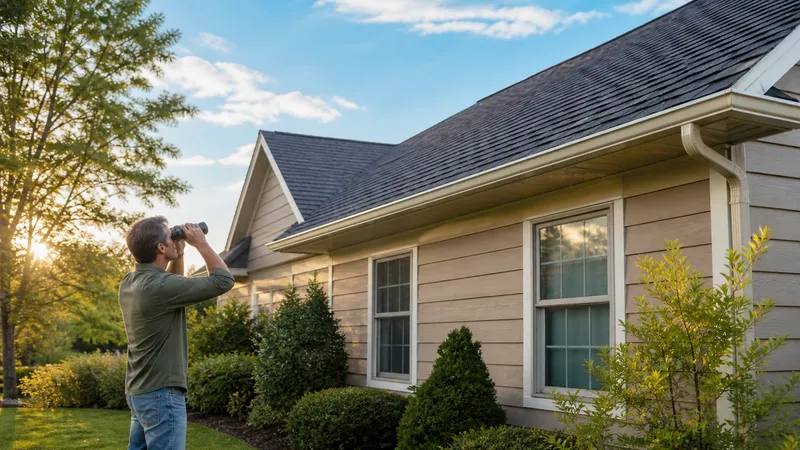
How to inspect a roof from the ground twice a year, what leak and damage signs to look for by material, and when to stop and call a licensed roofer.
Key takeaways
- Inspect twice a year—spring and fall—plus after any severe storm, per NRCA. Do it from the ground, a low ladder, or the gutter line, not the roof surface.
- Watch for missing, curling, or cracked shingles; granules piling up in the gutters; and lifted or damaged flashing around chimneys and vents.
- Attic water stains, daylight through the roof boards, or a musty smell mean water is already getting in—don't wait for a ceiling stain to act.
- Maintenance interval and inspection points differ by material: asphalt shingles need the most frequent watching, metal and tile the least, but tile cracks underfoot.
- Stop at the ladder. Climbing onto a steep roof, walking a tile roof, or touching flashing is a job for a licensed roofer, not a maintenance task.
- A roof's lifespan varies widely by material—a cost and replacement-timing guide is planned separately; this page covers upkeep, not that decision.
Roof maintenance for most homeowners means a twice-a-year visual inspection from the ground or gutter line—spring and fall, plus a check after any severe storm—not climbing onto the roof itself. The National Roofing Contractors Association recommends biannual inspections timed to catch winter damage in spring and to prepare for storm and snow season in fall. What you’re looking for: missing or curling shingles, granules piling up in the gutters, lifted flashing around chimneys and vents, moss or algae growth, and sagging anywhere along the roofline. Inside, a stained ceiling, a musty attic smell, or daylight coming through the roof boards means water is already getting in, not that it might someday. This page covers what a homeowner can safely check and when to hand the rest to a licensed roofer. It does not cover repair or replacement costs—a Housetto guide for that is planned separately.
How to inspect a roof twice a year
Do this from the ground with binoculars, from a stable low ladder against the gutter line, or by walking the yard perimeter. You do not need to get on the roof to complete this list.
| Where to look | What to check | What it means |
|---|---|---|
| Shingle field (binoculars from the ground) | Missing, curling, cracked, or dark/bald patches on shingles | Curling and granule loss are aging signs; missing shingles expose the deck immediately |
| Gutters and downspouts | Granule buildup, leaf and debris pack, water backing up instead of draining | NRCA lists excess granules in gutters as an early biannual-inspection finding; clogged gutters back water up under the shingle edge |
| Flashing (chimney, vent pipes, skylights) | Lifted, rusted, or gapped metal where it meets the roof plane | InterNACHI-style inspection checklists treat flashing as the most common leak point on an otherwise sound roof |
| Roof plane and ridge | Sagging, dipping, or an uneven ridge line | Suggests deck or structural moisture damage, not a maintenance fix |
| North-facing or shaded slopes | Moss or algae streaking | Moss holds moisture against the shingle and can lift edges; heavy growth often means granule loss underneath |
| Attic (from inside, with a flashlight) | Water stains, damp insulation, daylight through the boards, musty smell | Any of these means active or recent water intrusion — see below |
Interior signs a roof problem already exists
By the time a ceiling stain shows up in a living space, water has usually been moving through the attic for a while. Check the attic itself once each season, on a dry day with a flashlight:
- Water stains on the underside of the roof deck or on insulation — even old, dry stains mark a path worth watching after the next hard rain.
- Daylight visible through the roof boards — any pinpoint of light from the attic means an equivalent-sized hole is letting water in from outside.
- A musty or damp smell — trapped moisture in an attic often shows up as smell before it shows up as a visible stain, and it’s a sign of both a possible leak and inadequate ventilation.
- Frost or condensation on the underside of the deck in cold weather — usually a ventilation problem rather than a leak, but worth flagging to a roofer either way since poor attic ventilation shortens shingle life.
Maintenance by roof material
Inspection points and how often they need attention differ by material. Your manufacturer’s installation and warranty documentation always wins over a general table like this one.
| Material | Inspect for | Typical maintenance interval | Notes |
|---|---|---|---|
| Asphalt shingle | Curling, cracking, granule loss, missing tabs, moss on shaded slopes | Twice-yearly visual check; CertainTeed recommends at least annual, ideally biannual, professional inspection | Most common residential roof; ages fastest in hot, UV-heavy climates. Algae/moss removal should use a mild cleaning agent and soft brush, not a power washer |
| Metal | Loose or backed-out fasteners, rust at cut edges or fastener heads, sealant failure at seams and penetrations | Twice-yearly visual check; otherwise low-maintenance | CertainTeed notes metal roofs “require almost no maintenance” beyond checking for incompatible-metal contact, which causes galvanic corrosion |
| Clay or concrete tile | Cracked, slipped, or missing tiles; failing underlayment beneath the tile field | Annual professional inspection; individual tile repair as needed | Long-lived material, but individual tiles crack underfoot — never walk a tile roof yourself; even a roofer uses foam pads or walks the batten lines |
| Flat / low-slope membrane (EPDM, TPO, built-up) | Ponding water, seam separation, blistering, clogged roof drains or scuppers | Check drains after every heavy rain; full inspection twice yearly | Water doesn’t shed by gravity the way a pitched roof does, so drainage checks matter more here than on any sloped material |
Trees, gutters, and the moisture path
Most roof leaks trace back to something that was blocking water from leaving the roof, not a sudden material failure. Two habits handle most of it:
- Keep gutters clear. A gutter packed with leaves backs water up under the lowest course of shingles, which is a common ice-dam and rot starting point in cold climates and a standing-water problem everywhere else. If you have heavy tree cover, this is not a twice-a-year job — check it more often.
- Trim branches back from the roofline. Overhanging limbs drop debris into valleys and gutters, and scrape granules off shingles in wind. They also give squirrels and other animals a bridge onto the roof.
Neither of these requires walking the roof. Gutters can be cleared from a stable ladder at the fascia line; branch trimming near the roof is itself a job worth handing to a tree service once branches are directly over the roof plane.
When to call a professional
| Situation | Why it’s not DIY |
|---|---|
| Any inspection or repair that requires walking on the roof surface | Fall risk — even a low-pitch roof can be slick with dew, algae, or loose granules |
| A roof steeper than a single-story ranch pitch, or any multi-story roof | Standard ladder and rooftop fall-protection gear most homeowners don’t own becomes necessary |
| Flashing repair or replacement around a chimney, vent, or skylight | Flashing is the most common leak point; getting the overlap and sealant wrong creates a new leak |
| Any tile, slate, or wet/mossy roof | Tiles and slate crack underfoot; wet or algae-covered surfaces are slick even at low pitch |
| Visible sagging, a soft spot underfoot reported by a contractor, or structural movement | Signals deck or framing damage, not a surface fix |
| An active leak during a storm | Water intrusion in progress needs professional tarping and diagnosis, not a rooftop patch mid-storm |
| Moss or algae removal beyond a gentle ground-level rinse | Pressure washers strip granules and shorten shingle life; a roofer uses the right chemical and technique |
Keep a record
The most useful thing a homeowner can do after each seasonal check is write down what was found — even “nothing” is a useful data point six months later when comparing photos.
| Keep this | Why |
|---|---|
| Dated photos of the roofline, gutters, and any flashing points, same angles each season | Shows what changed since the last check, not just what looks off today |
| Attic photos if you find a stain or daylight | A roofer can often narrow down the likely leak location faster with a photo in hand |
| Date and outcome of the last professional inspection | Tells you whether “it’s probably fine” is based on a real check or a guess |
| Roofing material and approximate installation year | Anchors expectations for the maintenance-by-material table above |
Related guides
Frequently asked questions
How often should I inspect my roof?
Twice a year — once in spring and once in fall — plus an extra check after any hailstorm, high wind, or heavy snow event, per the National Roofing Contractors Association. Do the inspection from the ground or a stable low ladder, not by walking the roof.
What are the first signs of a roof leak?
Inside the house: a brown or yellow ceiling stain, a musty attic smell, or visible daylight through the roof boards in the attic. Outside: missing or curling shingles, granules collecting in the gutters, and lifted flashing around a chimney or vent pipe.
Can I inspect my own roof or do I need a professional?
You can do the ground-level and gutter-line part yourself — binoculars, a look at the attic, a check from a stable low ladder. Actually walking the roof, especially anything steeper than a single-story ranch pitch or anything wet, mossy, or tiled, is a fall risk that should go to a licensed roofer.
Does roof maintenance differ by material?
Yes. Asphalt shingles need the most frequent watching for granule loss, curling, and moss. Metal roofs need the least maintenance but should be checked for loose fasteners and rust at cut edges. Tile roofs rarely fail on their own but crack if anyone walks on them. Flat and membrane roofs need drains and seams checked more often because they don’t shed water by gravity alone.
How long does a roof usually last before it needs replacing?
It depends heavily on material — asphalt shingles commonly run 20 to 30 years, metal 40 to 80, and clay or concrete tile 100 years or more, per InterNACHI’s life-expectancy chart. A separate guide covering roof replacement cost and timing in more depth is planned; this page focuses on the maintenance that gets a roof to the end of its expected range.