
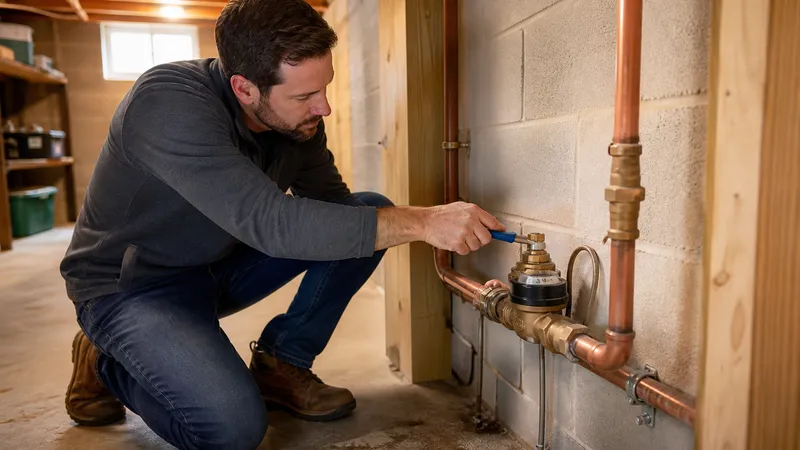
Your main shutoff is usually near the water meter or where the line enters the house. Find it, learn its type, and test it once a year—before a leak.
Key takeaways
- Look near the water meter, in the basement, crawlspace, or utility closet, or in an outdoor valve box in warm climates.
- A ball valve (quarter-turn handle) is far more reliable than an older gate valve (round wheel handle).
- InterNACHI's inspection standards note gate valves corrode and stick internally more than ball valves do.
- Test the valve once a year: turn it fully closed, then fully back open. A stiff or seized valve is worse than not knowing where it is.
- If the valve won't fully stop the water, that's an emergency-adjacent finding—call a plumber before you need it in a real leak.
- Tag the valve and log the test date so anyone in the house can shut off water in under a minute.
Your main water shutoff valve is almost always near the point where the water service line enters the house and close to the water meter: a basement wall, a utility closet, a crawlspace, or a mechanical room. In warmer climates without basements, it’s often in an underground valve box near the street-facing edge of the yard. Once you find it, check which of the two common types you have—a gate valve (round wheel handle) or a ball valve (lever handle, quarter-turn)—because the type determines how much you should trust it in an emergency. InterNACHI’s home inspection standards call out ball valves as the more dependable of the two, since gate valves are more prone to internal corrosion and sticking. This page is the deep dive the plumbing maintenance checklist and the running-toilet guide both point to—those pages mention knowing your shutoff in passing; this one covers the valve itself.
Where to look
| House type | Typical location | Notes |
|---|---|---|
| Homes with a basement | On the wall where the supply line enters, usually near the water meter | Look for the first shutoff before any branch lines to fixtures |
| Slab-on-grade or no basement | Utility closet, garage wall, or mechanical room | Often behind or near the water heater |
| Crawlspace homes | Just inside the crawlspace access, near the foundation wall closest to the street | May need a flashlight and to crouch |
| Warm-climate / no interior shutoff | Underground valve box in the yard, near the curb or meter pit | Usually needs a valve key; the utility’s curb stop is a separate, utility-owned valve further out |
| Condos and some townhomes | Sometimes there is no unit-level main shutoff—only fixture shutoffs and a building-wide valve | Check with the HOA or building management before assuming you have one |
Gate valve vs. ball valve
The handle tells you which type you have before you touch anything.
| Valve type | How to identify it | Reliability and replacement notes |
|---|---|---|
| Gate valve | Round wheel handle; takes several full turns to close | Internal gate and stem can corrode or accumulate mineral deposits over years of no use; per InterNACHI, these are more likely to stick or fail to seal fully than a ball valve. Common in homes built before the 1990s. |
| Ball valve | Lever handle; closes with a quarter turn (lever perpendicular to the pipe = off) | Fewer moving parts and a tighter seal even after long periods unused. Watts’ G4000 ball valve is built and sold as a quarter-turn, positive-shutoff replacement for older gate valves—this is a standard upgrade path, not a specialty part. |
If you have a gate valve and it’s original to an older house, don’t assume it will work perfectly the first time you need it. That assumption is exactly what causes trouble.
Test it annually
This takes about a minute and is the single most useful thing you can do with this information.
- Locate the valve and clear any stored items blocking access to it.
- Turn it fully closed. A ball valve’s lever should move a clean quarter turn; a gate valve’s wheel should turn smoothly through its full range without excessive force.
- Run a faucet inside the house to confirm the water actually stopped, not just that the handle moved.
- Turn the valve fully back open.
- Note any stiffness, grinding, or dripping at the valve body—those are early warning signs, not something to force past with a wrench.
Why homeowners get surprised by this
The failure mode is almost always the same story: a supply line bursts or a water heater lets go, the homeowner runs to the shutoff they’ve always known about, and the valve won’t turn—or it turns freely but the water keeps flowing because the internal gate never fully seated. A valve that sits untouched for years doesn’t announce that it’s failing. It looks the same from the outside right up until the moment you need it and it doesn’t work. That’s why “I know where it is” isn’t the same claim as “I know it works.” Testing it once a year, even briefly, is what actually closes that gap.
When to call a professional
| Situation | Why it’s not DIY |
|---|---|
| The valve won’t fully shut off the water | This is emergency-adjacent: if you can’t isolate water in a real leak, you have no backup plan until it’s fixed |
| The valve needs to be replaced | Usually means cutting into the main supply line and soldering, pressing, or threading a new connection—licensed plumber work |
| Corrosion, mineral crust, or a slow drip at the valve body itself | The valve or its fitting may be failing structurally, not just stiff to turn |
| No accessible shutoff exists inside the home at all | May require locating and installing one, or coordinating with the utility on the curb stop—not a retrofit to guess at |
Related guides
Frequently asked questions
Where is the main water shutoff valve usually located?
Most often near where the water line enters the house and close to the water meter: a basement wall, a utility closet, a crawlspace, or a mechanical room. In warmer climates without basements, it’s frequently in an underground valve box near the street-facing side of the yard.
What’s the difference between a gate valve and a ball valve?
A gate valve has a round wheel handle and closes by lowering a metal gate across the pipe over several turns; it’s prone to internal corrosion and can seize or fail to seal fully with age. A ball valve has a lever handle, closes with a quarter turn, and gives a tight, reliable shutoff even after sitting unused for years.
How often should I test my main shutoff valve?
Once a year is the minimum. Turn it fully closed, then fully back open. This keeps mineral deposits and corrosion from locking the valve in place, so it actually works the one time you need it in an emergency.
Why would a shutoff valve fail when I actually need it?
Valves that sit untouched for years, especially older gate valves, can corrode internally or seize the stem. The valve looks fine from the outside, but the handle won’t turn, or it turns without actually stopping the flow—something homeowners typically discover mid-emergency, which is exactly when it’s too late to test it.
Should I replace an old gate valve with a ball valve?
If your main shutoff is an old gate valve that’s stiff, drips, or you simply want a more dependable emergency shutoff, replacing it with a full-port ball valve is a common upgrade. It’s a job for a licensed plumber, since it usually means cutting into the main supply line.