
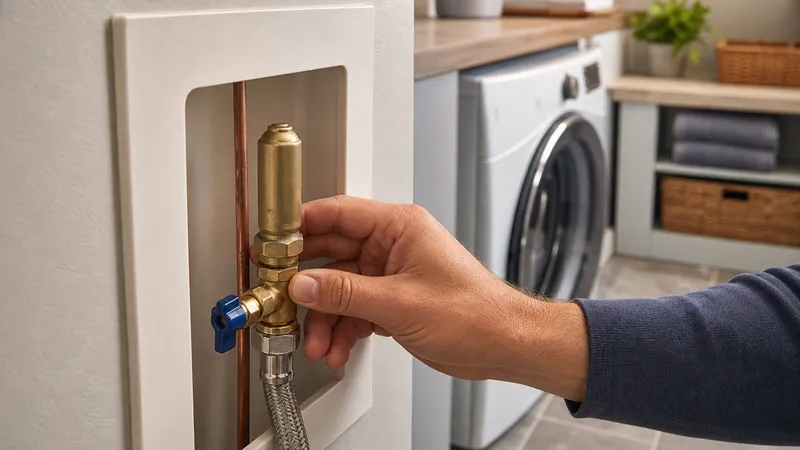
That bang is water hammer—a pressure shockwave from a fast-closing valve. Here's the fix path: arrestors, strapping, and checking your psi.
Key takeaways
- A bang right when a valve shuts is water hammer: a pressure shockwave, not a leak or a single loose fitting by itself.
- Washing machine and dishwasher solenoid valves close in a fraction of a second and are the most common trigger in a house.
- Code requires a water-hammer arrestor near quick-closing valves; a $10-$20 arrestor is usually the fix, not new pipe.
- Loose, unstrapped pipe runs turn a small shockwave into a loud bang. Securing the pipe can quiet it with no new parts at all.
- Household pressure above 80 psi is a common root cause. Keep it in the 40-80 psi range most utilities and plumbers target.
- Stop and call a plumber if the hammer is new, house-wide, and paired with pressure that reads high on a hose-bib gauge.
That bang, thud, or rattle you hear right after a faucet, washing machine, or dishwasher valve shuts off is almost always water hammer: a pressure shockwave created when fast-moving water in a pipe is forced to stop abruptly. Water doesn’t compress, so the momentum has to go somewhere—it slams into the closed valve and the nearest pipe wall, and that shock travels through the line as a bang or a series of knocks. It is a plumbing problem with a known cause and a standard fix, not a sign the house is falling apart.
What’s actually banging: pipe, valve, or pressure
The noise itself is the same shockwave in every case, but where it starts and how loud it gets depends on three separate things working together.
| What you notice | Likely cause | What fixes it |
|---|---|---|
| Bang right when the washer or dishwasher stops filling | Fast-closing solenoid valve creating the shockwave | Water hammer arrestor at that valve |
| Bang travels through walls, sounds worse in an upstairs bathroom | Loose or unstrapped pipe run letting the shockwave rattle against framing | Strap or clamp the pipe at the noisy run |
| Hammer on almost every fixture, even slow-closing ones, or noise got worse recently | House water pressure too high | Check pressure at a hose bib; service or replace the pressure regulator |
| Hammer only in one specific spot near an old air chamber | The original air chamber (a capped vertical pipe stub) is waterlogged | Drain and refill the system to restore the air pocket, or replace it with an arrestor |
Most houses have some combination of the first two: a quick-closing valve starts the shockwave, and a pipe that isn’t held tightly to the framing turns it into a noticeable bang instead of a quiet thump.
The fix, in order
- Identify the valve. Run the washing machine or dishwasher and listen for the exact moment the bang happens. That tells you which valve to treat first.
- Install a water-hammer arrestor at that valve. These are small, sealed chambers—usually gas- or spring-charged—that screw onto the valve or supply line and absorb the shockwave before it reaches the rest of the plumbing. Oatey and Sioux Chief both sell washing-machine-specific arrestors (roughly size “A” or “AA”) that thread directly onto the hot and cold valves behind the washer, and manufacturer guidance is to mount them as close to the valve as the connection allows so the shockwave has the shortest possible distance to travel before it’s absorbed.
- Strap loose pipe. If you can access the pipe run (basement, crawlspace, open wall), a rattling or slapping pipe usually just needs a proper clamp or strap at the stud or joist, not a new arrestor.
- Check house water pressure. Screw a $15-$20 pressure gauge onto an outdoor hose bib. If it reads above 80 psi, high pressure is likely making every valve closure hit harder, and an arrestor alone may not fully quiet the house.
- Consider the old-school fix for isolated cases. Homes built before arrestors were common sometimes have a capped air chamber—a short vertical pipe stub near a fixture—that cushions shocks with trapped air. These waterlog over time. Shutting off the main, opening the highest and lowest faucets in the house to drain the system, and refilling it can restore the air pocket, though a proper arrestor is the more durable fix.
Why plumbing code requires an arrestor here
This isn’t just a homeowner workaround. The International Plumbing Code requires that “a water-hammer arrestor shall be installed where quick-closing valves are utilized,” and the arrestor itself must meet the ASSE 1010 performance standard. The Uniform Plumbing Code has carried an equivalent requirement for building supply systems with quick-acting valves for years, which is why washing-machine outlet boxes installed in new construction increasingly come with an arrestor built in. If your house predates that and bangs every time the washer runs, you’re not missing something obvious—you’re missing a part that code now assumes is there.
Caveats that change the fix
| Situation | What’s different |
|---|---|
| Older home with galvanized or copper air chambers | Chambers waterlog faster than modern arrestors; expect to re-drain the system periodically or replace the chamber with a real arrestor |
| Multi-story house | Hammer is often louder upstairs even when the valve is downstairs, because the shockwave travels the pipe run; strap the whole vertical run, not just near the valve |
| Well system with its own pressure tank | Pressure can swing with the tank’s cut-in/cut-out settings; check both the low and high side, not a single gauge reading |
| Recently replaced pressure regulator | New regulators can fail early; if hammer started right after a plumbing repair or regulator swap, that’s the first thing to recheck |
Note that this is a different symptom from pressure that drops when two fixtures run at once—that’s usually a supply-side or fixture restriction issue, not hammer, and it’s covered separately.
When to call a professional
| Situation | Why it is not DIY |
|---|---|
| Hammer continues after an arrestor is installed correctly | Points to a pipe-support or house-pressure problem that needs a broader look |
| House pressure reads above 80 psi, or you suspect the pressure regulator has failed | Regulator diagnosis and replacement is plumbing work, and unregulated street pressure can stress every fixture in the house |
| The noisy pipe run is inside a finished wall or ceiling | Access without damage, and correct strapping, is a plumber’s job |
| Hammer is new, sudden, and house-wide with no recent valve or appliance change | Could indicate a larger pressure or supply issue worth a professional look before it damages a fitting |
For more on the systems in your house that create pressure- and flow-related symptoms like this one, see the systems hub.
Frequently asked questions
Why do my pipes bang only when the washing machine shuts off?
The washing machine’s solenoid valve closes almost instantly at the end of a fill cycle. That abrupt stop turns the water’s momentum into a pressure shockwave that slams against the valve and pipe wall—classic water hammer, and the single most common source of banging pipes in a house.
Is water hammer dangerous, or just annoying?
A single bang is mostly noise, but repeated shockwaves loosen joints, wear out valve seats, and can eventually crack solder joints or split old pipe. It is worth fixing rather than living with, especially if it happens on every cycle.
Will a water hammer arrestor fix banging pipes for good?
In most houses, yes, when it is installed on the correct valve, close to the source, and the arrestor is rated for the pipe size and pressure. If hammer continues after a proper install, the pipe likely needs strapping too, or the house pressure is too high.
What water pressure is too high and can cause hammer?
Most plumbers and utilities target 40-80 psi for a home, with roughly 60 psi as a comfortable middle. Pressure above 80 psi stresses fittings and makes any quick valve closure hit harder, so it is a common root cause behind hammer that keeps coming back.
Can I fix water hammer myself?
Installing a screw-on arrestor at an accessible valve, like a washing machine box, is a reasonable DIY job. Opening a wall to strap pipe, or diagnosing a failed pressure regulator, is a job for a licensed plumber.