
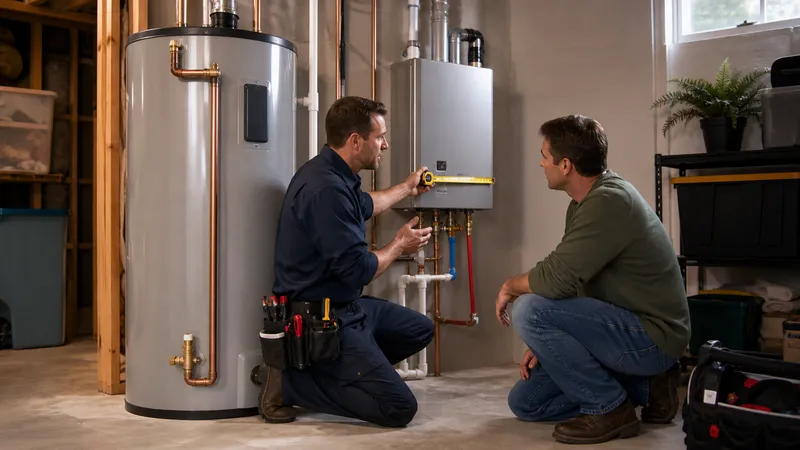
2026 water heater replacement costs by type—gas tank, electric tank, tankless, heat pump—plus what pushes the price up and the repair-vs-replace line.
Key takeaways
- A standard 40–50 gallon tank replacement runs $900–$3,100 installed for gas, $600–$1,800 for electric, per HomeGuide's 2026 cost data.
- Tankless costs more upfront: $1,400–$3,000 installed for electric, $2,100–$5,600 for gas, per Angi's 2026 pricing.
- Heat pump water heaters run $3,200–$4,700 installed, per Angi—higher upfront, but the lowest to operate of any type.
- Switching fuel type or adding a first-time gas line, new venting, or a 240V circuit is what actually blows past the base range—not the tank itself.
- A leaking tank at 10+ years old is a replace call, not a repair call—active leaks mean the tank's steel lining has already failed.
- Get at least two written installed quotes before you sign; labor and permit costs vary more by region than the unit itself does.
A water heater replacement costs $600 to $5,600 installed in 2026, and where you land in that range depends almost entirely on type: a standard 40–50 gallon tank runs $900–$3,100 installed for gas or $600–$1,800 for electric, tankless units run $1,400–$3,000 (electric) to $2,100–$5,600 (gas) installed, and heat pump water heaters run $3,200–$4,700 installed (Angi: Water Heater Replacement Cost; HomeGuide: Water Heater Installation Cost). This page is the cost breakdown by type and the factors that move the number. For the maintenance schedule that extends a tank’s life, see the water heater maintenance guide; for the full repair-vs-replace decision and part-by-part repair costs, see the water heater lifespan guide.
Water heater replacement cost by type (2026)
| Type | Typical installed cost (2026) | What drives it | Source |
|---|---|---|---|
| Gas tank (40–50 gal) | $900–$3,100 | Tank size, venting reuse, permit | HomeGuide |
| Electric tank (40–50 gal) | $600–$1,800 | Tank size, existing 240V circuit, permit | HomeGuide |
| Tankless electric | $1,400–$3,000 | Unit output, whether panel has spare capacity | Angi |
| Tankless gas | $2,100–$5,600 | Unit, labor, gas line upsizing, venting | Angi |
| Heat pump water heater | $3,200–$4,700 | Unit cost, ceiling clearance, condensate drain | Angi |
A larger tank pushes the range up regardless of fuel type—a 75–80 gallon tank typically runs $2,850–$5,550 installed, well above the 40–50 gallon figures above, per HomeGuide’s size-specific data. Angi’s broader tank-style estimate ($881–$1,825) sits toward the low end of the ranges above because it blends smaller electric units with straightforward, no-modification swaps; a same-size, same-fuel, same-location replacement is the cheapest version of this job by a wide margin (Angi: Water Heater Replacement Cost).
Gas tankless units also carry the widest range of any type, because “gas condensing whole-home unit” and “basic non-condensing unit with reused venting” are very different jobs. Angi puts the national average for a gas condensing whole-home tankless unit at $3,100 installed, versus $1,800 for an electric whole-home tankless unit—both well inside the ranges in the table above (Angi: Tankless Water Heater Cost).
What actually moves the price
The unit itself is rarely what blows a quote past the typical range. These four changes are—the add-on figures below are typical ranges compiled from installer cost data, not a single published table, so treat them as a rule of thumb to sanity-check a quote against, not a guaranteed price.
| Factor | Typical add-on cost | When it applies |
|---|---|---|
| Permit | Often bundled by the installer, or $50–$300 filed separately | Nearly every jurisdiction requires one for a water heater swap, and always for new gas or venting work |
| Venting change (reused flue → power vent or direct vent) | $300–$1,200 | Old flue can’t be reused, house has no existing vent path, or you’re upgrading to a sealed-combustion unit |
| Gas line work (upsizing for a tankless unit, or adding gas where there was none) | $300–$1,200 | Switching from electric to gas, or installing a tankless gas unit that needs a larger supply line |
| Electrical work (new 240V circuit for electric tank/tankless, or a dedicated circuit and disconnect for a heat pump unit) | $300–$800 | Switching from gas to electric, or the panel has no spare capacity |
| Tank size step-up (40 gal → 50 gal or larger) | $100–$400 more than a same-size swap | Household grew, or the old tank was undersized |
A straight swap—same fuel, same tank size, same location, existing venting and circuit reused—is the version of this job that lands at the bottom of the ranges in the table above. Add any one of the first four factors and the quote moves toward the middle or top of the range; add two or more (for example, switching from electric to gas tankless) and it can exceed the published range entirely.
Repair vs. replace: the short version
A water heater repair is worth pricing before you replace, but not always worth doing. The full repair-cost breakdown by part—thermocouple, gas valve, heating element—and the age-based math for when a repair stops making sense live on the water heater lifespan guide. The rule that matters most for a replacement decision:
Regional and situational caveats
| Situation | How it changes the number |
|---|---|
| High-cost-of-living metro areas | Labor rates run higher than the national averages above; get a local quote rather than assuming the low end |
| Rural or low-labor-cost areas | Installs can land below the national ranges, but permit and travel fees may still apply |
| Homes with no existing gas line | Adding gas service for the first time is a separate, larger job than upsizing an existing line—price it before committing to a gas tankless unit |
| Homes in seismic zones (much of the West) | Local code often requires seismic strapping, adding a modest but real line item most national estimates don’t include |
| Condo or apartment installs | Shared venting, tight utility closets, or HOA approval can add time and cost beyond a single-family swap |
When to call a professional
| Situation | Why it is not DIY |
|---|---|
| Any gas line or venting work | Combustion safety and carbon monoxide risk; requires licensed, permitted work |
| Any water heater installation, tank or tankless | Most jurisdictions require a licensed plumber (and often an inspection) for a water heater swap, not just for gas units |
| Switching fuel type (gas to electric or the reverse) | Requires new supply infrastructure—gas line or 240V circuit—that a licensed trade has to size and permit correctly |
| Heat pump water heater installation | Needs correct clearance, condensate drainage, and often a dedicated electrical circuit sized to the unit |
| Active leak at the tank base | Shut off water and power/gas if you can do so safely, then call a plumber—this is a replacement decision, not a DIY repair |
Related guides
Frequently asked questions
How much does it cost to replace a water heater in 2026?
A standard 40–50 gallon tank swap runs $900–$3,100 installed for gas or $600–$1,800 for electric, per HomeGuide’s 2026 data. Tankless units cost more upfront—$1,400–$3,000 installed for electric, $2,100–$5,600 for gas—and heat pump water heaters run $3,200–$4,700 installed, per Angi. Your actual quote depends on tank size, venting, and any electrical or gas line work.
Is a tankless water heater worth the extra upfront cost?
It depends on how long you’ll stay in the house and whether you already have the gas line or electrical capacity a tankless unit needs. Tankless units typically last 15–20+ years versus 8–12 for a tank, so the higher install cost spreads over a longer service life, but a first-time gas line upsize or 240V circuit can add $300–$1,200 to the install and erase much of that advantage in year one.
Why did my water heater replacement quote come in so much higher than the average?
The base unit and labor rarely explain a quote that’s far above the typical range. The usual reasons are a switch in fuel type (electric to gas or vice versa), new venting because the old flue can’t be reused, a gas line that needs to be upsized, an electrical panel that needs a new circuit or breaker space, or a local code requirement like an expansion tank, drip pan, or seismic strap that the old installation didn’t have.
Should I repair or replace a water heater that’s leaking?
Replace it if the tank itself is leaking and it’s 8–10+ years old—tank corrosion isn’t repairable, and a leaking tank only gets worse. If the leak is from a fitting, valve, or connection rather than the tank body, and the unit is younger, a repair can make sense. See the water heater lifespan guide for the full repair-vs-replace cost breakdown by part.