
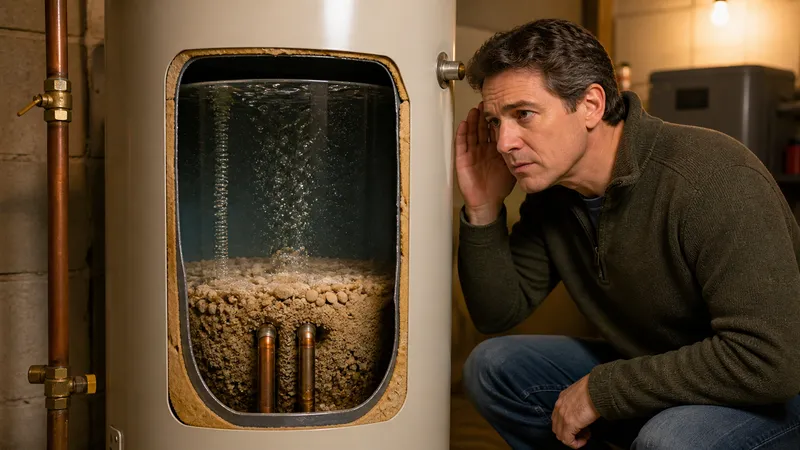
Popping or rumbling in a tank water heater is almost always sediment trapping water at the bottom of the tank—here's why, and when it's something worse.
Key takeaways
- Popping, cracking, or rumbling from a tank water heater is almost always sediment trapping water at the tank bottom, not a failing unit.
- Trapped water boils under the sediment layer; the steam bubbles forcing their way through the crust make the popping sound.
- A quarter-inch of sediment can cut a tank's heating efficiency by 25-40%, per manufacturer and utility guidance—this isn't just noise.
- A tankless unit doesn't hold standing water, so its noise is usually scale buildup on the heat exchanger, not sediment—descaling is the fix.
- Stop and call a plumber if the noise comes with a hissing pressure-relief valve, rust-colored water, a leak, or rising energy bills.
- One flush rarely fully clears years of hardened sediment—if popping continues after a flush, that's a professional-descale situation, not a failed DIY attempt.
Popping, cracking, or rumbling from a tank water heater is almost always sediment—minerals that settled out of the water and hardened at the bottom of the tank, trapping small pockets of water against the heating element or burner. That trapped water boils, and the steam bubbles forcing their way up through the sediment crust are what you’re hearing. Rheem’s own troubleshooting guidance for water heater noise identifies sediment as “the most common cause of a noisy water heater,” and says flushing the tank is the fix (Rheem: The Ultimate Guide to Water Heater Noises). It’s a maintenance issue, not usually an emergency—but it’s also not “just noise” to ignore.
Why sediment makes a popping sound
Every tank water heater heats a standing column of water sitting over a burner (gas) or a heating element (electric). Minerals dissolved in the water—calcium and magnesium, mainly—settle out as the water heats and cools, and gravity pulls them to the bottom of the tank. Over months and years, that settling builds an actual layer, sometimes an inch or more thick in a neglected tank.
Once that layer is established, it doesn’t just sit there. Water gets trapped in gaps within the sediment, right against the hottest part of the tank. That trapped water reaches boiling temperature well before the rest of the tank does, because it’s insulated by mineral crust on one side and heated directly on the other. The steam bubbles that form have to force their way up through the sediment to escape, and each one popping through the crust makes the crack or pop you hear. A thicker, more settled layer tends to produce a lower rumble instead of sharp pops, since the pockets are larger and the steam has farther to travel.
Why it matters beyond the noise
Sediment isn’t cosmetic. It sits directly between the heat source and the water you actually want heated, which is a straight efficiency loss. Utility and manufacturer guidance puts a number on it: a quarter-inch of sediment can cut a tank water heater’s heating efficiency by roughly 25-40%, since the burner or element has to work through the insulating layer to reach the water above it. The U.S. Department of Energy’s Energy Saver guide recommends draining about a quart of water from the tank every three months specifically to keep that layer from building up in the first place (DOE Energy Saver Guide).
Beyond the utility bill, sediment stresses the tank itself. Gas units can develop hot spots on the tank floor as the burner works harder against the insulating layer, which accelerates wear on the tank lining. Electric units can run an element hotter and longer than it’s rated for. Neither failure mode shows up overnight, but a tank that’s been popping for a year or two is a tank that’s been running less efficiently, and working harder, for that whole stretch. Flushing on schedule—covered step-by-step on the water heater flush guide—is the maintenance that actually addresses the noise’s cause, not just the sound.
| What you hear | Likely cause | What it means | What to do |
|---|---|---|---|
| Sharp popping or cracking, worse right after the burner or element kicks on | Sediment layer trapping water pockets against the heat source | Normal early-stage sign of an unflushed tank | Flush the tank; see the flush guide |
| Low rumbling or a “boiling kettle” sound | Thicker, more settled sediment layer | Same cause, further along | Flush soon; expect it may take more than one flush to fully clear |
| Ticking, rattling, or popping from a tankless unit | Mineral scale coating the heat exchanger | Tankless equivalent of tank sediment | Descale per the tankless maintenance guide |
| Hissing or a steady discharge sound near the top of the tank | Pressure-relief (T&P) valve releasing pressure | Can be normal occasionally, but continuous discharge is not | Stop; call a plumber if it doesn’t stop quickly |
| Rumbling plus a noticeably higher energy bill | Heavy sediment or a failing heating element | Efficiency loss beyond routine sediment | Flush first; if noise and bills persist, have the element and thermostat checked |
Tankless units: a different noise, same idea
A tankless water heater doesn’t hold a standing tank of water, so it can’t build the same bottom-of-tank sediment layer a storage unit does. Noise from a tankless unit more often means mineral scale building up inside the heat exchanger itself—the same hard-water minerals, just depositing on a different surface. The fix is a descaling flush through the unit’s built-in service valves rather than draining a tank. That procedure, and how often hard water changes the schedule, is covered in Tankless Water Heater Maintenance—this page won’t duplicate it.
When to call a professional
| Situation | Why it is not DIY |
|---|---|
| Popping or rumbling continues after a proper flush | May indicate heavy scale bonded to the tank wall or heating element, needing a professional descale or tank inspection |
| Noise paired with a leak or standing water at the base | Tank shell or fitting failure, not a sediment problem a flush can fix |
| Noise paired with rust-colored water that won’t clear | Anode rod may be fully consumed and the tank itself corroding—see anode rod replacement |
| Pressure-relief (T&P) valve hissing continuously or discharging water | Valve or pressure malfunction; a stuck or failing T&P valve is a safety component, not a wear item to watch |
| Rumbling or banging combined with rising energy bills | Can indicate a failing heating element working harder under a sediment crust |
| Any noise near a gas connection paired with a burning smell | Combustion and gas-line safety—not a homeowner diagnosis |
Related guides
Frequently asked questions
Why does my water heater make a popping or rumbling noise?
Sediment—minerals that settle out of the water and harden at the bottom of the tank—traps small pockets of water against the heating element or burner. That trapped water boils, and the steam bubbles forcing their way up through the sediment crust make the popping, cracking, or rumbling sound. It’s the most common water heater noise and almost always points to sediment, per Rheem’s own troubleshooting guidance.
Is a popping water heater dangerous?
Not by itself. Popping and rumbling from sediment are an efficiency and tank-life problem, not an emergency. It becomes a safety issue only if the noise is paired with a hissing or discharging pressure-relief valve, an active leak, or rust-colored water that won’t clear—any of those means stop and call a plumber.
Will flushing the tank stop the popping noise?
Usually, yes, at least partially. A proper flush clears loose sediment and often quiets the popping within a flush or two. Sediment that’s hardened over several years without service may not fully break up with one garden-hose flush; if popping continues after a proper flush, that points to heavier scale that a professional descale or a tank inspection should address.
Why is my tankless water heater making noise?
Tankless units don’t hold standing water, so they don’t build the same sediment layer a tank does. Popping, ticking, or rattling from a tankless unit more often points to mineral scale coating the heat exchanger, which needs a descaling flush rather than a tank drain.
What if my water heater is rumbling and my energy bill is going up?
That combination is worth a closer look beyond a routine flush. A thick sediment layer or a failing heating element both make the unit run longer to reach the same temperature, which shows up as both noise and a rising bill. If a flush doesn’t quiet it and bills keep climbing, have a technician check the element and thermostat rather than assuming another flush will fix it.