
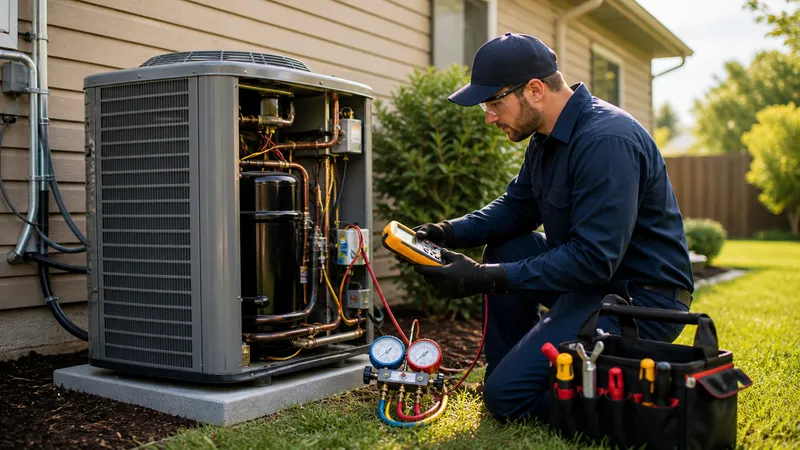
2026 AC compressor replacement costs run $800-$2,500 depending on warranty status—how to tell a bad compressor from a cheaper fix, and when to replace the unit.
Key takeaways
- A full compressor replacement typically runs **$800-$2,500** in 2026: **$600-$1,200** if the compressor is still under a parts warranty (labor only), **$1,300-$2,500** out of warranty (part plus labor).
- Loud clanking from the outdoor unit, the unit humming but not starting, tripped breakers on startup, and warm air with a running compressor point to the compressor—not the filter or thermostat.
- A cheap capacitor or contactor can mimic compressor failure. Get a technician's diagnosis before authorizing a $1,000+ repair.
- On an R-22 (pre-2010) system, a failed compressor is usually a signal to replace the whole unit, not the part—R-22 is banned from new production and now costs **$80-$300+ per pound** installed.
- EPA Section 608 restricts who can legally handle refrigerant. Never let anyone quote a DIY recharge or 'topping off' as the fix.
- Get at least two quotes before a compressor job over $1,000—the diagnosis (compressor vs. cheaper part) and the repair-vs-replace math both vary by contractor.
A full AC compressor replacement costs $800 to $2,500 in 2026, according to Angi’s cost data: $600-$1,200 if the compressor is still under a manufacturer parts warranty (you’re paying labor only), or $1,300-$2,500 out of warranty (part plus labor, full price). The number that actually matters for your decision isn’t the part cost—it’s whether the compressor is really the failure, and whether an old R-22 system is worth fixing at all instead of replacing outright. This page covers both. For general HVAC repair pricing across other components (capacitors, thermostats, blower motors), see the broader HVAC repair cost guide; this page is the deep dive specifically on the compressor, the most expensive single part in the system.
AC compressor replacement cost table (2026)
| Scenario | Typical cost | What you’re paying for |
|---|---|---|
| In-warranty compressor, labor only | $600-$1,200 | Labor, recovery/recharge of refrigerant, and diagnostic time; the compressor part itself is free under a manufacturer parts warranty |
| Out-of-warranty compressor, full replacement | $1,300-$2,500 | Compressor part, labor, refrigerant recharge, and disposal of the old unit |
| R-410A refrigerant recharge (newer systems) | $100-$400 added to the job | R-410A runs roughly $4-$10 per pound installed as of 2026 |
| R-22 refrigerant recharge (pre-2010 systems) | $750-$4,500 added to the job | R-22 now runs an estimated $80-$300+ per pound installed, since production stopped in 2020 |
| Full system replacement instead of compressor repair | $4,500-$12,000+ | New condenser, coil, and (often) matched R-410A or R-454B equipment—see the furnace and system replacement guidance for the whole-system view |
National averages vary by region, brand, and tonnage—Angi notes brand alone can swing the part cost by several hundred dollars (Goodman/Amana compressors run cheaper than York/Coleman, for example). Get a written, itemized quote before authorizing the work, and ask specifically whether the quote assumes an in-warranty or out-of-warranty part.
What actually moves the number
| Factor | How it changes the cost |
|---|---|
| Warranty status | In-warranty jobs skip the part cost entirely—labor only. Confirm the compressor’s warranty with the original installer or manufacturer serial lookup before assuming out-of-warranty pricing |
| Refrigerant type | R-410A recharges are inexpensive; R-22 recharges can cost more than the compressor labor itself, since R-22 is no longer manufactured |
| Compressor size/tonnage | A 2-ton residential compressor costs less than a 4-5 ton unit for a larger house |
| Access and unit age | An outdoor unit that’s hard to reach, or a compressor that’s failed alongside a corroded line set, adds labor time |
| Local labor rates | HVAC labor rates vary by region; a quote in a high-cost metro will run above the national range |
Is it really the compressor?
The compressor is the most expensive single part in a split AC system, so it’s worth confirming before you approve a four-figure repair. These signs point specifically at the compressor rather than a cheaper component:
| What you notice | Likely cause | Repair cost ballpark |
|---|---|---|
| Loud clanking, grinding, or banging from the outdoor unit when it runs | Mechanical failure inside the compressor | Compressor replacement (see table above) |
| Outdoor unit hums but won’t start, or the fan spins with no compressor sound | Failing compressor or a bad start/run capacitor | Get both tested—capacitor replacement often runs $150-$400 |
| Breaker trips repeatedly when the AC tries to start | Compressor drawing excess current (hard start), or a bad capacitor/contactor | Diagnostic visit before any part replacement |
| System runs, fan blows, but air stays warm | Could be the compressor not compressing refrigerant, low refrigerant from a leak, or a dirty coil | Diagnostic visit—don’t assume compressor without a pressure test |
| Oil residue or stains at the compressor housing | Refrigerant leak carrying compressor oil with it, often near end-of-life for the compressor | Leak location plus repair or replacement, depending on severity |
A failed capacitor is a common and much cheaper cause of “the AC won’t start” that looks identical to a dying compressor from the thermostat’s point of view. That’s why a technician’s amp-draw and winding-resistance test on the compressor itself—not just a description of the symptoms—should come before you sign off on compressor-level pricing.
Repair vs. replace: the R-22 math
This is the decision that separates a compressor job from a full-system job. The EPA confirms that production and import of virgin R-22 ended January 1, 2020, with only reclaimed and pre-2020 stockpiled supply available to service existing systems. The EPA does not require you to replace a working R-22 system, and its consumer guidance says owners “can continue to use” R-22 equipment—but that guidance predates the price the shrinking stockpile now commands. Because the supply is fixed and dropping, R-22 pricing has climbed well past R-410A pricing, and most cost estimators put installed R-22 at roughly $80 to $300+ per pound in 2026, against $4-$10 per pound for R-410A.
| System | Compressor fails | Typical recommendation |
|---|---|---|
| R-410A system, under 10 years old | Compressor replacement alone | Usually cheaper than a full system swap; compressor labor plus part, no refrigerant premium |
| R-410A system, 10-15 years old | Compressor replacement vs. full system | Compare quotes directly—an aging condenser and coil may be close behind the compressor in remaining life |
| R-22 system (installed before roughly 2010) | Compressor replacement vs. full system | Most contractors recommend full replacement—refrigerant cost alone can rival or exceed the compressor repair, and the rest of the unit is likely near end-of-life anyway |
Run the math before you commit: a compressor-only repair on an R-22 unit needing a recharge can land at $2,000-$6,000+ once refrigerant is included—within range of a full system replacement that comes with a new warranty and modern efficiency. A technician can give you both quotes side by side; ask for that comparison explicitly instead of accepting the first repair quote.
When to call a professional
| Situation | Why it is not DIY |
|---|---|
| Diagnosing compressor vs. capacitor vs. refrigerant leak | Requires amp-draw testing, winding-resistance testing, and refrigerant pressure gauges a homeowner doesn’t own |
| Any refrigerant recharge or leak repair | Illegal without EPA Section 608 certification; refrigerant is pressurized and can cause frostbite or asphyxiation in enclosed spaces |
| Removing the outdoor unit’s access panel | Exposes high-voltage electrical connections and the compressor’s internal wiring |
| Comparing compressor repair vs. full system replacement cost | Needs a technician’s assessment of the coil, line set, and remaining equipment life, not just the compressor quote |
| Breaker trips repeatedly on AC startup | Electrical fault risk—don’t keep resetting the breaker and running the unit |
A repeated breaker trip on startup or a hard-start hum is a reasonable moment to stop running the unit and call a technician rather than resetting the breaker again.
Records that make this decision easier
| Record | Why it matters |
|---|---|
| Compressor and system install date | Determines whether the compressor is still under a parts warranty and which refrigerant type the system uses |
| Manufacturer parts warranty terms | Confirms whether you’re negotiating a labor-only repair or a full out-of-pocket replacement |
| Prior refrigerant top-offs or leak repairs | A pattern of repeated top-offs is evidence the compressor or line set has an ongoing problem, useful when comparing repair vs. replace quotes |
| Written, itemized quotes from at least two contractors | Confirms the diagnosis and lets you compare compressor-only repair against full-system replacement pricing |
Related guides
Frequently asked questions
How much does it cost to replace an AC compressor in 2026?
Most homeowners pay $800 to $2,500 for a compressor replacement in 2026, according to Angi’s cost data. If the compressor is still covered by a manufacturer parts warranty, you’re typically paying labor only, around $600-$1,200. Out of warranty, expect $1,300-$2,500 for the part and labor combined.
How do I know if it’s the compressor and not something cheaper?
Compressor failure usually shows up as loud clanking or grinding from the outdoor unit, a hard-start hum with no cooling, breakers that trip when the AC tries to start, or warm air even though the unit is running. A failed capacitor or contactor can cause similar symptoms for a fraction of the repair cost, so get a technician to test the compressor’s amp draw and windings before you approve a full replacement.
Is it worth replacing just the compressor, or should I replace the whole AC unit?
Compare the compressor quote to a full system quote and factor in the unit’s age and refrigerant type. On an R-22 system (installed before roughly 2010), most contractors recommend a full system replacement instead, since R-22 is no longer produced and the refrigerant alone can add $750-$4,500 to a repair. On a newer R-410A system under 10 years old, replacing just the compressor is usually the cheaper move.
Does a home warranty cover AC compressor replacement?
Many home warranty plans cover compressor failure as a mechanical breakdown, subject to a service call fee and the plan’s coverage caps—see our home warranty coverage guide for what’s typically included and excluded. A manufacturer’s parts warranty on the compressor itself is separate and usually only covers the part, not labor.
Can I add refrigerant myself instead of paying for a compressor repair?
No. The EPA’s Section 608 refrigerant sales restriction limits refrigerant purchases to certified technicians, and a system that keeps needing refrigerant added has a leak that needs to be found and fixed, not topped off repeatedly. Attempting it yourself is both illegal without certification and unlikely to fix the underlying compressor or leak problem.