
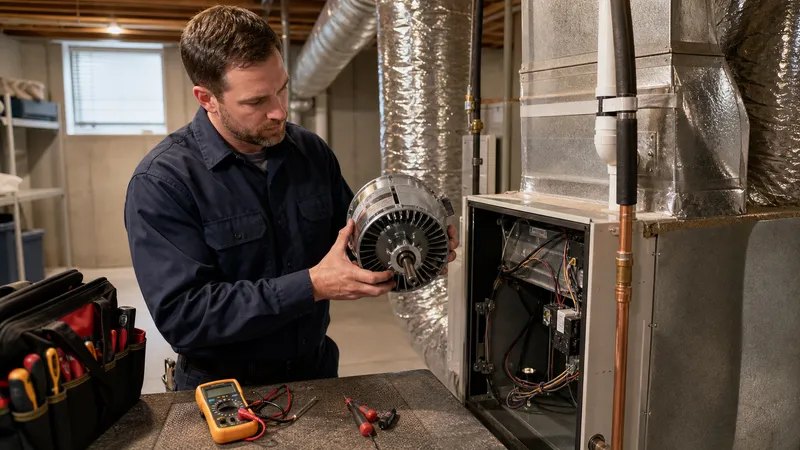
2026 HVAC repair cost ranges by part—capacitor, blower motor, refrigerant leak, compressor—plus the repair-vs-replace math and how to avoid overpaying.
Key takeaways
- Most single-part HVAC repairs run $150-$800 in 2026; a compressor or coil replacement can run $1,000-$3,000+.
- Diagnostic/service call fees typically run $75-$200 and are often credited toward the repair if you approve the work that visit.
- The 50% rule: if a repair quote exceeds about half the cost of a new system, replacement is usually the better math.
- ENERGY STAR flags 10+ years old (AC/heat pump) or 15+ years old (furnace) as the point to start weighing replacement seriously.
- Get 2-3 written quotes for any repair over a few hundred dollars—prices for the same part vary widely by region and contractor.
- AC compressor replacement specifically gets its own deep-dive with full cost detail—this page covers it in one line.
Most single-part HVAC repairs in 2026 cost $150 to $800—a capacitor swap sits at the low end, a blower or fan motor at the high end—while bigger jobs like a refrigerant leak repair or a compressor replacement can run $1,000 to $3,000 or more. The number that actually matters for your wallet, though, is the comparison between that repair quote and the cost of replacing the whole system: if the repair is more than about half of what a new unit would cost, replacement is usually the better math. This page breaks out 2026 cost ranges by repair type, what moves the price, and how to tell which side of that math you’re on before you sign anything.
HVAC repair cost by type (2026)
| Repair | Typical 2026 cost | What drives the range |
|---|---|---|
| Diagnostic / service call fee | $75-$200 | Flat fee for the visit; often credited toward the repair if approved same-day |
| Capacitor replacement | $150-$400 | Part itself is cheap ($15-$40); most of the bill is the labor and trip |
| Thermostat repair or replacement | $100-$500 | Basic vs smart thermostat, wiring compatibility, C-wire installation |
| Contactor or relay repair | $100-$450 | Straightforward swap unless wiring or the control board is also damaged |
| Blower or fan motor replacement | $400-$800 | Motor size, whether it’s a variable-speed (ECM) motor, access difficulty |
| Refrigerant leak repair (find + repair, no recharge) | $300-$1,500+ | Leak location (accessible line vs buried coil), refrigerant type, EPA-certified labor |
| Evaporator coil replacement | $700-$2,500+ | Coil size, refrigerant type, whether the cabinet needs modification |
| Ductwork repair (accessible sections) | $300-$1,200 | Length of run, accessibility, sealing vs replacing a section |
| Compressor replacement | $1,000-$3,000+ | See the dedicated compressor cost guide for a full breakdown |
Sources: Angi’s 2026 HVAC repair cost guide and This Old House’s 2026 AC repair cost guide (updated March 2026). These are national ranges built from contractor-reported job costs—your local quote depends on region, contractor overhead, and how the fault presents in your specific system.
What moves the number
A handful of variables explain most of the spread inside each row above:
- Access. A capacitor behind an easy-open panel costs less to replace than one in a cramped attic air handler where the technician spends more time just reaching it.
- Part availability and age. Repairs on a 15-year-old system sometimes need a part the distributor no longer stocks, which adds cost or forces a compatible substitute.
- Refrigerant type. Systems still running R-22 (phased out under the EPA’s refrigerant transition) cost more to service because the refrigerant itself is scarce and expensive compared to R-410A or newer alternatives.
- Time of year. Mid-summer AC failures and mid-winter furnace failures often carry a premium—demand is highest exactly when your system picked the worst time to break.
- Region and local labor rates. The same capacitor swap can cost noticeably more in a high-cost-of-living metro than in a smaller market; national ranges are a starting point, not your quote.
Repair vs. replace: the math that actually decides it
| Signal | What it means | Source or rule of thumb |
|---|---|---|
| Repair quote exceeds ~50% of a new system’s installed cost | Replacement usually pays off faster over the system’s remaining life | Industry rule of thumb (the “50% rule”), cited across HVAC contractor cost guides |
| AC or heat pump is 10+ years old | Worth getting a replacement quote alongside the repair quote | ENERGY STAR: when to replace |
| Furnace or boiler is 15+ years old | Same—weigh replacement, not just this one repair | ENERGY STAR: when to replace |
| System has needed 2+ repairs in the past year | Recurring repairs on an aging system tend to compound | Homeowner rule of thumb, not a specific agency figure |
| A new ENERGY STAR-certified unit could cut cooling/heating costs | Up to 20% lower energy costs on a qualifying replacement | ENERGY STAR: when to replace |
None of these signals alone makes the call. A 12-year-old system with a $200 capacitor failure is still worth repairing—that’s nowhere near 50% of a new system’s cost. A 12-year-old system quoted $2,800 to replace a failing compressor is a different conversation, especially against a new central AC installed cost that runs roughly $2,500-$15,000 depending on size and efficiency tier. Put your actual repair quote next to a replacement quote before deciding either way.
How to avoid overpaying
- Get 2-3 written quotes for anything beyond a simple capacitor or thermostat swap. The same repair can vary by hundreds of dollars between contractors serving the same neighborhood.
- Ask about the diagnostic fee up front. Confirm whether it’s a flat charge regardless of outcome, or credited toward the repair if you approve the work that visit—get this in writing before the technician arrives, not after.
- Request the parts-vs-labor breakdown. A quote that just says “$650, refrigerant repair” gives you nothing to compare against another contractor’s quote for the same job.
- Ask if the part is OEM or aftermarket, and whether either choice affects your existing manufacturer warranty coverage before you approve it.
- Don’t authorize same-visit upsells you can’t verify. If a technician recommends a second repair beyond the original complaint, it’s reasonable to ask for that in writing and get a second opinion before authorizing it, especially above a few hundred dollars.
When to call a professional
| Situation | Why it is not DIY |
|---|---|
| Refrigerant leak, low charge, or any refrigerant fitting | Illegal to purchase or handle refrigerant without EPA Section 608 certification |
| Compressor, capacitor, or motor replacement inside the unit | Live electrical components and, on some units, capacitors that hold a charge after power-off |
| Blower motor or control board diagnosis | Requires multimeter testing and manufacturer wiring diagrams to avoid misdiagnosis |
| Ductwork inside a finished wall or ceiling | Needs access, leak testing, and correct sealing order a homeowner’s visual check can’t verify |
| Any repair on a system still under manufacturer or home warranty | DIY work or an unlicensed repair can void remaining coverage |
| System won’t hold a diagnosis after a fresh filter and a visible-duct check | Needs load calculation or airflow measurement tools a homeowner doesn’t own |
A visual check, a couple of written quotes, and a booked appointment are the right next step for anything on that list. If your HVAC system is still under a manufacturer or extended warranty, check coverage before paying out of pocket—see what a home warranty actually covers and home warranty vs. home insurance for how repair costs like these get treated differently under each type of coverage.
Related guides
Frequently asked questions
How much does it cost to fix an AC or furnace in 2026?
Most single-component HVAC repairs cost $150 to $800: a capacitor is usually the cheapest fix at $150-$400 including labor, while a blower motor or fan motor runs $400-$800. Bigger jobs like a refrigerant leak repair ($300-$1,500+) or a compressor replacement ($1,000-$3,000+) cost more because they involve more labor time, specialized parts, or EPA-certified refrigerant handling.
Is it worth repairing an old HVAC system, or should I replace it?
Use the 50% rule as a starting point: if the repair quote is more than about half the cost of a new system, replacement usually pays off faster. ENERGY STAR also flags age directly—air conditioners and heat pumps over 10 years old, and furnaces over 15 years old—as the point to get a replacement quote alongside the repair quote, since a new ENERGY STAR unit can cut cooling and heating costs by up to 20%.
Why do HVAC companies charge a diagnostic fee just to look at the problem?
The diagnostic or service call fee (typically $75-$200) covers the technician’s time to travel to your home and identify the actual fault before any parts are ordered or repair work begins. Many companies waive or credit this fee toward the final repair bill if you approve the recommended fix during that same visit—ask before the technician arrives so you know whether a no-repair visit still costs you the full fee.
How do I avoid overpaying for an HVAC repair?
Get 2-3 written quotes for anything beyond a simple capacitor swap, since the same repair can vary by hundreds of dollars between contractors in the same area. Ask what the diagnostic fee covers and whether it’s credited toward the repair, get the specific part and labor breakdown in writing, and compare the repair quote against the age and remaining expected lifespan of your system before authorizing anything over a few hundred dollars.