
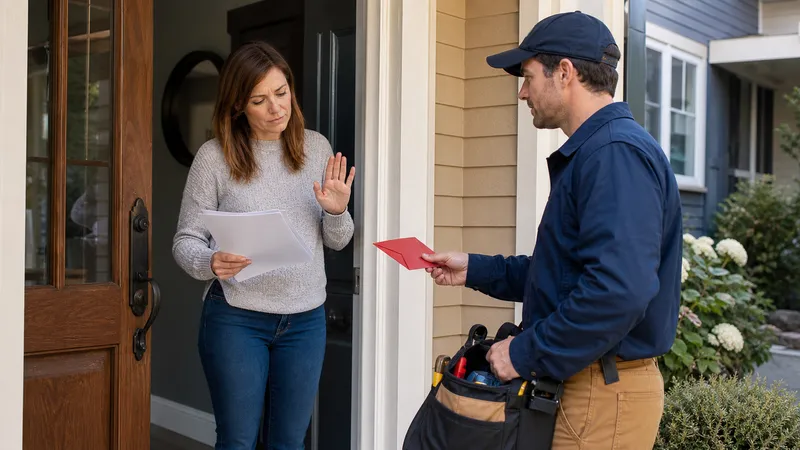
The warning signs of a scam or unlicensed contractor: cash-only demands, storm-chaser tactics, no written contract, and how to verify a license.
Key takeaways
- A contractor who shows up unsolicited after a storm, pressures same-day signing, or won't leave a written estimate is the FTC's classic scam pattern—stop there.
- The FTC says never pay for a home improvement job entirely up front; a deposit over roughly one-third of the total, before any material order, is a red flag.
- Cash-only or wire/gift-card/crypto-only payment requests leave no paper trail and are a named FTC warning sign, not just an inconvenience.
- Verify a license yourself through your state's licensing board site or phone line—don't take a contractor's card, badge, or verbal claim as proof.
- Federal law gives you three business days to cancel a contract signed at your home for $25 or more—the Cooling-Off Rule, not a courtesy the contractor offers.
- No proof of insurance when you ask means an injury or damage on your property could become your liability, not theirs.
The clearest red flags that a contractor is unreliable or unlicensed are unsolicited door-to-door or “storm chaser” solicitation, demanding payment in full before work starts, refusing to put anything in writing, no proof of license or insurance when you ask, insisting on cash only, and high-pressure “sign today” pricing. Any one of these is reason to slow down; two or more together is reason to walk away. This page covers the warning signs that show up during the sales pitch and the early stages of hiring—not the vetting questions to ask a good contractor before you hire one, which is its own guide.
The core warning signs
The FTC’s guidance on avoiding home improvement scams names a consistent set of tactics scammers use, and state licensing boards echo the same list when they publish consumer alerts. None of these prove fraud on their own, but each one removes a layer of protection you’d otherwise have.
| Warning sign | Why it matters | Your move |
|---|---|---|
| Unsolicited knock, flyer, or “we were just in the neighborhood” pitch | Legitimate contractors are usually found, not the ones finding you—this is the FTC’s top-cited scam entry point | Don’t schedule work on the spot; ask for a license number and call the board yourself before agreeing to anything |
| Demands full or near-full payment upfront | Once paid, a scam contractor has no reason to finish—the FTC says never pay for the entire job before work begins | Cap any deposit; pay the rest in stages tied to completed, inspected work |
| Cash-only, or insists on wire transfer, gift cards, or cryptocurrency | No receipt, no bank dispute path, and the FTC lists this as a named scam tactic across fraud categories, not unique to contractors | Insist on a payment method you can trace and dispute—check, card, or traceable bank transfer |
| No written contract or estimate | Verbal promises about scope, materials, and price are unenforceable if the job goes wrong | Do not let work start without a signed, dated document listing scope, materials, price, and timeline |
| Can’t or won’t show proof of license and insurance when asked | A real license is checkable in minutes; hesitation or a vague answer is the tell | Verify independently with your state licensing board before you say yes |
| “Today only” or “this price expires when I leave” pricing | Manufactured urgency is a pressure tactic to stop you from comparing bids or checking references | A legitimate quote holds for at least a few days; treat any expiring “deal” as a signal to slow down |
| Unmarked vehicle, out-of-state plates, no fixed local address | Makes the contractor hard to trace if something goes wrong, and is common in storm-chaser crews that leave town after the storm season | Ask for a physical business address and confirm it’s real, not just a P.O. box |
Storm chasers and disaster-area solicitation
After a hail storm, hurricane, or wind event, crews sometimes arrive from out of state within days offering fast roof or siding repair, often going door to door before your own insurance adjuster has even inspected the damage. The FTC’s post-disaster scam guidance flags this pattern specifically, and it comes with two variants worth knowing by name:
- Deductible waiver offers. A contractor who offers to “cover your deductible” or inflate the insurance estimate to make up the difference isn’t giving you a discount—that’s insurance fraud, and the policyholder (you), not just the contractor, can be held liable for it.
- “We’ll handle your claim” pitches. A contractor can help document damage, but signing anything that hands them power over your claim, or signing your insurance check over to them before work is verified complete, removes your leverage if the job is never finished. Filing the claim yourself and matching contractor estimates against your own adjuster’s scope is covered in How to File a Home Insurance Claim.
If a roof needs repair after storm damage regardless of who you hire, Roof Repair Cost Guide: Leaks, Shingles & Patches has current price ranges so you can sanity-check any quote against a real number, not just the urgency of the pitch.
How to actually verify a license
A license number on a business card or truck door is a starting point, not verification. Check the official state or local licensing regulator for the trade and location, using its license lookup or contacting the agency directly. NASCLA, the National Association of State Contractors Licensing Agencies, offers licensing resources, but its directory may require purchase or membership; it is not a substitute for the regulator’s current license record.
| Check | What you’re confirming |
|---|---|
| Name on the license matches the business or individual you’re hiring | Some scammers use a real contractor’s license number attached to a different, unlicensed business |
| License status shows active, not expired, suspended, or revoked | A lapsed or revoked license means the state has already flagged a problem or the contractor let coverage lapse |
| License class or specialty matches the actual work (roofing, electrical, general) | A general contractor license doesn’t always cover specialty trades that require their own license in your state |
| Bond and insurance on file are current | Many states require a surety bond as a baseline consumer protection—confirm it hasn’t lapsed |
Call the board’s verification line if you’re unsure how to read the online result—most have one specifically for this. If your state doesn’t license general contractors at all (a handful don’t), ask for proof of general liability insurance instead, and confirm it directly with the insurer, not just a certificate the contractor hands you.
The Cooling-Off Rule: your right to cancel
If you signed a contract with a contractor at your home—not at their office or showroom—for $25 or more, the FTC’s Cooling-Off Rule (16 CFR Part 429) gives you until midnight of the third business day after signing to cancel, with no penalty. The seller is legally required to give you two copies of a cancellation form and tell you about this right in writing at the time of sale. If a contractor pressured you into signing and didn’t mention this or hand you the form, that omission is itself a red flag worth reporting, separate from whatever the contract said.
What moves this from “annoying” to “walk away”
| Situation | Why it’s a stop, not a negotiation |
|---|---|
| Two or more red flags from the table above show up together | Individually explainable; stacked, they match the FTC’s documented scam pattern closely enough to not risk it |
| Contractor asks you to pull the permit yourself, or says the job doesn’t need one when it clearly involves structural, electrical, or plumbing work | Often a sign they can’t pull it themselves because they’re unlicensed in your jurisdiction |
| Pressure to sign your insurance check over before the job is complete and inspected | Removes your only leverage if the work is left unfinished |
| Business has no verifiable address, and online reviews are absent, recently mass-posted, or all five-star with no detail | Consistent with a shell business set up to disappear after a job or a storm season |
| Contractor already started demolition or ordered materials before any signed agreement | Creates pressure to keep paying to “finish what’s started” without a contract protecting you |
If you already paid and something’s wrong
Stop payment where you still can, keep every text, estimate, and receipt, and report the contractor to your state licensing board and attorney general’s consumer protection office—both take unlicensed-practice and fraud complaints even if you never get the money back. File a complaint with the FTC at ReportFraud.ftc.gov as well; individual complaints feed the pattern data that gets storm-chaser crews and repeat offenders shut down in other states.
Related guides
Frequently asked questions
What are the biggest red flags that a contractor is unreliable or a scam?
Unsolicited door-to-door or storm-chaser solicitation, demanding full or nearly full payment upfront, refusing to put the job in writing, no proof of license or insurance when asked, cash-only or wire/gift-card payment demands, high-pressure same-day pricing, and unmarked vehicles or no fixed business address are the FTC’s and state licensing boards’ most consistently cited warning signs.
How much should I pay a contractor upfront?
The FTC’s general guidance is not to pay for the entire job before work starts, and to keep any deposit modest—commonly cited around one-third of the total unless special-order materials genuinely require a larger deposit. Pay the remaining balance in stages tied to completed work, and hold a final payment until you’ve inspected the finished job.
How do I check if a contractor’s license is real?
Look up your state’s contractor licensing board (most have a free online license search or a phone verification line) and search the license number the contractor gave you. Confirm the name, license status (active, not expired or revoked), license class matches the work being done, and that any bond or insurance on file is current—don’t rely on a card, badge, or verbal claim.
Can I cancel a contract if I signed with a contractor at my door?
Often yes. The FTC’s Cooling-Off Rule gives consumers the right to cancel a contract for $25 or more signed away from the seller’s regular place of business—including at your home—within three business days, with no penalty. The contractor is required to give you two copies of a cancellation form in writing; if they didn’t, that’s itself a red flag.
Is it a scam if a contractor offers to handle my insurance claim after storm damage?
Be cautious. Legitimate contractors can help document damage for a claim, but an offer to waive your deductible or inflate the claim amount is insurance fraud that exposes you, the policyholder, not just the contractor. Never sign an insurance check over to a contractor before work is verified complete, and get your own adjuster’s assessment rather than relying solely on the contractor’s estimate.