
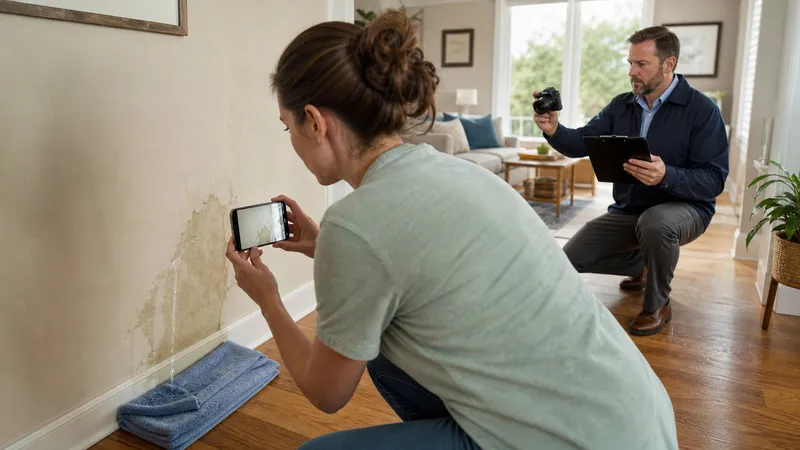
Document damage before cleanup, call your insurer fast, understand your deductible, and avoid the mistakes that get a home insurance claim cut or denied.
Key takeaways
- Photograph and video every room before you clean up or throw anything out—documentation done after cleanup is much weaker, per FEMA guidance.
- Contact your insurer immediately. Reporting deadlines vary by state and by policy, so don't wait to find out yours.
- Compare the damage cost to your deductible before you file. A claim under your deductible pays you nothing and can still raise your renewal rate.
- Only do temporary protective repairs (tarps, boarding a window) before approval. Save those receipts—insurers reimburse reasonable protective measures, not full repairs done early.
- An adjuster works for the insurance company, not for you. Get your own repair estimate so you have something to compare their number against.
- The most common reasons claims get reduced or denied: reporting late, incomplete documentation, and repairs done by an unlicensed contractor before the scope was approved.
To file a home insurance claim: photograph and video the damage before you clean anything up, contact your insurer right away (deadlines vary by state and policy), find out what your deductible is before deciding whether it’s worth filing, and let the adjuster inspect the damage before you authorize full repairs. This page assumes you already have a homeowners policy in force—if you’re still sorting out whether a problem is an insurance claim or a home warranty repair, see Home Warranty vs. Home Insurance first.
The claims process at a glance
| Step | What you do | Why it matters |
|---|---|---|
| 1. Document | Photograph and video every damaged area, room by room, before cleanup | Weak or missing documentation is one of the top reasons a payout gets cut, per FEMA |
| 2. Report a crime, if any | File a police report for theft, vandalism, or burglary and get the report number | Most insurers require it before they’ll process a related claim (III) |
| 3. Contact your insurer | Call, use the app, or go online with your policy number and a description of the loss | Starts the claim and clock; forms must be sent to you within a set time by law (III) |
| 4. Protect the property | Tarp, board up, or shut off water—temporary measures only | Prevents further damage; save receipts, insurers typically reimburse reasonable protective steps |
| 5. Meet the adjuster | Walk the damage with them, hand over your item list and photos | The adjuster’s assessment sets what the insurer offers to pay |
| 6. Get repair estimates | Get at least one estimate from a licensed contractor | Gives you an independent number to compare against the adjuster’s |
| 7. Review the settlement | Confirm the offer covers your policy’s actual scope before you sign or start full repairs | Signing too fast can lock in a short payout |
Document the damage before you clean anything up
Take photos and video of every affected room, inside and out, before you throw anything away or start drying things out. FEMA is direct on this point: document damage with photos or video before cleanup begins, including wide shots for context and close-ups of individual items. Note the make, model, and serial number of damaged appliances and electronics where you can still read the label. Photograph the insides of closets and cabinets, not just open rooms—water and smoke damage there is easy to overlook later.
After you’ve documented, it’s safe to do two things: throw out anything that’s now a health hazard (flooded food, soaked carpet padding, wet insulation), and take reasonable steps to stop the damage from getting worse—a tarp over a hole in the roof, a shop vac on standing water, a board over a broken window. Keep every receipt for materials you buy to do this; it’s a normal, reimbursable part of the claim.
Contact your insurer promptly
Call your insurer, use their app, or go through your agent as soon as you know there’s damage worth reporting. The Insurance Information Institute recommends having your policy number ready and being prepared to describe what happened and the extent of the damage. Your insurer is required to send you claim forms within a set time period once you report; return them promptly to avoid delays in processing.
Reporting late is one of the more avoidable ways to weaken a claim. Even if you’re still assessing the full extent of the damage, report the loss and follow up with details as you gather them—don’t wait until you have a complete picture to make the first call.
Understand your deductible before you file
Before you report the damage, find out what your deductible is. The NAIC recommends this specifically: if the repair cost is close to or under your deductible, filing may not be worth it, since the insurer only pays the amount above that number—and a filed claim still shows up in your claims history even if it pays nothing. Some policies carry separate, often higher, deductibles for specific perils like wind or hail; check your declarations page rather than assuming your standard deductible applies to every kind of loss.
Get repair estimates
Get at least one estimate from a licensed contractor, ideally before or around the same time as the adjuster’s visit. The estimate isn’t a substitute for the adjuster’s assessment—it’s a number you can compare against theirs. If your contractor’s estimate is significantly higher than what the adjuster offers, that gap is worth raising with your insurer before you accept a settlement, not after repairs are underway.
What a claims adjuster does
The adjuster is the insurance company’s representative, not a neutral third party and not your advocate. Per III, the adjuster inspects the property damage, reviews your policy to confirm what’s covered and which deductible applies, and calculates the amount the insurance company should pay. Larger or more complex losses can involve more than one adjuster—for example, a structural specialist for the house and a separate contents adjuster for damaged belongings.
Have your documentation ready before they arrive: photos, video, a written list of damaged or destroyed items with estimated values, and any receipts you already have. The more organized your list, the less back-and-forth the adjuster needs to finalize their number.
Common mistakes that get claims denied or reduced
| Mistake | Why it hurts your claim |
|---|---|
| Waiting weeks to report the loss | Late reporting can violate your policy’s notice requirement and makes it harder to verify the damage happened when you say it did |
| Cleaning up or discarding items before photographing them | No documentation means no proof for the adjuster to evaluate—weakened or missing evidence is a top reason payouts get cut (FEMA) |
| Hiring an unlicensed contractor to do full repairs before the adjuster inspects | The insurer can’t verify the original damage or the scope of work, and unlicensed repairs may not be reimbursed at all |
| Accepting the first settlement offer without your own estimate | You have nothing to compare it against, and it’s harder to reopen a claim after you’ve signed off |
| Filing for damage under your deductible | It pays you nothing and still adds to your claims history |
| Not reading the “duties after loss” section of your policy | Missing a required step (like notice timing or proof-of-loss deadlines) can be used to deny or delay payment |
When to call a professional
| Situation | Who to call | Why it’s not DIY |
|---|---|---|
| Structural damage—sagging roof, cracked foundation, leaning walls | A licensed structural contractor or engineer | Needs a professional assessment before anyone reoccupies the space, insurance claim or not |
| Damage from fire, gas, or a downed power line | Fire department or utility first, insurer second | Immediate safety hazard; the claim can wait until the scene is safe |
| Full repairs of any kind before the adjuster has approved the scope | A licensed, insured contractor, after approval | Repairs before inspection remove the evidence the adjuster needs and can void reimbursement for that work |
| Settlement offer that seems well below your contractor estimate | Your state insurance department or a public adjuster | A public adjuster works for you, not the insurer, for a percentage of the payout—worth it mainly on large, disputed claims |
| Any dispute you can’t resolve with the insurer directly | Your state insurance department consumer division | State regulators handle unresolved claim complaints and can intervene on unfair claims handling |
Related guides
Frequently asked questions
How long do I have to file a home insurance claim?
There’s no single national deadline—the Insurance Information Institute notes your insurer must send you claim forms within a set time once you report a loss, but how long you have to report the loss in the first place varies by state and by your specific policy, according to the NAIC. Check your policy’s “duties after loss” section or call your agent, and don’t wait to find out.
What happens if my damage is less than my deductible?
You’d be paying to fix it yourself either way, since the insurer only pays the amount above your deductible. The NAIC recommends checking your deductible before you report the damage—filing a claim you know won’t pay out still creates a claims-history record that can affect future premiums or renewal.
Should I get a repair estimate before or after the adjuster visits?
Get one in parallel, not instead of the adjuster’s assessment. The adjuster’s number determines what the insurer pays; your own contractor estimate gives you an independent figure to compare it against and to raise if the adjuster’s scope looks short.
Can I start repairs before my insurance company approves the claim?
Only temporary protective repairs—like tarping a roof or boarding a broken window—to stop further damage. Save those receipts; insurers generally reimburse them. Full repairs done before the adjuster inspects and the scope is approved are a common reason payouts get reduced, because there’s no damage left to verify.
What does a home insurance claims adjuster actually do?
The adjuster inspects the damage, reviews your policy for coverage and applicable deductibles, and calculates what the insurance company will pay. Some claims involve more than one adjuster—for example, a structural adjuster for the house and a contents specialist for damaged belongings, per the Insurance Information Institute.