
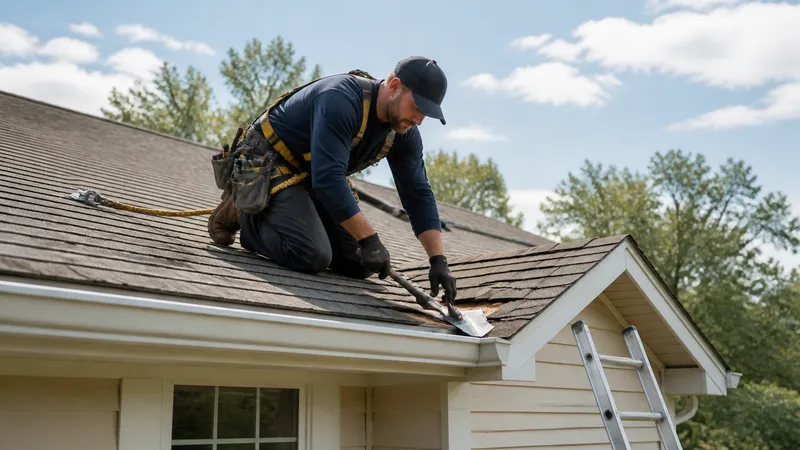
2026 roof repair costs by job: leak patches run $150-$1,550, shingle repairs $200-$800 per square, flashing $150-$1,600—plus what insurance actually covers.
Key takeaways
- Most roof repairs run $386-$1,875 nationally in 2026, per Angi, with a typical homeowner spending around $1,172.
- A small leak patch runs $150-$400; a full flashing replacement can hit $1,600; a full re-roof averages $9,607 for comparison.
- Roof pitch, story height, and material each add cost—a steep, multi-story roof can run 35-50% more than a single-story job of the same size.
- Homeowners insurance typically covers sudden storm damage (wind, hail, falling limbs) but not wear-and-tear failures like an aging, worn-out roof.
- Get 2-3 written, itemized quotes before agreeing to a repair—verbal estimates hide scope and material differences that explain price swings.
- This page covers repair pricing only. For the inspection schedule that catches problems before they need this table, see the roof maintenance guide.
A typical roof repair costs $386 to $1,875 nationally in 2026, with most homeowners spending around $1,172, according to Angi’s roof repair cost data. Where you land in that range depends on the job: a small leak patch or a few replaced shingles sits near the bottom, while flashing replacement, storm damage spread across a slope, or anything requiring a multi-story lift climbs toward the top. This page prices out the common repair jobs, what pushes the number higher, and what homeowners insurance will and won’t pay for. It does not cover the inspection routine that catches problems early—Housetto’s roof maintenance guide is the page for that.
Roof repair cost by job (2026)
| Repair type | Typical 2026 cost | Notes |
|---|---|---|
| Small leak patch (accessible spot, sealant or single-shingle fix) | $150-$400 | Low end of Angi’s $150-$1,550 leak-repair range; assumes the leak hasn’t reached decking or interior finishes yet |
| Shingle replacement, a few shingles | $100-$300 | Materials plus labor for a handful of missing or wind-lifted shingles, per Angi’s asphalt shingle repair data |
| Shingle replacement, full square (100 sq ft) | $200-$800 | Wider damage—hail scarring, a torn-off section—priced per “square,” the roofing industry’s 100-square-foot unit |
| Flashing repair (vent, valley, or general) | $150-$600 | Resealing or replacing flashing at a vent pipe, valley, or skylight; chimney flashing runs higher, $400-$1,600, because of the masonry work involved |
| Emergency tarp (temporary, stops active water intrusion) | $233-$1,254, average $743 | HomeAdvisor figure; after-hours or storm-surge crews may add a same-day or call-out fee |
| Full re-roof (comparison only—not a repair) | $9,607 average; $4-$11 per sq ft | Shown for scale—see the “repair vs. replace” section below for when a repair stops making sense |
What moves the number
The job type sets the baseline; these four factors decide where you land inside—or above—that range.
| Factor | How it changes the price |
|---|---|
| Roof pitch | A steep pitch (8/12 or steeper) requires harness systems and toe boards, which can add 20-40% to labor cost on its own |
| Story height | Multi-story homes often need scaffolding or a lift, adding roughly $200-$600 per day in equipment rental beyond a single-story ladder job |
| Combined pitch + height | A steep roof on a two-story home can run 35-50% more than a standard-pitch, single-story job of the same size |
| Material type | Asphalt is the cheapest to repair and the most common. Metal and tile repairs cost more per job—metal because of specialized fasteners and sealants, tile because individual tiles crack underfoot and often need a roofer trained on that material |
Access is the theme running through all four: anything that slows a crew down or requires extra equipment shows up in the labor line, not the materials line.
Repair vs. replace
A repair is cheaper up front in almost every case—compare the $1,172 typical repair to the $9,607 average full re-roof in the table above. Repair stops being the right call in a few specific situations:
- Damage is spread across multiple slopes or areas, not concentrated in one spot a patch can address.
- The roof is already near the end of its material’s expected life. Asphalt shingle roofs commonly run 20-30 years; if yours is at year 22 and needs a third repair this year, a roofer’s replacement quote is worth getting alongside the repair quote.
- A contractor finds deck or structural damage during the repair. Rot or sag under the shingles means the repair scope—and cost—can grow mid-job; ask for a stop-and-call clause in writing before work starts if you’re worried about this.
Does insurance cover roof repair?
| Cause of damage | Typically covered by homeowners insurance? |
|---|---|
| Wind, hail, or a fallen tree limb from a storm | Usually yes—these are classic covered perils under a standard policy |
| Fire or lightning strike | Usually yes |
| A roof that simply wore out (curling, cracking, granule loss with age) | No—the NAIC’s Consumer’s Guide to Home Insurance is explicit that a homeowners policy “isn’t a maintenance contract” and doesn’t pay to repair items that simply wear out |
| Damage traced to a leak you already knew about and didn’t fix | No—insurers treat this as neglect, not a sudden loss |
| A roof’s age reducing the payout even on a covered claim | Sometimes—some policies pay actual cash value (depreciated) on an older roof instead of full replacement cost; check your specific policy’s roof-age clause |
The practical takeaway: photograph storm damage the same day if possible, and call your insurer before you call a roofer if you suspect the cause was a specific storm event. If the damage built up gradually, budget for it as a repair cost, not a claim.
When to call a professional
| Situation | Why it’s not DIY |
|---|---|
| Any repair that requires walking the roof surface | Fall risk—even low-pitch roofs get slick with dew, algae, or loose granules |
| Flashing repair around a chimney, valley, or skylight | Flashing is the most common leak point; getting the overlap and sealant wrong creates a new leak |
| A steep-pitch or multi-story roof | Requires harness systems, ladders, or lift equipment most homeowners don’t own |
| Storm damage you plan to file an insurance claim on | Insurers typically want a professional inspection and a documented, itemized estimate before approving a claim |
| A leak that has reached decking, insulation, or an interior ceiling | The repair now involves more than the surface—water has likely traveled beyond where it entered |
| Tile, slate, or a wet/mossy roof | These crack or become slick underfoot even for an experienced homeowner |
Related guides
Frequently asked questions
How much does it cost to fix a roof leak?
Angi’s 2026 data puts roof leak repair between $150 and $1,550, depending on the leak’s source and how much of the roof deck or interior it has damaged. A simple sealant or shingle patch on an accessible spot is at the low end; a leak that has reached flashing, decking, or an interior ceiling costs more to trace and fix.
How much does it cost to replace a section of shingles?
Replacing a handful of missing or damaged shingles typically costs $100-$300. A full square (100 square feet) of asphalt shingle replacement, including labor, generally runs $200-$800 depending on shingle grade, pitch, and access, per Angi’s 2026 cost data.
How much does emergency roof tarping cost?
HomeAdvisor reports a national range of roughly $233-$1,254 for emergency tarping, averaging around $743, with after-hours or storm-surge crews sometimes adding a same-day or call-out fee on top. A tarp is a temporary fix meant to stop water intrusion until a permanent repair can be scheduled, not a repair itself.
Does homeowners insurance cover roof repair?
Usually only if the damage is sudden and from a covered peril—wind, hail, a falling tree limb, or fire. The NAIC’s consumer guide to home insurance is explicit that a homeowners policy is not a maintenance contract: damage from age, neglect, or ordinary wear and tear, like a roof that simply wears out, is the homeowner’s responsibility, not the insurer’s.
Is it cheaper to repair or replace a roof?
Repair is cheaper up front in nearly every case—a typical repair averages around $1,172 versus $9,607 for a full replacement, per Angi’s 2026 data. Repair stops making sense when damage is spread across multiple areas, the roof is already near the end of its material’s expected lifespan, or a contractor finds structural deck damage that a patch won’t fix.