
Tank water heaters last 8–12 years, tankless 15–20+. Real repair costs by part, the rust-water warning sign, and why waiting risks a flood.
Key takeaways
- Tank water heaters typically last 8–12 years; tankless units run 15–20+ years, per Rheem's own lifespan comparison.
- Rust-colored hot water that doesn't clear, or any moisture at the tank's base, means tank corrosion—stop delaying and plan replacement now.
- A tank failure is usually a flood, not a slow stop—that's why 'wait until it fails' is riskier for water heaters than for most appliances.
- A thermocouple ($150–$325), gas valve ($150–$300), or heating element ($200–$750) repair is often worth it on a unit under 8 years old.
- Rheem's own guidance says persistent rumbling after a flush, especially on a unit 8–12+ years old, can mean it's time to replace, not repair again.
- Get a replacement quote once total repair cost approaches $1,000 or the tank is past 8–10 years, per Fixr's cost data.
A tank water heater typically lasts 8 to 12 years; a tankless unit typically runs 15 to 20 years or more, per Rheem’s own tank-vs-tankless lifespan comparison—with well-maintained tankless units sometimes reaching 25–30 years. Maintenance history changes where a unit lands in that range: the annual flush, anode rod inspection, and tankless descaling are the real prevention levers, covered step-by-step on those pages. This page is different from all three: it’s the lifespan and repair-vs-replace decision—what actually kills a water heater, the one sign that means stop delaying, and the real cost math for repairing versus replacing.
The one sign that means stop delaying
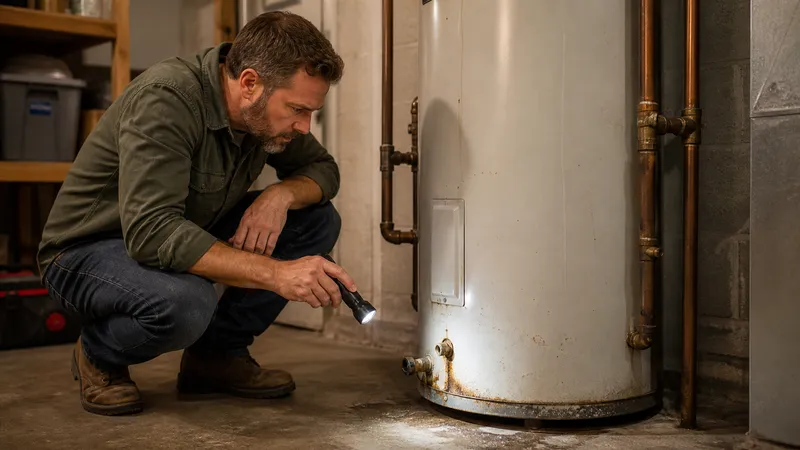
Rust-colored water from the hot tap that doesn’t run clear after a few minutes, or any rust, moisture, or a puddle at the base of the tank, means the tank itself is corroding from the inside. That’s not a sediment problem a flush can fix—it’s the tank’s steel lining failing, and it only moves in one direction. Once you see either sign, the tank flush troubleshooting guide already flags the same tell: rust color that doesn’t clear after flushing can mean the anode rod is fully consumed and the tank has started corroding, which “a flush cannot fix.”
Other signs it’s time to replace, not repair
| Sign | What it usually means | Action |
|---|---|---|
| Rust-colored water that doesn’t clear, or rust/moisture at the tank base | Internal tank corrosion—not repairable | Replace; don’t flush and wait |
| Age at or past 8–12 years (tank) or 15–20 years (tankless) | Approaching or past typical service life, per Rheem | Budget for replacement even if it’s still running |
| Popping or rumbling that persists after a full flush | Rheem’s own guidance says persistent noise after maintenance “could signal aging components or that it’s time to consider replacement”—see the flush guide for the flush procedure first | If a flush doesn’t quiet it, treat the noise as an aging signal, not a nuisance |
| Inconsistent or fluctuating hot water temperature | Failing heating element, thermostat, or gas valve; worse if the unit is also old | Repair if the unit is young; weigh against replacement if old |
| Pilot or ignition problems that keep recurring | Thermocouple or gas valve wearing out, not a one-time relight issue | Repairable on a younger unit; recurring failures on an old one favor replacement |
Rheem’s own troubleshooting guidance on water heater noise is explicit that context matters: persistent rumbling “combined with visible leaks or a unit that’s 8–12+ years old” is a stronger replace signal than the same noise on a 3-year-old unit (Rheem: The Ultimate Guide to Water Heater Noises).
Repair vs. replace: the real cost math
Not every problem means the tank is dying. A failed thermocouple, heating element, or gas valve on an otherwise-younger unit is a legitimately cheap, worthwhile repair. The same failure on a tank already past 8–10 years is a weaker bet—not because the part is expensive, but because you’re paying for a fix on a tank that’s statistically close to failing on its own terms anyway.
| Repair | Typical 2026 cost | Worth it on a unit under 8 years? | Source |
|---|---|---|---|
| Thermocouple replacement | $150–$325 | Usually yes—cheap relative to a new install | Fixr: Water Heater Repair Cost |
| Gas control valve replacement | $150–$300 | Usually yes | Fixr |
| Heating element replacement (electric) | $200–$750 | Usually yes, at the lower end of the range | Fixr |
| Pilot light / ignition repair | $75–$175 | Yes, unless it recurs repeatedly | Fixr |
| New water heater, installed | $600–$1,500 | — | Fixr |
Fixr’s own guidance draws the line at repair estimates approaching $1,000: at that point, and especially on a unit already near or past its typical 8–10 year mark, replacement is the more economical call, since an aging tank with one major failure often has a second one waiting (Fixr: Water Heater Repair Cost). A $200 thermocouple swap on a 4-year-old unit is an easy yes. The same $200 thermocouple on a 10-year-old tank that’s also started rumbling again after a flush is a sign to get a replacement quote alongside the repair quote, not just the repair quote alone.
Why “wait until it fails” is riskier here than for most appliances
A dishwasher or a dryer that fails mostly just stops working—you notice, you’re inconvenienced, and you schedule a repair or replacement on your own timeline. A tank water heater’s failure mode is different: internal corrosion doesn’t announce itself with a slow decline in performance. It eats through the tank wall until water finds the weak point, and at that point you have an active leak or, in the worst case, a ruptured tank releasing its full contents into a utility closet, basement, or garage—often while no one is home to catch it early.
That asymmetry is the real argument for replacing a tank proactively once it’s past 8–10 years and already showing an early sign (recurring noise, an aging anode rod, a repair quote on the table), instead of running it to failure the way you might with a smaller appliance. A planned replacement is a scheduled expense. An unplanned tank failure is a scheduled expense plus a flood.
When to call a professional
| Situation | Why it is not DIY |
|---|---|
| Rust-colored water that doesn’t clear, or any water at the tank’s base | Tank corrosion; needs a professional assessment and likely replacement |
| Recurring pilot/ignition failure or a thermocouple that won’t hold | Diagnosing between thermocouple, gas valve, and gas supply issues requires combustion know-how |
| Persistent popping or rumbling after a full flush | May indicate a failing heating element or a tank too far gone for sediment removal to fix |
| A repair quote is approaching $1,000, or the unit is past 8–10 years old | Get a written replacement quote alongside the repair quote before approving either |
| Gas smell, soot, or a scorched-looking burner area | Emergency: leave, call your gas utility or 911, then a technician |
A visual check, a photo of the corrosion or the label, and a booked appointment are often the right next step—that’s not a failure to DIY it.
Related guides
Frequently asked questions
How long does a water heater last?
A tank water heater typically lasts 8–12 years; a tankless unit typically lasts 15–20 years or more, according to Rheem’s own tank-vs-tankless lifespan comparison. Regular flushing, anode rod replacement, and descaling (tankless) are what push a unit toward the long end of that range.
What is the biggest warning sign a water heater is about to fail?
Rust-colored hot water that doesn’t clear after running the tap for a few minutes, or any rust, moisture, or a puddle at the base of the tank. Both point to internal tank corrosion, which cannot be repaired—only replacement stops the eventual leak or rupture.
Is it worth repairing an old water heater?
It depends on what’s broken and the tank’s age. A thermocouple, heating element, or gas valve failure on a unit under 8 years old is usually a cheap, worthwhile repair. The same failure on a tank past 8–10 years is a weaker bet, because the tank itself is approaching the end of its typical service life and a repair doesn’t reverse internal corrosion.
Why replace a water heater before it actually fails?
Because a water heater’s failure mode is usually a flood, not a quiet shutdown. Tanks don’t fail gradually—internal corrosion eats through the tank wall until it leaks or ruptures, often without warning. Replacing an aging tank on your own schedule avoids replacing it, and cleaning up water damage, on its schedule.
How much does it cost to repair a water heater versus replace it?
Individual repairs run $75–$750 depending on the part, per Fixr’s cost data. A full replacement typically runs $600–$1,500 installed. Fixr’s guidance suggests replacing rather than repairing once a single repair estimate nears $1,000, or once the unit is already past its typical 8–10 year service life.