
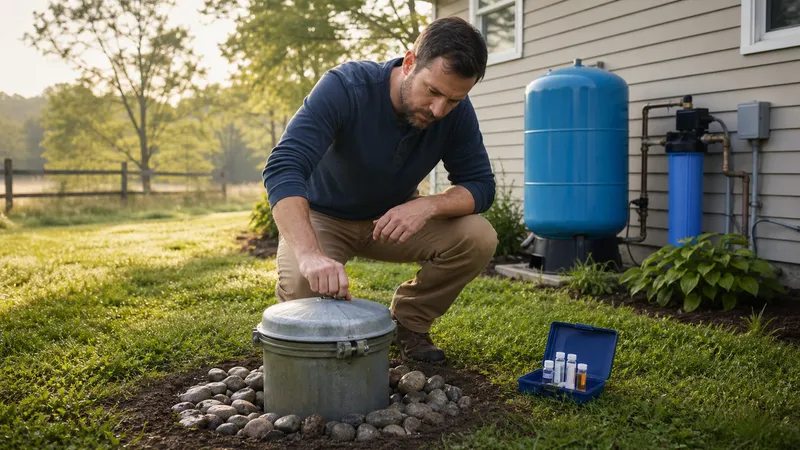
Unlike city water, a private well is your responsibility. What CDC/EPA say to test annually, plus cap, filter, and pressure-tank checks.
Key takeaways
- Test your well water at least once a year for coliform bacteria and nitrates — no one else is required to do this for you.
- Any positive bacteria result means stop drinking the water and shock-chlorinate or call a well professional; don't wait for symptoms.
- Inspect the well cap and casing twice a year: cracks, gaps, or a missing cap let surface water and contaminants straight into your supply.
- Change sediment/particulate filters every 3–6 months, sooner if water pressure drops or the cartridge looks visibly loaded.
- A pressure tank that short-cycles (pump kicks on and off every few seconds) is waterlogged and needs its air charge checked, not a new pump.
- EPA does not regulate private wells the way it regulates city water — testing, upkeep, and safety calls are entirely on the homeowner.
If your water comes from a private well, testing, maintaining, and keeping it safe is entirely on you. The EPA is direct about this: private well water is not regulated under the Safe Drinking Water Act the way public utility water is, and “private well owners are responsible for delivering safe drinking water to their households.” Nobody tests it unless you do. The core maintenance job on a well system is four things: test the water at least annually, inspect the well cap and casing, change sediment filters on schedule, and watch the pressure tank for waterlogging. This page covers all four. For the mechanics of pressure-tank cut-in/cut-out pressure and troubleshooting a pressure drop, see Why Does Water Pressure Drop When Two Faucets Run at Once? — this page doesn’t repeat that depth.
What to test for and how often
| Test for | How often | Why |
|---|---|---|
| Total coliform bacteria | Annually, at minimum | CDC and EPA both name this as the baseline yearly test. A positive result flags surface or septic contamination reaching the well. |
| Nitrates | Annually | Nitrates come from fertilizer, septic systems, and livestock runoff. High levels are especially dangerous for infants (methemoglobinemia, or “blue baby syndrome”). |
| Total dissolved solids (TDS) and pH | Annually | EPA lists these alongside bacteria and nitrates as part of the standard annual well check — they flag scale, corrosion, and taste/odor issues before they become bigger problems. |
| Arsenic, lead, radon, pesticides, or other local contaminants | Periodically, based on your region | CDC and EPA recommend testing for contaminants known to occur in your area — ask your state or county health department which ones are relevant near you, since this varies by geology and local land use. |
| Anytime water changes taste, color, or smell | Immediately | A sudden change is the clearest signal something in the well or plumbing has changed. Don’t wait for the next scheduled test. |
| After flooding, nearby construction, or well/pump service | As soon as practical | Any of these can introduce contamination or disturb the well’s seal. |
Most state health departments and university extension offices offer low-cost well water test kits — often for the annual coliform/nitrate panel specifically. A certified lab (not a big-box store test strip) is the reliable option for a result you can act on.
Well cap and casing: the physical seal that keeps contaminants out
The well cap and casing are the only thing standing between your water and everything happening at ground level — lawn chemicals, septic effluent, flood water, insects, and rodents. The EPA’s home-water protection guidance calls out three specific things to check:
| Task | Cadence | What you’re looking for | DIY or pro |
|---|---|---|---|
| Well cap inspection | Twice a year | Cracks, gaps, a loose fit, or a cap that’s missing entirely | DIY visual check; replace a damaged cap yourself or call a well contractor for a proper sanitary seal |
| Casing inspection | Twice a year | Cracked, corroded, or damaged casing above ground | DIY visual check; repair is a well contractor job |
| Surface seal and grading | Annually, and after heavy rain | Settling or cracking around the base; make sure the ground slopes away from the well so runoff drains away from it, not toward it | DIY — regrade with soil if water pools near the casing |
| Casing height | Check once, note it | Casing should extend above the ground surface, not be cut off below grade — a below-grade casing lets surface water pool right at the entry point | Call a well contractor if the casing was cut low |
| Setback from contamination sources | Check once, note it | Distance from septic tanks, drain fields, livestock areas, and fuel storage | Note only — moving a well or a septic system is a licensed job |
Sediment and particulate filter changes
Most well systems run through at least one sediment (particulate) filter before the pressure tank or point of use, catching sand, silt, and rust particles the well pulls up. There’s no single federal interval for this — it depends on how much sediment your well produces and the filter’s micron rating.
| Signal | What it means | Action |
|---|---|---|
| Routine schedule | General homeowner rule of thumb, not a regulatory standard | Change every 3–6 months for most wells; every 4–6 weeks for high-sediment wells |
| Visible pressure drop at faucets | Filter is loading up with sediment and restricting flow | Change the cartridge now, don’t wait for the calendar date |
| Cartridge looks brown, packed, or discolored | Filter is at or past capacity | Change it |
| Grit at faucet aerators or in appliances | Filter is undersized, past its life, or missing altogether | Change the filter; consider a finer micron rating if grit continues |
| New well or after well/pump service | Disturbed sediment often spikes right after service | Check and likely change the filter sooner than usual |
Keep a spare cartridge on hand in the correct size — running the house without a filter, or with a clogged one bypassing through a pressure-relief path, defeats the point of having it.
Pressure tank basics — and the waterlogged-tank symptom
The pressure tank stores pressurized water so the pump doesn’t run every time a faucet opens, cycling between a cut-in and cut-out pressure. That mechanism — and how to troubleshoot pressure drops from it — is covered in depth in Why Does Water Pressure Drop When Two Faucets Run at Once?. The one pressure-tank symptom worth covering here, since that guide doesn’t, is a waterlogged tank.
A properly charged pressure tank has an air cushion above the water (a bladder or diaphragm keeps them separate) that lets it store pressure. Over time that air charge can leak out or the bladder can fail, and the tank fills almost entirely with water — “waterlogged.” When that happens, the tank can no longer buffer pressure, so the pump has to turn on and off constantly to keep up with even small demand.
| Symptom | Likely cause | What to do |
|---|---|---|
| Pump cycles on/off every few seconds (short-cycling), even for a single open faucet | Waterlogged tank — air charge is gone | Shut off power to the pump, drain the tank, and check the air pre-charge at the Schrader valve with a tire gauge against the tank’s rated pre-charge (often close to the pump’s cut-in pressure) |
| Pump runs much longer than usual to refill pressure | Same waterlogging, more advanced, or a failing bladder | If recharging the air doesn’t hold, the bladder has likely failed — the tank needs replacement |
| Banging or hammering when the pump starts and stops | Often paired with a waterlogged tank | Address the air charge first; if hammering continues, have a well contractor check the tank and check valve |
Recharging air on a bladder-style tank is a manageable DIY task with the power off and the tank drained — but a tank that won’t hold air after recharging, or a pump that won’t stop running, is a job for a well or pump professional.
When to call a professional
| Situation | Why it’s not DIY |
|---|---|
| Any positive bacteria (coliform or E. coli) test result | Requires shock chlorination done correctly, a retest, and sometimes source investigation — a licensed well or water-treatment professional can confirm it’s actually resolved |
| Pump failure or no water pressure at all | Diagnosing a failed pump, pressure switch, or wiring inside a well requires electrical and well-system expertise |
| Well casing damage, a below-grade casing, or a compromised seal | Repairing the casing or reworking the wellhead is licensed well-contractor work, not a homeowner fix |
| Sudden, unexplained change in water taste, color, or smell | Could signal contamination, a failing component, or aquifer changes — needs a water test and possibly a professional inspection before you keep drinking it |
| Pressure tank that won’t hold an air charge, or a bladder that’s clearly failed | Tank replacement and proper pre-charge setting is specialized work |
| Any work that requires opening the pump’s electrical connections or pulling the pump itself | Electrical and confined-space risk; this is licensed well-pump service |
Keep a record
| Keep this | Why |
|---|---|
| Annual test results (bacteria, nitrates, TDS, pH) | Shows trends year over year and is often required for a home sale |
| Well cap/casing inspection dates and photos | Confirms the physical seal has been checked, not assumed |
| Sediment filter size and last change date | Stops guessing at the next filter run |
| Pressure tank air pre-charge reading and date | Useful baseline if short-cycling starts later |
| Well depth, pump type, and any service records | Needed by any well contractor you eventually call |
Related guides
Frequently asked questions
How often should I test my well water?
At least once a year for total coliform bacteria and nitrates, per CDC and EPA guidance. Test more often — or for additional contaminants like arsenic, radon, or pesticides — if you notice a change in taste, color, or smell, if someone in the home is pregnant or an infant, or if you know of nearby land use changes such as new farming, flooding, or a nearby fuel tank.
What does it mean if my well water tests positive for bacteria?
Stop using the water for drinking and cooking until you know the cause. A positive total coliform result means the well may be vulnerable to surface contamination; a positive E. coli result is a more urgent fecal-contamination signal. Both typically call for shock chlorination and a retest, and a well professional if the problem doesn’t clear on a retest.
How do I know if my well pressure tank is waterlogged?
The clearest sign is short-cycling: the pump kicks on and off in rapid, frequent bursts (sometimes every few seconds) instead of running for a minute or two every so often. That means the tank’s air cushion is gone and it’s no longer storing pressure the way it should.
Do I need to test my well water if nothing has changed and the water looks fine?
Yes. Bacteria and nitrates are odorless, colorless, and tasteless at levels that can still make people sick, especially infants. CDC and EPA both recommend annual testing regardless of how the water looks, tastes, or smells.
How often should I replace my well’s sediment filter?
There’s no single government-mandated interval, but a common homeowner rule of thumb is every 3–6 months, or sooner if you notice reduced water pressure, a cartridge that looks visibly brown or clogged, or grit at faucet aerators. High-sediment wells may need a change every 4–6 weeks.