
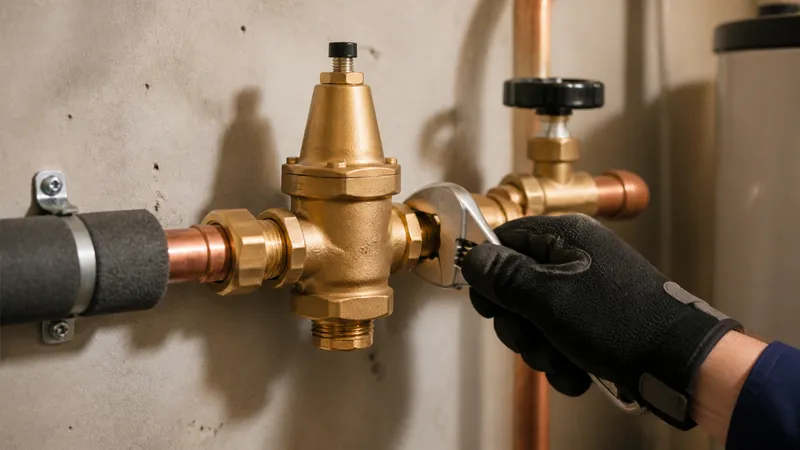
A pressure-reducing valve protects your pipes from high street pressure. Here's how to test it with a $15 gauge, and the reading that means replace it.
Key takeaways
- A pressure-reducing valve (PRV) knocks high municipal water pressure down to a safe range before it reaches your pipes and fixtures.
- Test it with a $10-$20 gauge on a hose bib: 40-80 psi static is normal, above 80 psi means the PRV likely needs attention now.
- A PRV commonly lasts 10-15 years; plan an inspection around year 7-10, sooner with hard or sediment-heavy water.
- A failing PRV usually lets pressure run high or swing widely, not low — that's a different symptom from a pressure drop under load.
- The PRV is typically a bell-shaped brass valve near the main shutoff, where the supply line first enters the house.
- Replacing a PRV is plumbing work — it involves shutting down and often sweating copper on the main line.
A water pressure regulator — also called a pressure-reducing valve, or PRV — is the valve that takes whatever pressure your utility sends down the street and knocks it down to a safe, steady range before it reaches your pipes and fixtures. You can check whether yours is doing its job with a $10-$20 gauge screwed onto an outdoor hose bib: a static reading of 40-80 psi with nothing else running is healthy, and a reading above 80 psi, or one that swings wildly test to test, usually means the PRV is failing and letting more pressure through than it should.
This page covers the regulator itself: what it does, how to test it, and when a high or unstable reading means it’s time to replace it. If your symptom is pressure that drops when a second faucet turns on, that’s a different, usually normal, situation covered in why water pressure drops when two faucets run. If you’re chasing a banging or hammering noise, high pressure from a failed PRV is one of the root causes covered in why pipes bang or hammer.
Why your house even has one
Municipal water systems often run well above what a house needs — utilities push pressure high enough to reach elevated buildings and cover fire-flow demand across a whole system, and street pressure can spike further overnight when nobody nearby is using water. Sustained pressure that high shortens the life of faucet cartridges, supply hoses, water heater tanks, and appliance valves, and it makes any fast-closing valve (a washing machine solenoid, an ice maker) hit harder — a known contributor to water hammer.
Both major U.S. plumbing codes address this directly. Where static water supply pressure exceeds 80 psi, an approved pressure regulator complying with the ASSE 1003 standard is required to bring it down to 80 psi or below at the point of use, per the International Plumbing Code’s excessive-pressure provisions. The Uniform Plumbing Code carries an equivalent requirement. That 80 psi ceiling is also the number Watts, a major PRV manufacturer, cites as the trigger point in its own homeowner guidance — pressure above that is considered high enough to require regulation, not just uncomfortable.
Static pressure reading: what it means, what to do
| Static reading at the hose bib | What it means | Action |
|---|---|---|
| Under 40 psi | Below the range most utilities and plumbers target; could be a partially closed valve, a well system issue, or a PRV set too low | Investigate the cause — see pressure drops with two faucets if it’s load-related, otherwise check shutoff valves before assuming the PRV |
| 40-80 psi | Normal range for a healthy home; most utilities target roughly 60 psi as a comfortable middle | No action — this is where you want it |
| Just above 80 psi, stable | Code threshold exceeded; a PRV may be missing, set too high, or starting to let more through than it should | Have a plumber check or reset the valve before it stresses fixtures further |
| Well above 80 psi, or swinging widely between tests | A PRV that’s failed is often letting pressure run high, sometimes dramatically, rather than holding a set point | Treat as a failing PRV — schedule replacement |
How to test your house’s static pressure
- Buy a hose-bib pressure gauge. These run about $10-$20 at any hardware store and screw directly onto an outdoor spigot — no tools required.
- Shut off everything inside. No faucets, no dishwasher, no irrigation, no ice maker filling. You want a true static reading.
- Thread the gauge onto the hose bib and open it fully. Read the needle. That’s your baseline static pressure.
- Repeat at a few different times of day. Early morning, midday, and evening. Municipal pressure isn’t always constant, and a PRV that’s failing often shows it as inconsistency rather than one single bad number.
- Watch for a spike after use, too. Run a tub or hose briefly, shut it off, and watch the gauge. A sudden jump well above your static reading — rather than a smooth settle — suggests the valve isn’t absorbing pressure changes the way it should. Zurn Wilkins’s own installation guidance for its PRVs uses this same before/after read-and-wait approach when technicians verify a valve is holding its set point.
A single low or high test isn’t proof by itself — a fluke reading happens. Consistency across a few tests is what tells you whether you have a real PRV problem or just caught the utility at an odd moment.
PRV lifespan and how it fails
A pressure-reducing valve is a mechanical part with a spring, a diaphragm, and a seat that all wear with use — it isn’t a “set it and forget it, forever” fixture. Residential PRVs are commonly rated for around 10-15 years of service, and many plumbers suggest a first inspection around year 7-10, sooner if your water is hard or sediment-heavy, since mineral scale on the seat and diaphragm is the most common thing that shortens a valve’s working life. Treat that range as an industry rule of thumb rather than a fixed number — a valve in soft, clean municipal water can outlast one in a hard-water well-fed system by years in either direction.
| Sign | What it usually means |
|---|---|
| Static pressure reads consistently in the 40-80 psi range across multiple tests | Healthy — the PRV is holding its set point |
| Pressure reads high (well above 80 psi) and stays there | The seat or diaphragm has failed open; the valve is no longer regulating |
| Pressure swings between low and high on repeated tests, with no clear pattern | A worn or debris-jammed valve that can’t hold a stable set point |
| Visible moisture, mineral crust, or an active drip at the valve body | Internal seals have given out; this is a leak, not just a pressure problem |
| Pressure at the fixtures feels noticeably harder or louder than it used to | A common first tell before a gauge confirms it numerically |
Unlike a fixture that just gets weak, a PRV that fails typically errs high — it lets more of the street’s pressure through than it’s supposed to, sometimes dramatically. That’s the opposite direction from most of the plumbing problems homeowners search for, which is why it’s worth testing specifically rather than assuming “no low-pressure complaints” means the regulator is fine.
Where to find it
The PRV is typically located near the main water shutoff valve, at the point where the supply line first enters the house — commonly a basement, crawlspace, garage, or a utility closet close to the water meter. It’s usually easy to recognize once you know what you’re looking for: a brass, bell- or cone-shaped valve body inline with the main pipe, often with a spring-loaded bonnet on top and an adjustment screw or bolt underneath the bonnet. If you can find your main shutoff, the PRV is almost always within a foot or two of it, upstream of any branch to individual fixtures.
Caveats that change the picture
| Situation | What’s different |
|---|---|
| Well system with its own pressure tank | You likely don’t have a municipal-style PRV at all — pressure is set by the tank’s cut-in/cut-out switch, not a spring-loaded regulator |
| Hard water or heavy sediment | Mineral scale builds on the seat and diaphragm faster; plan for the shorter end of the 10-15 year range and inspect sooner |
| Recently replaced PRV with pressure still running high | Points to a different supply-side issue — a bad gauge, a second unregulated line, or a valve installed but not adjusted to the right set point |
| Multi-story or larger home | Pressure loss with height means the top floor may read differently than a ground-floor hose bib; test near where the complaint is happening too |
When to call a professional
| Situation | Why it’s not DIY |
|---|---|
| PRV replacement itself | Usually requires shutting down and draining the main line, then soldering or otherwise joining copper — licensed plumbing work for most homeowners |
| Persistent high pressure after a new PRV install | May point to a different supply-side issue (wrong set point, second unregulated line) that needs a professional diagnosis, not a second guess at the valve |
| Any leak or moisture at the PRV body itself | A leaking valve on the main line is an active plumbing failure, not a wait-and-see item |
Keep a record of what you find
A dated pressure reading is worth more later than a memory of “it seemed fine.” Note the static psi, the date, and whether you tested at more than one time of day, so a plumber or a future you has a real baseline to compare against.
Related guides
Frequently asked questions
How do I test my home’s water pressure to check the PRV?
Screw a $10-$20 pressure gauge onto an outdoor hose bib with nothing else running in the house and read the static pressure. Test at a few different times of day; a reading that stays in the 40-80 psi range is healthy, and one that reads above 80 psi or swings widely between tests points to a PRV that needs attention.
How long does a water pressure regulator last?
Most residential PRVs are commonly rated for around 10-15 years of service. Many plumbers recommend a first inspection around year 7-10, and sooner in homes with hard water or heavy sediment, since mineral buildup on the internal seat and diaphragm is what usually ends a PRV’s life early.
Where is the pressure regulator located in my house?
Look near the main water shutoff, where the supply line first enters the home — often in a basement, crawlspace, garage, or utility closet close to the water meter. It’s usually a bell-shaped brass valve with a cone-shaped bonnet inline with the main pipe.
Do I actually need a pressure regulator?
If your street (municipal) pressure runs above 80 psi at any point, plumbing code (both the IPC and UPC) requires a pressure-reducing valve to bring it back down to 80 psi or less. Many homes have one even when street pressure is borderline, since utility pressure can spike overnight when demand is low.
Can I replace a pressure-reducing valve myself?
Most homeowners should not. Replacement usually means shutting off and draining the main supply line and soldering or otherwise joining copper (or working with a press-fit or shark-bite style fitting a plumber trusts), plus resetting the outlet pressure correctly afterward. A licensed plumber is the right call for the swap itself.