
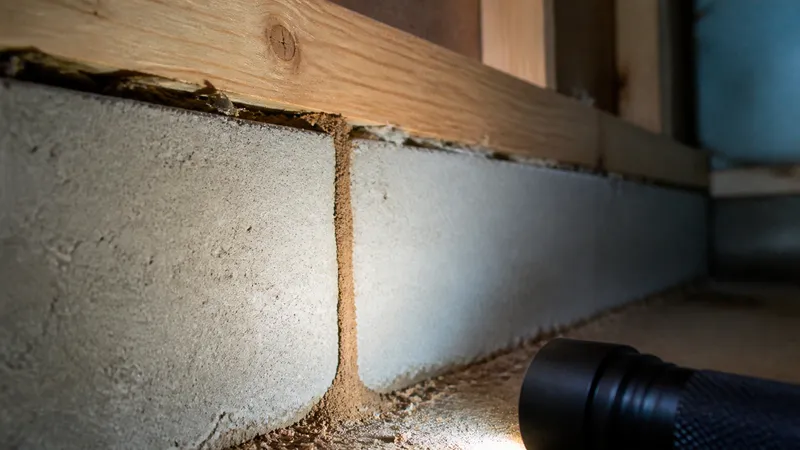
Mud tubes, frass, and hollow-sounding wood are the visual signs of termites experts check for. Learn what to look for and when to call a pro.
Key takeaways
- Mud shelter tubes on the foundation, about pencil-width, are the clearest sign of subterranean termites and mean it's time to call a pro.
- Frass from drywood termites looks like tiny six-sided pellets, roughly 1/32 inch long, piled below a small exit hole in wood.
- Wings shed indoors in matching pairs, or swarmers emerging from walls or floors, mean an active colony, not a one-off bug sighting.
- Wood that sounds hollow or papery when tapped, or that gives when you press a screwdriver into it, has already lost structural material.
- Mississippi State University Extension recommends an annual professional inspection even with no visible signs, since termites can feed unseen inside walls for years.
- Break open a mud tube and check for live termites before you call anyone — an old, dry tube with nothing inside may just mean past, not current, activity.
The visual signs of a termite infestation are mud shelter tubes on the foundation, small six-sided fecal pellets (frass) below a pinhole in wood, discarded wings in matching pairs after a swarm, and wood that sounds hollow or gives easily when pressed with a screwdriver — according to Mississippi State University Extension’s guide to termite signs. Finding any one of these means the colony is likely already active, not that damage is coming; termites can feed inside walls and framing for years before a homeowner notices anything from the outside.
The visual signs, and what each one means
| Sign | What it looks like | What it means |
|---|---|---|
| Mud shelter tubes | Pencil-width (1/4-1 inch) tubes of soil and saliva running up a foundation wall, pier, or plumbing line | Subterranean termites traveling between soil and wood; a fresh, moist tube means current activity |
| Frass (drywood termite droppings) | Tiny six-sided pellets, about 1/32 inch long, piled below a small hole in wood | Drywood termites pushing waste out of an active gallery inside the wood |
| Swarmer wings | Pairs of equal-length wings shed together on a sill or floor | A swarm already happened indoors; a colony is established nearby, possibly inside the structure |
| Live swarmers indoors | Winged insects emerging from a wall, ceiling, or floor crack, often in spring | An active colony inside the structure, not just insects that wandered in from outside |
| Hollow or papery-sounding wood | Wood that sounds hollow when tapped, or crumbles under a screwdriver’s pressure | Termites have eaten the interior, leaving a thin, damaged outer shell |
| Sunken or rippled paint, bubbling drywall | Wallpaper or paint with a wavy, sunken line over a stud or baseboard | Damage or moisture from tube-building underneath the surface |
Source: Mississippi State University Extension, Signs of Termite Infestation
Termite swarmers vs. flying ants
Both swarm in similar weather and get confused constantly, but the two are easy to tell apart once you know the tells:
| Feature | Termite swarmer | Flying ant |
|---|---|---|
| Wings | Two pairs, equal length, shed easily in matched pairs | Two pairs, front wings longer than back wings |
| Waist | Thick, no visible pinch | Narrow, pinched |
| Antennae | Straight | Bent (elbowed) |
If you find a small pile of shed wings — always in matched pairs, not single wings — on an indoor windowsill or floor, treat it as a termite indicator until a professional rules it out.
How to check what you found
- Find a mud tube? Break open a short section (about 1 inch) and look inside. Live, cream-colored termites mean active infestation. An empty, dry, crumbling tube may mean the colony moved on — but doesn’t rule out activity elsewhere on the foundation.
- Find frass? Look for the small pinhole exit above the pile. Vacuum the pellets, mark the spot, and check again in a week or two; a new pile means the gallery behind that hole is still active.
- Find damaged wood? Press a flathead screwdriver or awl into the surface at a few spots along the same framing member. Wood that gives easily or crumbles has already lost structural material — note how far the soft area extends before you call anyone.
- Not sure what you’re looking at? Take clear photos with something for scale (a coin, a ruler) before you disturb it. A professional inspector will want to see the tube, pellet pile, or damage as close to undisturbed as possible.
When to call a professional
| Situation | Why it’s not DIY |
|---|---|
| You found live termites in a mud tube or fresh frass | Subterranean and drywood colonies need species-specific treatment (soil termiticide, bait stations, or localized fumigation); the wrong method wastes money and time |
| Wood sounds hollow or a screwdriver sinks in easily | You need to know how far the damage extends into framing before any repair, which usually requires opening a wall or accessing a crawlspace |
| You’re buying or selling a home | Many mortgage lenders and real estate contracts in termite-prone regions require a licensed inspector’s WDO (wood-destroying organism) report, not a homeowner walkthrough |
| You see swarmers indoors but can’t find an entry point | A licensed inspector can probe framing, sills, and crawlspace wood to locate the colony’s access point, which is difficult to do reliably without training |
| It’s been more than a year since your last inspection | Mississippi State University Extension recommends annual professional inspections regardless of visible signs, since termites can go unnoticed inside walls for years |
For general pest-proofing that also reduces every insect’s easy entry into your house — not just termites — see How to Seal Your Home Against Pests Before Winter. Sealing gaps helps with ants, mice, and overwintering bugs, but it won’t stop subterranean termites, which travel through soil and don’t need an above-ground gap to reach your framing.
Related guides
Frequently asked questions
What do termite mud tubes actually look like?
Pencil-width tubes of soil and saliva, usually 1/4 to 1 inch wide, running up a foundation wall, support pier, or plumbing penetration from the soil toward wood framing. Fresh tubes look moist and darker; older ones look dry and brittle but can still mean nearby activity. Subterranean termites build these tubes to travel between soil and wood without exposure to open air.
What does termite frass (droppings) look like?
Drywood termite frass is made of tiny, uniform, six-sided pellets about 1/32 inch (0.8 mm) long, often described as looking like fine sawdust, coffee grounds, or pepper. You’ll usually find a small pile of it below a pinhole-sized exit hole the termites kick pellets out of, according to Mississippi State University Extension.
Are winged termites the same as flying ants?
No, and mixing them up delays treatment. Termite swarmers have two pairs of wings that are equal in length and shed in matching pairs, a thick waist, and straight antennae. Flying ants have unequal wing pairs, a pinched waist, and bent antennae. If you find a pile of shed, matched-pair wings on a windowsill or floor, treat it as termites until a professional confirms otherwise.
Can I tell if wood is termite-damaged without cutting into it?
Tap it and press it. Termite-hollowed wood often sounds papery or hollow instead of solid, and a screwdriver or awl pressed firmly into the surface will sink in easily or crumble it, because the termites eat the wood from the inside and leave a thin outer layer intact. Sunken or rippled paint and drywall over a stud can also signal damage underneath.
How often should I have my home inspected for termites?
Mississippi State University Extension recommends an annual inspection by a pest management professional, even in homes with no visible signs, because subterranean termites can feed inside wall cavities and framing for years before damage becomes visible from the outside.