
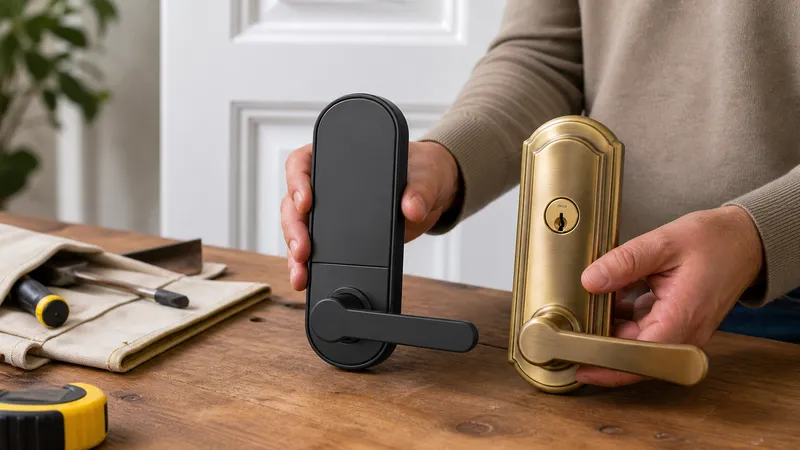
Smart locks vs. traditional deadbolts compared on security grade, 2026 pricing, and failure points, so you can decide which one belongs on your door.
Key takeaways
- A smart lock is a deadbolt with electronics added; the security grade (ANSI/BHMA 1, 2, or 3) still comes from the bolt and cylinder hardware, not the app.
- In 2026, installed pricing runs about $100-$250 for a basic traditional deadbolt versus $200-$600 for a smart lock, with big-city labor pushing both ranges higher.
- Grade 2 is the minimum reasonable spec for a front door; Grade 1 or a UL 437-listed cylinder is worth the extra cost on a primary entry.
- Smart locks add a failure mode traditional deadbolts don't have: dead batteries, lost Wi-Fi, or a bricked app during a lockout.
- Keep a physical key override on any smart lock you install; a lock with no mechanical backup is a single point of failure.
- Re-keying a traditional deadbolt after a lost key costs a locksmith visit; revoking a smart lock code takes seconds in the app, which matters more for renters, roommates, and short-term guests.
A smart lock is worth the switch if you value remote access, code-sharing, and activity logs more than you value the lowest possible price and zero electronics on your front door — the physical security itself is roughly equal to a traditional deadbolt of the same ANSI/BHMA grade. The real decision is less “which is more secure” and more “which failure mode do you want”: a traditional deadbolt fails by being picked, bumped, or drilled; a smart lock adds dead batteries, app outages, and Wi-Fi dependency to that same list, in exchange for keyless entry and remote control.
Smart lock vs. traditional deadbolt at a glance
| Factor | Traditional deadbolt | Smart lock |
|---|---|---|
| Physical security | Set by ANSI/BHMA grade (1/2/3) and cylinder; a licensed locksmith can spec a UL 437-listed cylinder for pick/drill resistance | Same bolt hardware in most models, plus electronics that add a second attack surface (app, Bluetooth, Wi-Fi) |
| 2026 installed cost | About $100-$250 for a single-cylinder Grade 2 deadbolt, more for Grade 1 or double-cylinder | About $200-$600 depending on features; DIY install lowers labor cost but not hardware cost |
| Access control | One key per household; lost key means re-keying or replacing the cylinder | Add or revoke individual codes/fobs instantly; useful for guests, dog walkers, or short-term rentals |
| Failure mode | Mechanical only: pick, bump, drill, or a broken key in the cylinder | Adds dead batteries, firmware bugs, lost Wi-Fi, or a locked-out app account |
| Records/activity log | None | Most models log every entry with a timestamp; useful for a home record but also a privacy consideration for guests |
| Typical lifespan | 15-20+ years for quality hardware with no electronics to fail | 3-7 years before battery contacts corrode, firmware support ends, or a manufacturer discontinues the app |
Security grade matters more than the “smart” label
Lock hardware is rated by ANSI/BHMA on a 1-2-3 grading scale based on cycle testing and impact resistance. Grade 1 deadbolts are tested to withstand 250,000 open/close cycles and 10 hammer blows delivering 75 foot-pounds of force; Grade 2 handles 150,000 cycles and 5 blows; Grade 3 — common in big-box starter hardware — is tested to 100,000 cycles and 2 blows. For cylinder-specific pick and drill resistance, look separately for a UL 437 listing, which many higher-end traditional and smart deadbolts carry but base-model hardware often does not.
A Grade 2 deadbolt is a reasonable minimum for a front door; a higher-traffic household or a door that’s the sole entry point is better served by Grade 1. This applies whether the lock has an app or not — a Grade 3 smart lock is not more secure than a Grade 1 traditional deadbolt just because it has a keypad.
2026 cost comparison: what moves the number
| Lock type | Typical installed cost (2026) | What moves it |
|---|---|---|
| Basic single-cylinder deadbolt (Grade 2-3) | $100-$200 | Hardware finish, whether the door needs re-boring, locksmith vs. DIY |
| Grade 1 deadbolt with UL 437 cylinder | $150-$300 | Higher-security cylinder costs more than the bolt mechanism itself |
| Keypad deadbolt, no app | $195-$295 | Battery type, keypad durability rating |
| Wi-Fi/Bluetooth smart lock | $295-$495 | Number of access methods (app, fob, fingerprint), retrofit vs. full replacement |
| Premium smart lock with camera/video doorbell | $395-$595 | Subscription fees for cloud video storage are a separate recurring cost, not included in install price |
Labor for either type typically runs $50-$150 per hour with a $50-$100 minimum service call in most markets; expect the higher end of every range above in major metro areas and the lower end in a straightforward retrofit where the existing bore matches the new hardware.
When to call a professional
| Situation | Why it’s not DIY |
|---|---|
| Door needs re-boring for a different bolt size or backset | A locksmith or carpenter should cut the new bore cleanly; a bad DIY bore weakens the door |
| You want a UL 437-rated cylinder matched to your existing hardware | A locksmith can confirm cylinder compatibility before you buy the wrong part |
| Smart lock won’t pair, loses connection repeatedly, or the app shows persistent errors | Contact the manufacturer’s support first; a locksmith can install a replacement but can’t fix firmware |
| You’re re-keying after a lost key, a breakup, or moving into a resale home | A locksmith can re-key the existing cylinder same-day, often cheaper than replacing the whole lock |
Related guides
Frequently asked questions
Are smart locks as secure as traditional deadbolts?
The physical security is the same when the underlying hardware is the same grade — many smart locks use a standard ANSI/BHMA Grade 1 or 2 deadbolt mechanism with electronics added. The difference is the added attack surface: a traditional deadbolt can only be picked, bumped, or forced, while a smart lock can also be targeted through its app, Bluetooth, Wi-Fi, or a dead battery.
How much does it cost to install a smart lock in 2026?
Installed smart locks typically run $200-$600 in 2026, depending on the model and whether you hire a locksmith or install it yourself. Basic keypad deadbolts with no app run $195-$295 installed; full Wi-Fi smart locks with app control run $295-$495; premium models with cameras or video doorbell integration run $395-$595. Prices are higher in major metro labor markets and lower in a DIY install with existing wiring compatible.
What is an ANSI/BHMA lock grade and why does it matter?
ANSI/BHMA is the industry testing standard for lock hardware. Grade 1 deadbolts withstand 250,000 open/close cycles and 10 hammer blows at 75 foot-pounds of force; Grade 2 handles 150,000 cycles and 5 blows; Grade 3 is entry-level home-center hardware rated for 100,000 cycles and 2 blows. The grade tells you how much physical force and wear the bolt itself can take, regardless of whether it’s a smart lock or traditional deadbolt.
What happens to a smart lock if the power or Wi-Fi goes out?
Most smart locks run on internal batteries (typically 4 AA or a rechargeable pack lasting 6-12 months) so a home power outage doesn’t disable them, but they log low-battery warnings you should not ignore. Losing Wi-Fi disables remote app access and voice-assistant control, but the physical keypad, fingerprint, or key override should still work — confirm this before buying, since not every model has a mechanical backup.
Should renters install a smart lock?
Only with landlord permission, and only a model that reuses the existing deadbolt mechanism so you can swap the original hardware back at move-out. Battery-powered retrofit locks that clip over the existing thumb-turn, rather than replacing the whole deadbolt, are usually the better fit for a rental.